For decades, planetary science suffered from a severe case of gas giant snobbery. If you wanted rings, you looked to the heavyweight champions of the outer solar system. Saturn wore the crown, while Jupiter, Uranus, and Neptune maintained their own subtle halos of ice and dust. Rings were treated as exclusive accessories of massive worlds possessing immense gravitational clout.
Then came 2013, and the cosmic order fractured.
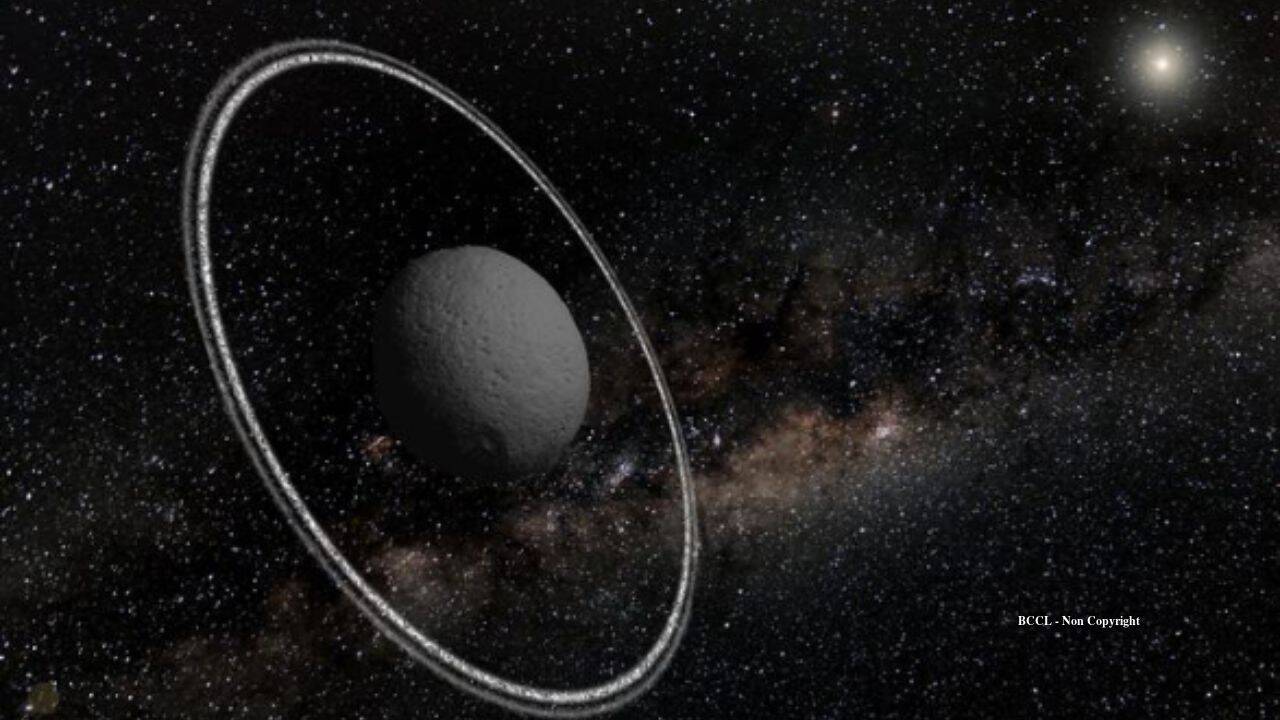
Astronomers peering at Chariklo—a lumpy, minor centaur asteroid measuring a mere 250 kilometers across, orbiting quietly between Saturn and Uranus—discovered it possessed two distinct, razor-thin rings. It made no physical sense. Standard orbital mechanics suggested that a body so small lacked the gravitational muscle to shepherd debris into stable containment over billions of years. The physics community shrugged, labeled it an astronomical anomaly, and assumed the rings were ancient, frozen relics destined to slowly fade into the void.
They were entirely wrong.
Fresh data beamed back by the James Webb Space Telescope reveals that Chariklo’s mysterious rings are not static monuments to a chaotic past. They are actively, aggressively changing. Over a span of just a few years, the inner ring has grown significantly more opaque, while its outer companion has lost density, thinning out into a ghost of its former self.
This discovery shatters the comfortable consensus that small-body ring systems are sluggish, frozen clockwork. Instead, planetary scientists are staring down an unexpected structural crisis. Something is shredding one ring while feeding material into the other, and the standard theoretical models cannot explain why.
To understand why this observation matters, one must look closely at how humanity caught Chariklo in the act. Direct imaging of a 250-kilometer rock orbiting billions of kilometers away is impossible with current hardware. Instead, an international team led by researchers from the Andalusian Institute of Astrophysics orchestrated a stellar occultation. On October 18, 2022, they used the James Webb Space Telescope to track the exact moment Chariklo passed directly in front of a distant background star.
As the centaur drifted across the starlight, the star flickered. Those precise dips in illumination mapped out the dimensions, positions, and optical depths of the rings with terrifying accuracy. Because Chariklo was drifting relative to the telescope at a crawl of roughly 2.5 kilometers per second, the spatial resolution was unprecedented.
When researchers compared these crisp infrared profiles against older archival data, the math refused to reconcile. The positions of the rings remained locked in place, sitting roughly 390 and 405 kilometers from the center of the asteroid. But their contents had shifted dramatically. The inner ring, designated C1R, saw its opacity jump by roughly fifty percent. Meanwhile, the outer ring, C2R, experienced a massive drop in density, shedding up to sixty percent of its observable signature.
Baffled researchers are now running through a shortlist of uncomfortable hypotheses. The core issue boils down to particle dynamics. Ring systems do not maintain themselves. Without a containment mechanism—typically hypothesized to be tiny, unseen shepherd moonlets—ring particles should disperse into space within millions of years.
Could a hidden moon be clearing out the outer ring while dumping debris into the inner ring? It is possible, yet no such moon has been visually confirmed. Alternatively, catastrophic internal collisions might be grinding larger boulders in the inner ring into fine, highly reflective dust, artificially inflating its opacity. Meanwhile, the outer ring might be bleeding material into the dark expanse of space, starved of replenishment.
Yet, an unsettling counter-argument lingers in the background. Could the apparent transformation be an artifact of observational perspective rather than physical evolution? Astronomers are forced to weigh whether changing viewing angles or the specific infrared filters utilized by different instruments created an optical illusion. The lead researchers have pushed back hard against this skepticism, pointing out that the differential nature of the changes—one ring darkening while the other brightens—defies a simple calibration error.
If the evolution is real, the implications stretch far beyond one bizarre asteroid. Centaurs are migratory objects, kicked out from the Kuiper Belt into the inner solar system where they experience thermal shocks and gravitational tugs from the gas giants. If small bodies can routinely sprout, alter, and discard ring systems on decadal timescales, our textbooks are fundamentally incomplete. Ring formation is not a rare accident born exclusively from the chaotic birth throes of gas giants. It may be an ongoing, dynamic process happening to minor bodies across the solar system right now.
The scientific community is left scrambling for telescope time. Every subsequent stellar occultation involving Centaurs like Chiron, Haumea, or Quaoar is now subjected to intense scrutiny. Researchers are no longer looking for static snapshots of ancient debris fields. They are hunting for live evidence of celestial architecture tearing itself apart and rebuilding in real time, forcing a painful and exhilarating rewrite of how planetary rings live and die.