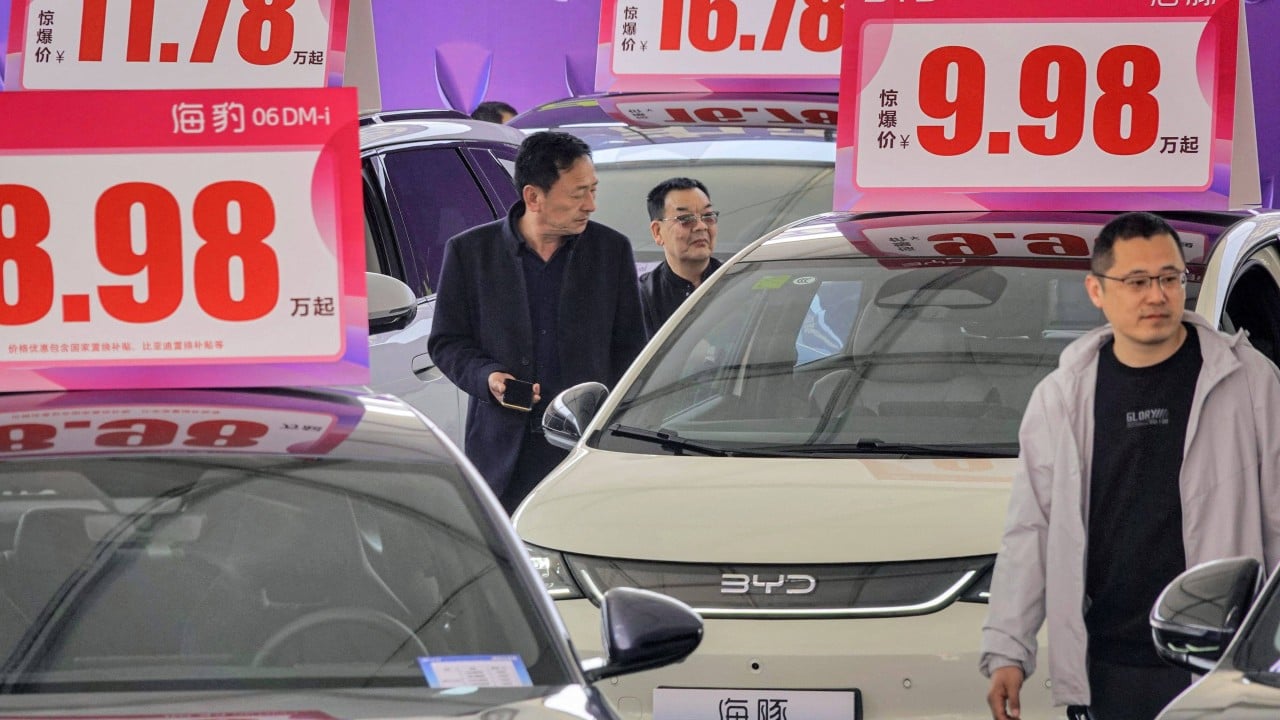
China’s automotive market is running out of oxygen. For the past several years, the narrative surrounding the Chinese electric vehicle industry focused entirely on hyper-growth, technological dominance, and global expansion. That narrative is dead. As domestic car sales slow to a crawl, a brutal price war is tearing through a crowded market of over one hundred active brands. This is not a temporary dip in consumer confidence. It is a structural reckoning that will force dozens of automakers into bankruptcy and reshape the global supply chain.
The primary driver behind this crisis is a massive, state-subsidized overcapacity problem. Beijing spent over a decade pouring billions into the New Energy Vehicle (NEV) sector, creating a highly fragmented ecosystem where survival depended on high volume rather than profitability. Now that domestic demand has plateaued, manufacturers are trapped. They cannot stop production because their factories require scale to minimize fixed costs, yet they cannot sell cars at full price because consumers are holding back, waiting for the next round of discounts. The result is a race to the bottom that threatens to destroy margins across the entire industry.
The Myth of the Rational Discount
Many Western analysts assume that price wars are tactical maneuvers designed to clear inventory before a new model year. In China, the price cuts are existential. When a major player like BYD drops the price of a plug-in hybrid by twenty percent, it is not trying to boost quarterly sales figures. It is trying to starve its competitors of cash.
The mechanics of this warfare are ruthless. Domestic car companies are operating on razor-thin margins, or in many cases, outright losses per vehicle. For every car sold, start-ups and mid-tier legacy brands are bleeding capital, relying on local government lifelines or venture funding to keep the lights on. BYD, with its vertically integrated supply chain, can survive a protracted price war because it owns its battery manufacturing. Most other brands do not. They are buying components at fixed costs and selling finished vehicles at variable losses.
This creates a dangerous psychological feedback loop among Chinese car buyers. When vehicle prices drop by thousands of dollars every few months, the rational consumer stops buying. Consumers assume that if they wait until next quarter, the car they want will be even cheaper. Consequently, price cuts are no longer stimulating demand. They are freezing it. Dealership foot traffic may spike briefly after a major discount announcement, but actual transaction volumes remain stubborn.
The Regional Protectionism Trap
To understand how China's car market became so unsustainably crowded, you have to look outside Beijing. The central government sets the macro policy, but provincial governments execute it. For a provincial governor, an automotive factory is a golden goose. It provides thousands of manufacturing jobs, boosts local GDP metrics, and generates reliable tax revenue.
When a local automaker begins to fail due to national price pressures, the local government rarely lets it die quietly. Instead, they step in with emergency loans, subsidized land deals, or localized consumer incentives. If a factory is based in a specific province, that province might offer unique cash-back incentives exclusively for residents who buy cars built by that local brand.
This regional protectionism keeps "zombie" car companies alive long after the free market would have liquidated them. It prevents the natural consolidation that a healthy economy requires. Instead of five or six dominant players emerging to achieve true global scale, China remains cluttered with dozens of sub-scale manufacturers, all producing remarkably similar electric sedans and SUVs. These zombie companies cannot afford the research and development needed to compete in the next generation of autonomous driving, yet they possess just enough state-backed capital to keep cutting prices and dragging down the rest of the market.
The Margin Squeeze Down the Supply Chain
The pain of this price war does not stop at the major automakers. It flows directly downhill into the component ecosystem. Tier-one suppliers are facing unprecedented demands from car brands to slash their component prices by fifteen to thirty percent annually.
Unlike the automakers, these suppliers do not have deep pockets or government backing. A typical battery component manufacturer or semiconductor distributor operates on single-digit margins. When an automaker demands a sudden price reduction, the supplier has two choices: comply and wipe out their own profits, or refuse and lose a massive volume contract.
- Lithium and Raw Materials: The cost of battery-grade lithium carbonate has plummeted from its historic peaks, providing some relief, but the volatility makes long-term planning impossible for suppliers.
- Tooling and Engineering: Automakers are rushing vehicle development cycles, demanding new models in twelve to eighteen months instead of the traditional four-year cycle. This forces suppliers to absorb massive engineering costs upfront with no guarantee of long-term volume.
- Payment Delays: Automakers are stretching out their accounts payable. Suppliers who used to be paid in ninety days are now waiting six months or more for cash, creating a secondary liquidity crisis across the industrial heartland.
This supply chain squeeze degrades component quality. When engineers are forced to strip every possible cent out of a wiring harness or a thermal management system, reliability suffers. The industry is silently trading long-term vehicle durability for short-term price competitiveness.
The Deflationary Export Wave
With the domestic market resembling a meat grinder, Chinese automakers see international expansion not as an ambitious growth strategy, but as a survival mechanism. They need to export their overcapacity to markets where they can command higher margins.
This strategy is hitting a wall of geopolitical resistance. Europe and North America are actively erecting trade barriers, implementing steep tariffs to protect their own legacy automotive industries from being flooded by cheap Chinese imports. The assumption that Chinese EVs will easily conquer global markets ignores the reality of logistics, regulatory compliance, and dealer network setup.
Furthermore, exporting vehicles introduces a different set of financial pressures. Shipping a car from Shanghai to Rotterdam is expensive. Setting up spare parts networks, localized software engineering teams, and Western-standard warranty support requires massive capital expenditure. If a Chinese automaker is already losing money at home, it cannot afford the multi-billion-dollar entry fee required to build a sustainable brand presence in a mature Western market.
Instead, much of this excess inventory is flowing into developing regions across Southeast Asia, the Middle East, and South America. Even in these regions, the domestic price war follows them. Chinese brands are now competing aggressively against each other in cities like Bangkok and São Paulo, exporting the exact same deflationary dynamics that crippled their margins in Shanghai.
The Software Monopolization
As hardware margins march toward zero, the industry's ultimate survival plan hinges on software. The belief is that if you sell a car at cost, you can make up the profit later through over-the-air software updates, autonomous driving subscriptions, and digital services.
This is a dangerous gamble. The vast majority of consumers, even in tech-forward China, show a strong resistance to paying monthly subscriptions for features their hardware already possesses. Heated seats, advanced driver-assistance systems, and infotainment upgrades are increasingly viewed as standard equipment, not premium add-ons.
More importantly, the software race requires an entirely different level of capital investment. Developing a proprietary autonomous driving stack requires thousands of high-salaried software engineers and massive cloud-computing infrastructure for AI training. Only a handful of players—such as Huawei, Xiaomi, and BYD—have the scale to fund this ongoing tech development. The mid-tier automakers are forced to buy white-label software solutions from tech giants, effectively surrendering their unique identity and their final hope of capturing high-margin revenue. They are being relegated to mere hardware assemblers, while the tech companies capture the lucrative ecosystem value.
The current trajectory of the Chinese automotive market points toward a mandatory, painful consolidation. The price war cannot be sustained by market forces or local subsidies forever. Banks will eventually stop lending to unprofitable ventures, local governments will face budget realities, and consumers will tire of the constant price fluctuations. The market will contract, leaving a lean group of hyper-efficient giants. The companies that survive will not be those with the flashiest tech features or the loudest marketing campaigns, but those with the deepest cash reserves and the most ruthless control over their internal supply chains.