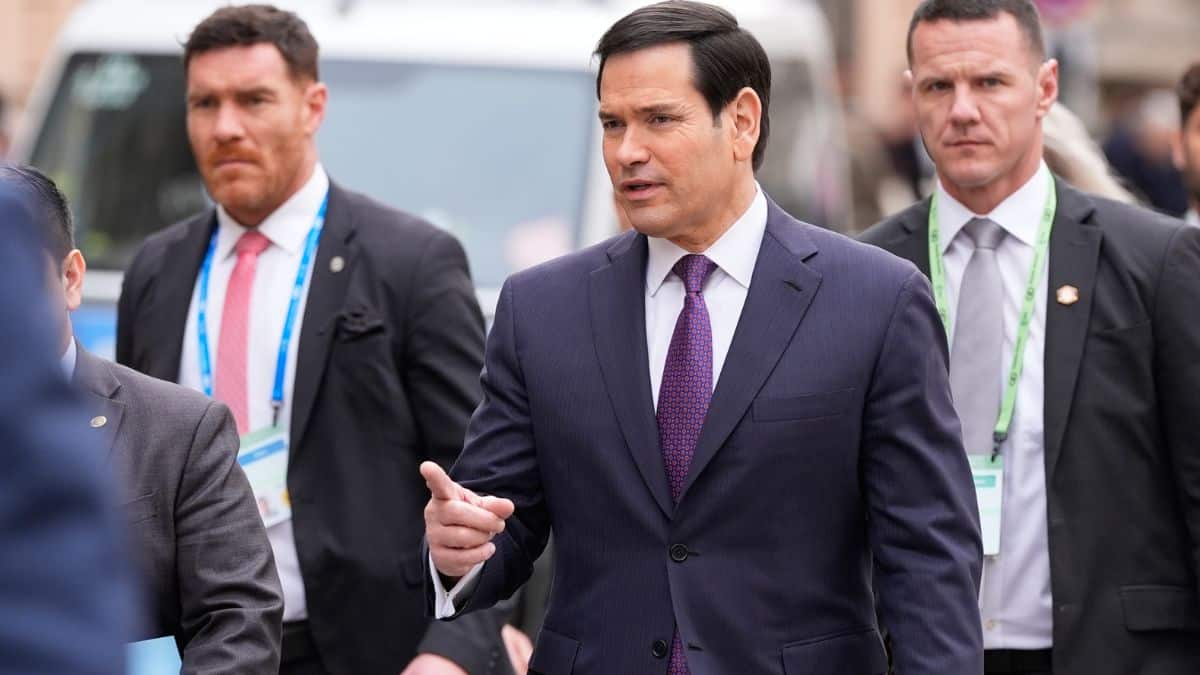
Washington and Beijing have reached a state of "strategic stability." That was the declaration from Secretary of State Marco Rubio this week, speaking from the unlikely backdrop of Saint Kitts and Nevis. For a man who built his political identity as the ultimate China hawk, the phrasing sounds suspiciously like a de-escalation. It isn't.
This is not a return to the era of engagement or a softening of the American stance. It is a cold, calculated acknowledgement that both sides have finally realized they are holding a shared detonator. The stability Rubio refers to is not born of trust, but of mutual exhaustion and the terrifying realization that an all-out trade war would trigger a global depression neither side can survive.
The timing is the tell. This announcement serves as the opening act for President Donald Trump’s scheduled trip to Beijing on March 31. By framing the current tension as stability, the administration is clearing the brush for a high-stakes summit where the goal is no longer to "change" China, but to manage a permanent rivalry.
The Myth of De-escalation
Look past the diplomatic niceties and you find a landscape defined by "wrecking-ball politics." Rubio’s version of stability is essentially a ceasefire in a conflict that has already moved into the trenches. While he talks about avoiding an "all-out global trade war," the U.S. is simultaneously tightening the noose on advanced semiconductors and chipmaking equipment.
This is the new realism. The administration has accepted that the post-Cold War dream of folding China into a Western-led democratic order was, in Rubio’s own words, a "dangerous delusion." Stability, in this context, means knowing exactly where the red lines are so you can walk right up to them without accidentally starting a third world war.
The Nuclear Wildcard
One of the most significant—and overlooked—pillars of this "stability" is the push for a trilateral arms control deal. The U.S. is moving away from the bilateral frameworks of the past, insisting that any future nuclear treaty must include China. Beijing has spent the last two years expanding its silo fields and modernizing its delivery systems at a pace that has left Washington unnerved.
The Secretary of State dismissed China’s argument that its arsenal is still smaller than those of the U.S. and Russia as "irrelevant." The concern is no longer about parity; it is about the trajectory. By demanding China’s inclusion in arms talks, the U.S. is attempting to force transparency on a military apparatus that thrives on opacity. It is a gamble that assumes Beijing cares more about international legitimacy than it does about its "no first use" ambiguity.
Dependency as a National Security Threat
The most hard-hitting aspect of Rubio’s analysis centers on the supply chain. The "stability" he describes is precarious because the U.S. remains dangerously tethered to Chinese production for basic survival. We are talking about a world where 90% of critical minerals and certain pharmaceutical precursors originate from a single adversary.
This is the "how" behind the current policy. The administration is using this period of relative calm to aggressively diversify. It is a race against time. If the U.S. cannot decouple its most sensitive supply chains before the next major flare-up—likely over Taiwan or the South China Sea—the "strategic stability" Rubio touts will evaporate instantly.
The Tariff Defeat and the Pivot
The recent Supreme Court ruling that struck down several of Trump’s sweeping tariffs under the International Emergency Economic Powers Act has forced a tactical shift. The administration is now pivoting to a new 10% global tariff, attempting to circumvent the legal setbacks just weeks before the Beijing summit.
This legal friction has changed the leverage. Beijing sees a weakened executive branch in Washington, even if the rhetoric remains fierce. They are "calling the bluff" on maximum pressure, betting that the American legal system will do more to slow down Trump’s trade war than their own retaliatory measures ever could.
The Reality of the Beijing Summit
When Trump lands in Beijing at the end of March, the "biggest display in history" will be mere window dressing for a brutal negotiation. The agenda is stripped of the idealistic baggage of previous decades. It is about soybeans, fentanyl precursors, and nuclear warheads.
Stability is the word of the day because both sides need the room to breathe. The U.S. needs time to reindustrialize and build its "Golden Dome" missile defense. China needs time to stabilize its cooling economy and navigate its own internal demographic crises.
We are entering an era where "stability" means two giants standing back-to-back, each sharpening a knife. It is a peace of sorts, but it is a peace defined by the threat of total economic and military ruin. Rubio isn't announcing a friendship; he is announcing the rules of the fight.
Watch the movement of critical mineral contracts over the next thirty days to see if the "stability" holds.