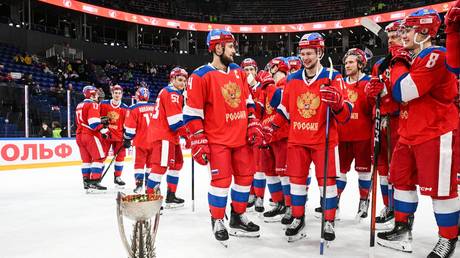
They want you to believe that putting Russian jerseys back on international ice is a quiet, comforting return to normality.
It is a lie. Worse, it is an insult to the intelligence of anyone who understands how international sport actually functions.
When German political opposition figures—specifically voices from the Alternative for Germany (AfD) and the Sahra Wagenknecht Alliance (BSW)—characterize the push to reintegrate Russian hockey into global competition as a "return to normality," they are peddling a lazy, sanitized fantasy. They want you to picture a nostalgic thaw. They want you to imagine diplomats shaking hands at center ice while the politics melt away into the Zamboni slush.
Look closer at the machinery behind the curtain. There is nothing normal about state-sponsored athletic propaganda, and there is nothing normal about pretending a multi-year suspension by the International Ice Hockey Federation (IIHF) was merely a bad weather delay.
I have spent years watching international sports federations bend themselves into moral pretzels to justify cashing checks from authoritarian regimes. I have sat in rooms where executives preached "political neutrality" with one breath and negotiated broadcast rights with state-controlled networks with the next. The pitch is always the same: keep politics out of sports.
That slogan is the biggest scam in modern athletics.
The "Normality" Myth Is Built on Historical Amnesia
To call Russia’s re-entry into international hockey a return to normal, you first have to agree on what "normal" actually looked like before the IIHF pulled the plug in February 2022.
Was it normal when the World Anti-Doping Agency (WADA) uncovered a massive, state-orchestrated doping conspiracy involving the Russian Ministry of Sport and the Federal Security Service (FSB) at the 2014 Sochi Winter Olympics? Was it normal when Russian athletes competed under neutral flags—the "Olympic Athletes from Russia" in 2018 and the "Russian Olympic Committee" in 2022—because their national federation could not be trusted to run a clean urine test?
Let us be brutally precise about our definitions here. In international sports governance, reintegration is not an administrative reset button; it is the formal restoration of institutional trust, commercial access, and diplomatic legitimacy.
When German opposition politicians frame this as a benign restoration of status quo, they are erasing a decade of institutional rot. They are pretending that Russian hockey is just another national program like Finland or Switzerland, operated by an independent federation answering solely to the rules of the puck.
It is not. In Russia, ice hockey is a direct extension of state power. The Kontinental Hockey League (KHL) is propped up by state-owned energy giants like Gazprom and Rosneft. Its boardrooms are populated by oligarchs from the Kremlin’s inner circle. The Night Hockey League was literally founded on Vladimir Putin’s initiative so he could score eight goals a game against compliant former NHLers on state television.
You cannot separate the jersey from the state when the state buys the thread, pays the salaries, and writes the broadcast script. Calling their return "normal" ignores the fundamental reality that Russian hockey has not functioned as a normal, autonomous sporting body since the Soviet Union collapsed—if it ever did at all.
Why the German Opposition Is Playing a Domestic Angle
Stop asking whether Russia deserves to play in the IIHF World Championship. That is the wrong question entirely. The real question is why German opposition politicians are suddenly so eager to act as unpaid public relations agents for the Russian Ice Hockey Federation.
Follow the domestic political incentives in Berlin. Both the far-right AfD and the populist-left BSW build their electoral brands on opposing the German government's foreign policy, energy sanctions, and support for Ukraine. For them, sports diplomacy is a low-cost, high-visibility wedge issue.
By framing the IIHF ban as an "unnatural" overreach by Western elites, these politicians accomplish two things at once:
- They signal alignment with Moscow without having to defend military aggression directly on the Bundestag floor.
- They appeal to sports fans who are exhausted by geopolitical tension and desperately want an excuse to stop thinking about war while watching a power play.
It is cynical theater. These lawmakers are not losing sleep over the developmental trajectory of Russian under-20 defensemen or the competitive balance of Group A at the World Championships. They are using the rink as a proxy battleground for German domestic discontent.
And the mainstream sports media falls for it every single time. Reporters transcribe the "return to normality" quote, treat it as a legitimate debate over athletic fairness, and completely miss the political mechanics driving the soundbite.
The IIHF’s "Safety" Excuse vs. The Cold Hard Ledger
If the German opposition is playing domestic politics, the IIHF is playing an equally dishonest game of corporate survival.
When IIHF President Luc Tardif and the governing council repeatedly extended the ban on Russia and Belarus, their official justification was narrow and bureaucratic: safety and security. They argued they could not guarantee the physical safety of Russian teams, fans, or host nations while the war in Ukraine raged on.
Notice what they avoided saying. They refused to take a hard, permanent moral stand on state aggression because international federations live in terror of setting precedents they cannot control. If you ban a country for invading its neighbor, what do you do the next time another major sports market starts a regional conflict?
Instead, the IIHF hid behind logistics. That safety argument was always a ticking clock, designed specifically to leave the back door unlocked for a quiet, bureaucratic re-entry the moment the political heat cooled down.
Here is the uncomfortable truth nobody in Zurich wants to admit out loud: international hockey bleeds money and relevance without Russia.
Look at the economics of the sport:
- Broadcast Valuation: The Russian television market and European rights holders pay a massive premium for rivalry matchups. A gold medal game between Canada and Russia moves needles globally in a way that Canada versus Latvia simply does not.
- Star Power: Leaving NHL superstars like Alexander Ovechkin, Nikita Kucherov, Kirill Kaprizov, and Igor Shesterkin off the international stage hollows out the product. Sponsors do not write eight-figure checks for "best-on-best" tournaments when one of the top three talent pools on earth is sitting at home.
- Ticket Gate: Russian fans travel in huge numbers to European host cities, filling hotels and arenas for preliminary round games that otherwise play to half-empty bowls.
I have seen sports federations blow millions trying to manufacture artificial rivalries to replace a suspended powerhouse. It never works. You cannot market-research your way around the absence of a historic villain.
When the IIHF eventually opens the door—whether under a neutral flag, a youth-first phased return, or full reinstatement—it will not be because normality has returned to Eastern Europe. It will be because the federation’s balance sheet demanded a blood transfusion.
Dismantling the "Punishing the Athletes" Fallacy
Whenever this debate surfaces, critics immediately reach for their favorite emotional shield: "You shouldn't punish individual athletes for the actions of their government."
Let us dismantle that premise right now, because it collapses under five seconds of scrutiny.
First, international team sports are not individual human rights exercises. Nobody has a constitutional right to wear a national crest at an IIHF tournament. Representation is a privilege granted by an international body to a national member association. When a national association operates as an appendage of a belligerent state, suspending that association is the most basic regulatory tool available.
Second, the idea that Russian hockey players are helpless, apolitical bystanders does not survive contact with reality. During the height of the conflict, multiple KHL clubs participated in state-organized patriotic displays, featuring "Z" war symbols on arena ice, jerseys, and pre-game ceremonies. Former NHL stars and current Russian hockey officials openly campaigned for the war effort and appeared at state rallies.
Yes, there are individual players—especially those playing in North America—who have kept their heads down, stayed silent to protect their families back home, and simply want to play hockey. Their personal bind is real, and pretending they are all cartoon villains is just as dishonest as pretending they are all innocent victims.
Imagine a scenario where the NHL decides to stage a World Cup of Hockey and invites a "Team Russia" roster composed entirely of North American-based players, bypassing the Russian Ice Hockey Federation completely. Even then, the moment those players step onto the ice, the Kremlin’s propaganda apparatus claims every goal, every hit, and every medal as a victory for the Russian state. You cannot control how an authoritarian regime weaponizes athletic success.
The Downside of Keeping the Door Locked
If you want real credibility in this industry, you have to admit the flaws in your own position. The hardline stance—keeping Russia locked out indefinitely until a complete geopolitical resolution occurs—has serious, corrosive downsides that advocates rarely acknowledge.
The biggest risk is competitive fragmentation.
Hockey is not soccer. It does not have two hundred viable national programs keeping the ecosystem healthy. It has a tiny, fragile elite tier of maybe six or seven nations capable of winning a major tournament. When you remove one of the big dogs for five or ten years, you do not just hurt Russia; you degrade the competitive standard of the entire sport.
Younger generations of players in Sweden, Finland, Canada, and the United States lose the benchmark of playing against Russian skill and tactical style at the World Juniors and U18 levels. Over a decade, isolation breeds complacency among the remaining powers.
Furthermore, indefinite bans create parallel universes. Russia has already responded by pouring resources into domestic exhibitions, tournaments with Belarus and Kazakhstan, and deepening ties with Asian markets. The longer the isolation lasts, the less leverage the IIHF actually holds over Russian hockey governance, anti-doping compliance, and player transfer agreements.
Right now, the transfer transfer friction between the NHL and KHL is already messy. Keep Russia completely severed from the international framework long enough, and you risk a return to the Cold War era of defections, broken contracts, and zero regulatory oversight.
What Reintegration Actually Demands (Instead of Cheap Slogans)
If "return to normality" is a dangerous delusion, and permanent exile risks fracturing the sport, what does a serious, adults-in-the-room approach look like?
It starts by throwing the German opposition's framing into the trash and establishing hard, non-negotiable structural conditions rather than vague diplomatic wishes. If international hockey ever brings Russian teams back into the fold, it cannot be a handshake and a shrug. It requires a brutal, transparent audit of how the game is run inside Russia.
Here is what actual governance looks like:
- Total Institutional Decoupling: No state symbols, no anthems, no federation branding, and zero participation from Russian Ice Hockey Federation officials who have publicly endorsed military aggression or state propaganda. If an athlete wants to compete, they enter through an independent vetting panel, not a Kremlin-approved roster.
- Independent Anti-Doping Jurisdiction: WADA and the International Testing Agency (ITA) must have unrestricted, unannounced, out-of-competition testing access inside Russia, backed by escrow funds paid upfront by the participating players or independent sponsors—not state ministries.
- Zero Broadcast Monetization for State Media: International federations cannot sell tournament rights to Russian state-controlled broadcasters that wrap hockey games in political messaging. If Russian fans want to watch, they watch via a neutral, unmonetized global stream with zero commercial revenue flowing back to state-linked entities.
- Youth-First Probation: You do not start by handing the men's senior team a spotlight on prime-time television. Any theoretical pathway begins at the junior level under strict neutrality protocols, testing whether the federation can abide by basic behavioral and anti-doping standards without turning the rink into a political rally.
Will Moscow ever accept terms that strip away the propaganda value of hockey? Almost certainly not. Because for the Kremlin, the trophy was never the point—the validation was.
Stop Buying the Nostalgia
When politicians in Berlin or executives in Zurich start whispering about a "return to normality," look at their hands, not their mouths.
They are not trying to heal the world through the magic of sport. They are trying to lower their own political friction, cash their broadcast checks, and pretend that history stopped moving in 2022.
Sport is a mirror, not a time machine. You can drop the puck tomorrow, turn up the arena music, and pretend the last few years were just a bad dream—but the blood on the ice does not wash off just because you painted over the blue line.