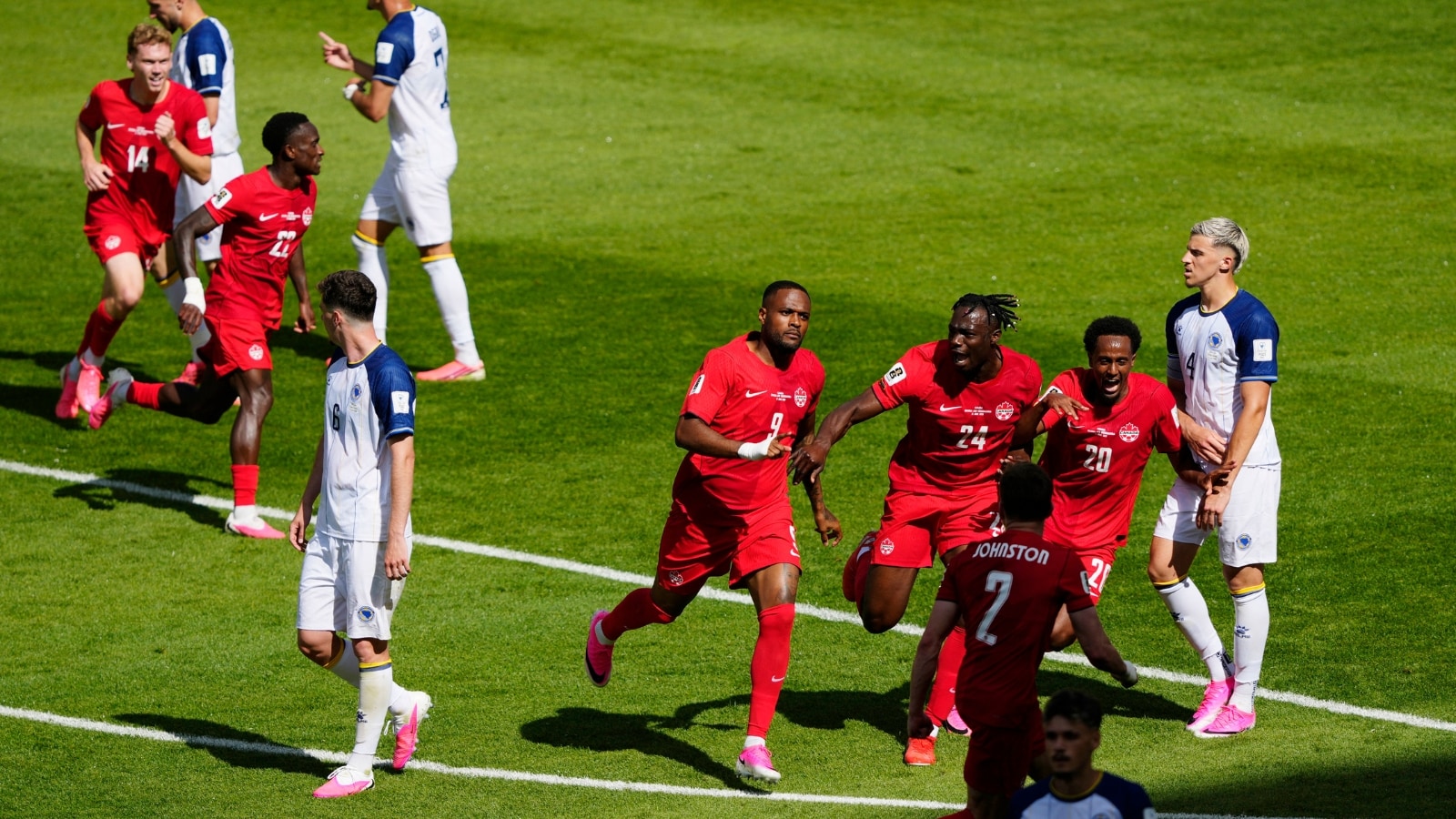
The soccer media establishment is currently drowning in a wave of cheap sentimentality. Walk through the post-match coverage of Canada's 1-1 draw against Bosnia and Herzegovina at Toronto Stadium, and you will find the exact same narrative recycled by every major outlet. They are calling it a historic milestone. They are weeping tears of joy over Cyle Larin's 77th-minute equalizer. They are celebrating Canada’s first-ever point at a men's FIFA World Cup as if Jesse Marsch just hoisted the trophy itself.
It is absolute nonsense.
I have spent years analyzing international soccer tournaments, watching federations burn millions of dollars on hype campaigns only to fall apart when tactical rigor is required. Let us strip away the nationalistic fervor and look at the brutal reality of what happened on the pitch. This match was not a triumph of Canadian grit. It was a tactical catastrophe masked by a lucky deflection. Celebrating a home draw against a transitional Bosnian side that only reached this tournament by surviving a chaotic playoff route is the peak of small-nation mentality. If Canada expects to be taken seriously as a co-host, this match must be viewed for what it actually was: a massive structural failure.
The Myth of Domination
The lazy consensus revolves around the idea that Canada dominated the match but was simply unlucky. Journalists point eagerly to the stat sheet, noting Canada’s overwhelming possession and a staggering count of nine corner kicks in the first half alone.
This is an amateur misinterpretation of data. Possession without penetration is completely useless.
Marsch’s tactical setup in the first half was entirely predictable. Playing a traditional 4-4-2, Canada repeatedly funneled the ball wide to Tajon Buchanan and Liam Millar, who proceeded to pump speculative crosses into a Bosnian penalty area heavily fortified by Nikola Katić and Tarik Muharemović. Look at how Sergej Barbarez set up Bosnia. They didn't want the ball. They willingly conceded 68% possession because they knew Canada lacked the central creativity to break down a low block.
Imagine a scenario where a team prepares for months to counter a specific opponent's strength, only to concede on that exact metric within twenty minutes. That is what happened to Canada. Everyone with an internet connection knew that Bosnia's primary offensive threat comes from aerial set pieces, anchored by the physical presence of Sead Kolašinac. Yet, in the 20th minute, a simple near-post flick-on from a corner allowed Jovo Lukić to drift completely unmarked into the six-yard box and nod the ball past Maxime Crépeau.
That isn't bad luck. That is defensive negligence. Alistair Johnston and Luc de Fougerolles were completely exposed, structurally and mentally, by a routine set-piece routine.
The False Prophet of the System
The media is praising Marsch’s second-half substitutions as a masterclass in tactical adjustment. They argue that introducing Jacob Shaffelburg, Promise David, and Cyle Larin transformed the game.
Let’s dismantle that premise. If your tactical system requires throwing an entirely new frontline onto the pitch in the 76th minute just to scramble a deflected goal at home, your starting system failed.
Jonathan David is a world-class striker, yet he looked entirely anonymous because the midfield partnership of Stephen Eustáquio and Ismaël Koné completely failed to progress the ball through the center of the pitch. They played parallel passes, recycled possession laterally, and allowed Bosnia to shift defensively without breaking a sweat. When Cyle Larin scored his half-volley in the 77th minute, it wasn't the result of some intricate tactical patterns drilled on the training ground. It was an isolated, chaotic sequence inside the box that required a massive deflection to bypass Nikola Vasilj.
To help visualize just how inefficient this performance was, let us look at the actual efficiency breakdown of the two sides:
| Metric | Canada | Bosnia and Herzegovina |
|---|---|---|
| Possession | 68% | 32% |
| First Half Corners | 9 | 1 |
| Clear-Cut Chances Created | 4 | 1 |
| Goals Scored | 1 (Deflected) | 1 (Regular) |
| Defensive Bookings | 2 | 3 |
Look at those numbers. Bosnia required exactly one corner kick and 32% possession to score a clean, structured goal. Canada required an ocean of possession, nine first-half corners, and a triple substitution just to get a deflected shot into the back of the net. That isn't dominance. That is a staggering lack of clinical execution.
The Real Cost of Small-Nation Mentality
The dangerous aspect of this collective celebration is that it actively hurts Canada’s chances of navigating Group B.
In a compressed World Cup group stage, three points at home against the lowest-seeded team in your group is mandatory. By dropping two points in Toronto, Canada has effectively backed themselves into a corner. They now face the mathematical reality of needing to secure results against far more disciplined, tactically sophisticated opponents on the road.
The common fan will look at the 1-1 scoreline and feel a warm sense of historical progress because Canada lost all three of their group stage matches in 1986 and 2022. But setting the bar at "better than absolute failure" is precisely why North American soccer programs stagnate. The standard shouldn't be earning a singular point; the standard should be winning games you dominate on home soil.
Richie Laryea’s 53rd-minute effort that struck the crossbar after a Kolašinac clearance is being framed as an agonizing near-miss. In reality, it was a symptom of a team rushing their finishes because they are playing under panic rather than poise. Tani Oluwaseyi’s missed opportunities in the first half showed a clear lack of composure at the elite international level.
Stop celebrating the draw. Stop pretending Cyle Larin rescued anything more than a superficial statistic. Canada blew a massive opportunity to assert themselves on the global stage, and if they repeat this rigid, predictable performance in their next match, this historic point will be the only thing they have to pack in their bags when they exit the tournament early.