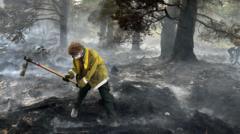
Public capital injected into post-fire upland restoration frequently fails to recover baseline ecological function because funding models treat complex hydrological systems as simple reforestation or replanting exercises. When severe wildfires burn across the Cairngorms National Park—Scotland’s largest expanse of arctic-alpine habitat, montane woodland, and blanket bog—the immediate policy reflex is to announce emergency grant disbursements for physical remediation. This response misdiagnoses the underlying asset failure. A severe muirburn or wildfire event in the Scottish Highlands does not merely remove surface biomass; it alters soil hydrophobicity, collapses hydrological retention capacity, and triggers an accelerating feedback loop of carbon oxidation and erosion. Deploying public funds without restructuring the grazing pressures, drainage infrastructure, and thermal management protocols that allowed the fuel load to accumulate guarantees diminishing returns on taxpayer capital.
The Structural Physics of Upland Fire Damage
To evaluate the efficacy of government-backed restoration, one must first separate surface vegetation loss from subterranean structural degradation. Standard reporting on Cairngorms wildfires focuses on hectares burned, a metric that obscures the actual ecological liability. Two fires of identical surface footprint produce vastly different restoration cost functions depending on burn severity, soil moisture at the time of ignition, and wind-driven residence time.
Surface Combustion vs. Subterranean Smoldering
High-intensity surface fires strip Calluna vulgaris (heather) canopies, juniper scrub, and regenerating Caledonian pine saplings. While visually dramatic, surface combustion leaves the underlying root matrix and bryophyte layer largely intact if the peat moisture content remains above critical ignition thresholds. Natural succession can re-establish ground cover within five to ten years without heavy capital intervention, provided herbivore browsing is suppressed.
The true balance-sheet liability occurs when drought conditions drop the water table, allowing fire to penetrate the acrotelm—the upper, biologically active layer of peat—and ignite the catotelm below. Smoldering combustion in deep peat operates at lower temperatures than flaming surface fires but persists for weeks, consuming organic matter accumulated over millennia. Once the peat structure is combusted, the soil loses its capillary porosity. Ash and charred organic compounds form a water-repellent crust, converting a sponge-like hydrological buffer into an impervious surface.
The Erosion Cascade and Sediment Transport
When autumn precipitation hits hydrophobic, post-fire peatlands in the Cairngorms, rainwater cannot infiltrate the soil profile. Instead, it generates rapid overland sheet flow. This runoff scours exposed mineral soils and loose peat particles, carving dendritic gully networks that further lower the local water table.
The mechanism operates as a self-reinforcing drain:
- Water Table Drawdown: Newly formed gullies act as drainage channels, pulling moisture out of adjacent unburned peat hags.
- Aerobic Oxidation: Exposed to oxygen, previously waterlogged peat shifts from anaerobic carbon sequestration to aerobic decomposition, releasing dissolved organic carbon (DOC) into headwater tributaries of the Dee, Spey, and Don rivers.
- Downstream Siltation: Suspended peat sediment degrades salmonid spawning gravels downstream, transferring an upland terrestrial liability into a lowland aquatic and commercial fishery cost.
Government funding allocated solely to seed broadcasting or tree planting on destabilized, hydrophobic peat fails immediately. Rain events wash seed stock into drainage channels before germination occurs, and bare-root saplings suffer desiccation in the drained surface layer.
The Restoration Cost Function
Allocating public funds to Cairngorms habitat recovery requires sequencing interventions according to physical stabilization priorities rather than political visibility. Tree planting photographs well for press releases; ditch blocking and peat reprofiling do not. Yet the capital efficiency of every downstream biological intervention depends entirely on front-loading hydrological engineering.
Phase One: Hydrological Re-wetting and Surface Stabilization
Before introducing biological stock, restoration teams must arrest sediment transport and elevate the water table. On steep Cairngorms gradients, this requires installing peat dams, timber baffles, or stone check-dams across erosion gullies to slow water velocity and trap mobile sediment. Where bare peat faces are exposed to frost heave—a primary driver of winter erosion in high-altitude Scottish sites—crews must apply geotextile netting or brash mulch harvested from donor sites to insulate the soil surface and create micro-climates for moss colonization.
The cost per hectare for mechanical peat reprofiling and dam installation exceeds basic planting by an order of magnitude, often requiring specialized low-ground-pressure machinery or helicopter airlifts for materials in roadless areas. However, skipping this phase invalidates all subsequent expenditure.
Phase Two: Inoculation and Pioneer Establishment
Once surface hydrology is stabilized and the water table rises within 10 centimeters of the surface, biological recovery can begin. Natural recolonization of Sphagnum mosses—the primary peat-forming genus—is severely bottlenecked in post-fire landscapes because fire destroys the local spore and fragment bank.
Effective restoration protocols deploy Sphagnum inoculation using micro-propagated beads, gel-suspended fragments, or donor mulch. Sphagnum acts as an ecosystem engineer: it holds up to twenty times its dry weight in water, acidifies the surrounding microenvironment to suppress competing vascular plants, and rebuilds the acrotelm. Simultaneously, nurse crops of native grasses (such as Deschampsia flexuosa) may be established on mineral-exposed edges to bind soil with fibrous root systems while slower-growing dwarf shrubs and native broadleaves establish.
Phase Three: Herbivore Exclusion and Browsing Suppression
The single highest point of failure in Highland habitat restoration is unmitigated herbivore pressure. The Cairngorms ecosystem supports high densities of red deer (Cervus elaphus), roe deer, mountain hares, and domestic sheep. Post-fire regeneration produces nutrient-rich young shoots that act as a magnet for grazing animals across adjacent estates.
Without strict population control or physical exclusion, herbivores selectively browse regenerating birch, rowan, Scots pine, and willow, arresting woodland succession in a state of permanent bonsai. Funding restoration without addressing deer density creates a subsidy for herbivore forage rather than ecological recovery.
The operational trade-off between fencing and culling presents distinct liabilities:
- Deer Fencing: Provides immediate protection for discrete restoration blocks, accelerating sapling growth. However, high-tensile wire fences in the Cairngorms pose a documented lethal collision hazard to capercaillie (Tetrao urogallus) and black grouse, two priority conservation species whose remaining UK populations are concentrated in the region. Fencing also concentrates grazing pressure onto unfenced perimeter habitats, degrading neighboring ground.
- Landscape-Scale Culling: Eliminates collision risks and benefits the entire watershed, allowing natural woodland expansion across altitudinal gradients. The limitation is governance friction: the Cairngorms National Park encompasses a patchwork of private sporting estates, conservation charities, and public landholdings with conflicting management objectives. Achieving the target density of fewer than 4 to 5 deer per square kilometer requires sustained, cross-boundary coordination that single-project restoration grants rarely enforce.
Governance Friction and Moral Hazard in Public Funding
Announcing government funds for fire recovery introduces a structural moral hazard into upland land management. In the Scottish Highlands, land management practices—specifically rotational muirburn conducted to maximize red grouse (Lagopus lagopus scotica) populations—are directly implicated in altering upland fuel loads and ignition risks.
The Fuel Load Paradox
Controlled muirburn aims to create a mosaic of uneven-aged heather, providing tender shoots for grouse nutrition alongside taller cover for nesting. When executed under strict meteorological parameters on mineral soils, rotational burning can reduce continuous fuel loads. However, historical drainage of upland estates via open hill ditches ("grips") to improve grouse and sheep productivity has systematically dried out deep peatlands across the Cairngorms.
Drained peatlands shift vegetation dominance from wet, fire-resistant Sphagnum communities toward dry, woody Calluna monocultures. Woody heather accumulates high levels of volatile oils and dead biomass. When an ignition event occurs during spring droughts—whether from an escaped muirburn, an unattended campfire, or a discarded disposable barbecue—the continuous woody fuel bed enables rapid fire spread across thousands of hectares.
Public Subsidy of Private Risk
When the state steps in to fund post-fire restoration on privately owned estates without attaching binding land-use covenants, it socializes the catastrophic tail-risk of degraded land management while keeping land value and sporting revenues private. If a landowner drains peatland or maintains excessive deer and sheep densities that suppress woodland regeneration, the ecological resilience of the landscape drops. When that brittle landscape inevitably burns, emergency public funds absorb the capital cost of remediation.
Furthermore, short-term government grant cycles—typically structured over one to three fiscal years—conflict with ecological recovery timelines that span decades. Restoration contractors are incentivized to hit rapid, auditable metrics (hectares fenced, saplings planted, dams installed) before the funding window closes. Once the grant expires, long-term maintenance—such as repairing storm-damaged peat dams, replacing failed plantings, and sustaining deer culls—falls into a funding vacuum.
Quantifying True Recovery: Moving Beyond Hectare Metrics
Evaluating the return on investment of Cairngorms restoration funds requires replacing simplistic area-based metrics with functional ecological indicators. Treating "1,000 hectares restored" as a uniform output masks the difference between a thriving, carbon-sequestering bog and a fenced paddock of struggling saplings on eroding peat.
Rigorous monitoring frameworks must track four primary variables over a minimum ten-year horizon:
- Water Table Depth Dynamics: Automated dipwells must verify that mean annual water table levels remain within 10 to 15 centimeters of the peat surface, preventing further aerobic carbon loss.
- Fluvial Particulate and Dissolved Organic Carbon: Downstream water quality sensors must measure reductions in turbidity and water discoloration, confirming that gully blocking has halted sediment export.
- Browse Impact Indices: Standardized herbivore dung counts and leading-shoot browse assessments must demonstrate that browsing rates remain below the threshold that prevents apical dominance in regenerating native trees.
- Bryophyte Cover Ratios: Fixed-point quadrat surveys must confirm an upward trajectory in Sphagnum and pleurocarpous moss cover relative to bare peat and woody dwarf shrubs.
Limitations of Active Intervention
Even optimally funded and scientifically sequenced restoration faces hard ecological ceilings in the Cairngorms. Climate trajectory models for the Scottish Highlands project warmer, drier summers alongside more intense winter precipitation events. Higher summer evapotranspiration rates will stress re-wetted peatlands, potentially narrowing the geographic envelope where active blanket bog formation remains viable, particularly on steep, south-facing slopes.
Additionally, seed-source isolation limits natural woodland recovery. Centuries of overgrazing and burning have fragmented native Caledonian pinewoods and montane scrub (such as downy willow and dwarf birch) into isolated refugia on cliff ledges and crags inaccessible to deer. Where seed trees have been entirely extirpated from a catchment, natural regeneration will not occur regardless of grazing reductions; expensive, labor-intensive enrichment planting is mandatory, carrying high mortality rates in harsh sub-arctic exposures.
Strategic Allocation Protocol for Public Funds
To prevent public restoration capital from subsidizing recurring ecological failure, funding bodies administering Cairngorms fire recovery grants must restructure disbursement conditions immediately:
- Mandate Hydrological Pre-Conditioning: Prohibit the release of funds for tree planting or seed broadcasting on peat soils until hydrological engineering (grip blocking, gully damming, and bare-peat stabilization) is verified complete and water table recovery is documented.
- Enforce Binding Herbivore Covenants: Require recipient landholdings to enter legally binding, multi-decade deer management agreements that cap local deer densities at ecological carrying capacity (under 5 animals per square kilometer) as a strict prerequisite for receiving capital grants, eliminating reliance on capercaillie-lethal fencing.
- Transition to Outcome-Based Escrow: Hold 30 to 40 percent of allocated restoration funds in escrow, releasing tranches at years three, five, and ten only upon independent verification of water table stability, reduced sediment runoff, and sapling survival rates rather than initial installation counts.
- Establish Fire-Buffer Zoning: Direct restoration capital first toward establishing high-moisture, broadleaf-dominated riparian corridors and re-wetted bog buffers around surviving ancient woodland fragments, converting restored zones into natural firebreaks that compartmentalize future ignition events across the park.


