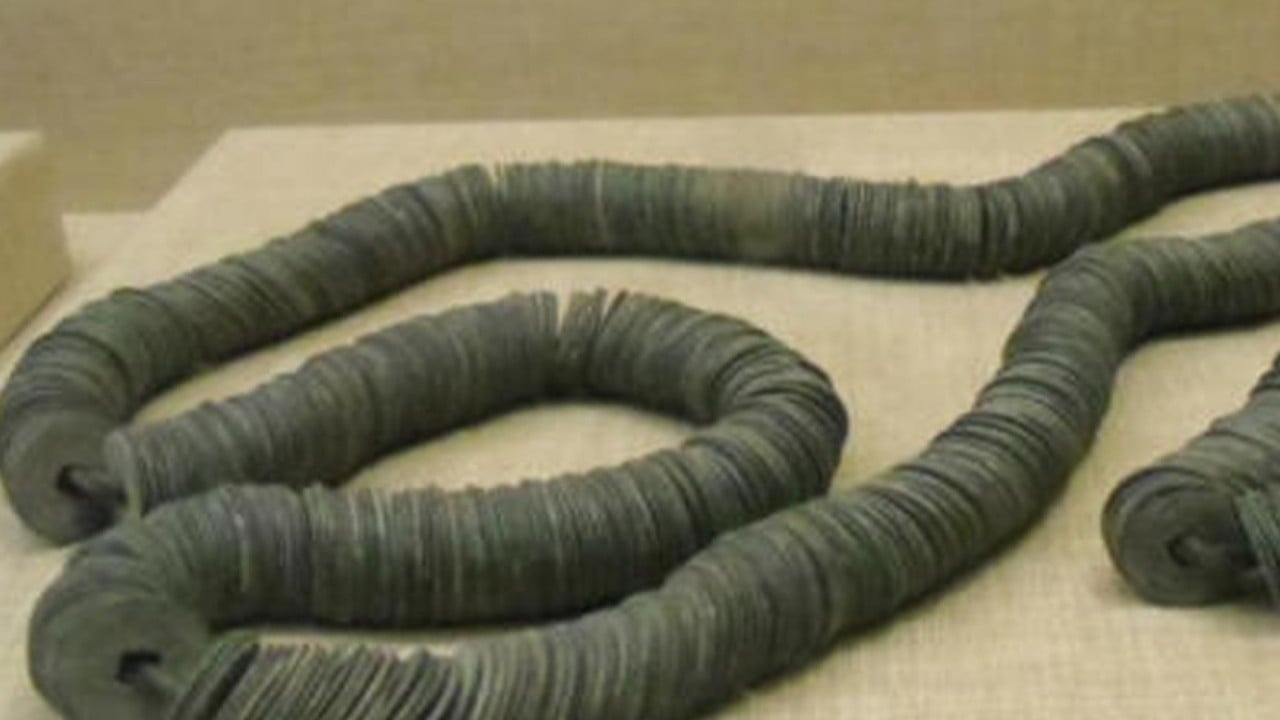
Try tying 35 metric tons of bronze around your belt. You wouldn't take a single step before your spine snapped in half.
Yet for over a thousand years, Chinese writers described wealthy elites as "carrying 10,000 strings of cash around the waist" (yaocang wanguan). If you've ever read classic Chinese literature or watched historical dramas, you've definitely stumbled across this phrase. Most people assume it's pure poetic exaggeration, like saying someone is "filthy rich" or "rolling in dough." If you enjoyed this piece, you should read: this related article.
They're only half right.
The idiom isn't just random hyperbole. It comes from a very specific historical collision between currency mechanics, physical weight, and a bizarre ancient wish about immortality. When you actually do the math on what a "string of cash" weighed in imperial China—and convert that value into modern purchasing power—the phrase stops sounding like a metaphor and starts looking like an ancient spreadsheet. For another angle on this event, see the recent update from ELLE.
The Literal Math Behind 10,000 Strings of Cash
To understand the true worth behind carrying 10,000 strings of cash around the waist, you first have to understand how imperial Chinese money actually worked.
Unlike modern paper bills or even Western gold coins, everyday currency in China for roughly two millennia consisted of round bronze or copper coins with a square hole punched right through the middle. We call them wuzhu or tongbao depending on the dynasty, though Westerners simply called them "cash coins."
Why the square hole? Two reasons. First, craftsmen slid the coins onto a square wooden rod to file down the rough bronze edges after casting. Second, nobody wanted to carry a loose sack of heavy metal coins. People threaded hemp cord through the square holes to bundle them together.
One standard string of cash—known as a guan or min—contained 1,000 individual coins.
Let's look at the physical reality of a single guan. During the Tang and Song dynasties, a standard bronze coin weighed roughly 3.5 to 4 grams. Multiply that by 1,000 coins, and one single string of cash weighed between 3.5 and 4 kilograms (about 7.7 to 8.8 pounds). That's roughly the weight of a newborn baby or a heavy bowling ball dangling from your belt.
Now multiply that by 10,000 strings.
Ten thousand guan equals 10,000,000 individual bronze coins. In physical weight, that hoard tips the scales at 35,000 to 40,000 kilograms—roughly 35 to 40 metric tons. Even if you swapped bronze for silver, which became standard later in the Ming and Qing dynasties, 10,000 strings roughly translated to 10,000 taels of silver. A single tael weighed about 37 grams, meaning you'd still be lugging around 370 kilograms (over 815 pounds) of solid silver bullion.
Nobody carried that around their waist. Not even emperors.
Where the Weird Waist Metaphor Actually Came From
If carrying 10,000 strings of cash around the waist was physically impossible, why did ancient scholars invent such an absurd visual?
You have to blame a sixth-century writer named Yin Yun and his collection of anecdotes called Xiaoshuo (literally "Small Talk"). In one famous story from the Southern Liang dynasty, a group of friends sat around drinking and sharing their ultimate life fantasies. One guy wanted to become the governor of Yangzhou, a notoriously wealthy trading hub. Another wished to own endless estates. A third dreamed of riding a crane straight up to heaven to become a Taoist immortal.
Then the fourth guy spoke up. He didn't want to choose. He wished to "carry 10,000 strings of cash around his waist, ride a crane, and fly straight to Yangzhou."
That single line went viral across centuries of Chinese literature.
Why Yangzhou? During the Sui, Tang, and Song dynasties, Yangzhou sat at the intersection of the Yangtze River and the Grand Canal. It was the Wall Street, Dubai, and Manhattan of medieval Asia rolled into one. Salt merchants there threw money around so recklessly that wearing a heavy belt stuffed with strings of coins became the ultimate flex. Travelers literally wore tubular cloth money belts (chan'yao) wrapped around their torsos to keep bandits from stealing their funds on the road.
Putting a few hundred coins in your belt meant you were a comfortable merchant. Saying you had 10,000 strings wrapped around your waist meant you had achieved total, untouchable financial freedom—paired with the joke that you'd also need a divine crane just to lift your fat wallet off the ground.
Converting Ancient Strings Into Modern Money
Historians hate converting ancient currency into modern dollars because inflation, supply chains, and basic living standards warp the numbers. A smartphone didn't exist in 1050 AD, and nobody today pays for an imperial concubine or a fleet of wooden grain barges.
Still, we can measure purchasing power using the universal baseline of pre-industrial economies—grain and labor.
Let's look at the Northern Song dynasty (960–1127 AD), widely considered the economic golden age of imperial China. Economic historians, including scholars referenced in Cambridge University Press's The Economic History of China, have documented Song grain prices extensively. During normal harvest years in the eleventh century, one dan (or shi, roughly 60 to 70 kilograms) of husked rice cost between 600 and 1,000 cash coins—basically one single guan.
Think about what that means.
One single string of cash fed an adult for nearly two months. With 10,000 strings of cash, you could buy 10,000 dan of rice. That's over 600 metric tons of food—enough to feed a small town of 1,500 people for an entire year.
Let's look at wages instead. A common laborer or low-ranking soldier in the Song or Ming dynasties earned roughly 1,000 to 2,000 coins a month, or about 12 to 24 strings of cash per year. Even a mid-level county magistrate often pulled in an official cash salary of around 200 to 400 strings annually (before accounting for gray-market perks and land rents).
To accumulate 10,000 strings of cash, an ordinary worker would have to save every single coin they earned—spending zero on food, rent, or taxes—for roughly 500 to 800 years.
In today's terms, if you benchmark against median household income or basic food security, 10,000 strings of cash sits comfortably between $5 million and $15 million USD in modern purchasing power. You weren't necessarily on the level of Jeff Bezos or the imperial treasury, which dealt in millions of guan annually, but you belonged firmly in the top 0.01% of society. You owned multiple estates, employed dozens of servants, and never worried about a bad harvest starving your family.
The Hidden Catch Most History Fans Miss
Here's where people get tripped up when reading classical texts. A "string of cash" almost never contained 1,000 actual coins.
Imperial governments and local merchants constantly manipulated the count in a practice called shengmo ("short-stringing"). Because bronze was expensive to mine and cast, dynasties frequently suffered severe coin shortages. To stretch the money supply, the state decreed that 770 or 800 coins officially counted as a full 1,000-coin guan for tax payments.
Private markets got even messier. Different cities used different string standards depending on what you were buying:
- Government tax payments often demanded 770 to 850 coins per string during the Song dynasty.
- Urban silk and tea merchants might accept 900 coins as a full string for wholesale trades.
- Local village markets sometimes dropped as low as 500 or 600 coins per string for everyday produce, especially if the coins were worn thin or privately cast.
By the late Qing dynasty in the nineteenth century, the copper cash had suffered centuries of inflation. Ten thousand strings of cash in 1890 didn't make you a regional tycoon anymore. Thanks to silver influxes from the Americas and the introduction of foreign silver dollars, 1,000 copper coins only bought about one silver dollar. Ten thousand strings in 1900 amounted to roughly 10,000 silver dollars—still a very comfortable fortune for a rural landlord, sure, but nowhere near the legendary mega-wealth the phrase implied during the Tang and Song eras.
Why Paper Money Didn't Kill the Phrase
You might wonder why Chinese speakers kept talking about heavy strings of coins long after China invented the world's first paper money (jiaozi) in Sichuan during the eleventh century.
The answer comes down to trust.
Every time an imperial dynasty ran into military trouble—whether fighting the Jurchens, the Mongols, or internal rebels—the court fired up the printing presses. Hyperinflation wiped out paper savings repeatedly across the Song, Yuan, and Ming dynasties. By the mid-Ming period, imperial paper notes had lost over 99% of their face value, becoming so worthless that merchants refused to touch them even at a massive discount.
Hard metal never lied. Bronze coins had intrinsic value, and silver bullion held its worth across borders and regime changes. Even when merchants settled massive deals using silver ingots or early banking drafts (piaohao) in Shanxi province, accounting books still denominated debts and wealth in guan and wen (individual cash coins) well into the twentieth century.
Language preserves what people trust. Saying someone had "10,000 banknotes in their pocket" sounded flimsy, risky, and temporary. Saying they carried "10,000 strings of cash around their waist" evoked solid, heavy, undeniable metal that no emperor's bad monetary policy could evaporate overnight.
How to Spot and Use the Idiom Correctly Today
If you're studying Mandarin, translating historical texts, or just trying to understand Chinese cultural references without sounding like a textbook, context matters enormously. Modern Chinese speakers still use yaocang wanguan (腰缠万贯) regularly, though its tone shifts depending on how you drop it into a sentence.
1. Watch out for sarcasm.
In casual conversation today, calling a friend yaocang wanguan usually has a playful or slightly mocking edge. If your buddy picks up the bar tab or buys a designer jacket, teasing them with this phrase lands well. Using it completely straight-faced for a tech billionaire can sound overly dramatic, almost like calling someone a "merchant prince" in English.
2. Pair it with its natural opposites.
Chinese idioms thrive on contrast. Writers love pairing yaocang wanguan with yiwen buming (一文不名—"not having a single coin to one's name") or jia tu sibi (家徒四壁—"a family possessing only four bare walls"). Notice how yiwen buming uses the exact same currency system: one wen was a single bronze coin, the smallest unit of a 1,000-coin guan.
3. Don't confuse guan with liang (taels).
If you're writing historical fiction or analyzing classical texts, keep your denominations straight. Before the mid-Ming dynasty (roughly the 1500s), large fortunes were measured in guan (strings of bronze coins) or bolts of silk. After the Single Whip Law tax reforms consolidated taxes into silver, mega-wealth shifted to wanliang (10,000 taels of silver). Mixing them up in a Tang-dynasty setting is an instant historical giveaway.
When you hear someone described as carrying 10,000 strings of cash around their waist, picture ten million heavy bronze coins strung onto ten thousand hemp cords, piled four stories high in a guarded courtyard—and remember that the whole joke started because nobody's belt could actually hold it.