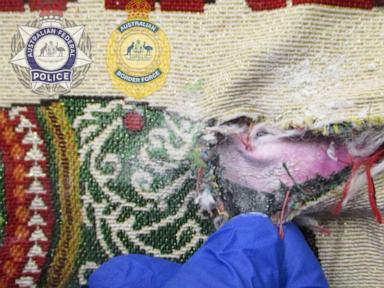
The headlines are reading exactly like the authorities want them to. A 26-year-old Thai airline employee arrives at Melbourne Airport on an international flight. Australian Border Force officers run her luggage through an X-ray machine. They spot "anomalies" in 12 tote bags, slice into the linings, and pull out a kilogram of heroin worth half a million dollars. Press releases are fired off. Law enforcement takes a victory lap. The public nods along, satisfied that the border is secure because a corrupt "trusted insider" has been intercepted.
It is a comforting narrative. It is also entirely wrong.
The arrest of an airline crew member with a single kilogram of heroin is not proof that border security is working. It is definitive evidence that the system is failing. When a major international drug syndicate resorts to stuffing a couple of pounds of white powder into the fabric of retail shopping bags carried by an on-duty flight attendant, you are not witnessing a masterclass in organized crime. You are witnessing a low-level, amateur distraction.
I have spent years analyzing transit networks and supply-chain vulnerabilities, and I can tell you that the obsession with the "rogue flight attendant" narrative is a classic case of looking at the wrong variable. Law enforcement loves these cases because they are photogenic, easy to prosecute, and make for great headlines. But if you think stopping a flight attendant with a bag full of retail merchandise is putting a dent in the international drug trade, you are fundamentally misunderstanding how modern smuggling works.
The Illusion of the Trusted Insider
The official statement from the Australian Border Force followed a predictable script: criminal syndicates have a track record of targeting "trusted insiders" to breach border controls.
Let us look at the actual mechanics of this operation. The suspect carried 12 separate tote bags through a standard international arrivals terminal. She did not bypass security. She did not use a secret employee tunnel. She went through the exact same baggage screening process that every commercial crew member undergoes.
The phrase "trusted insider" implies an individual leveraging high-level operational access—someone altering digital cargo manifests, manipulating container seals, or using airside security passes to move contraband around checkpoints.
Walking through a customs hall with a kilo of heroin hidden in an X-ray-opaque lining is not an insider threat. It is the exact same method used by standard "mules" or backpackers, except the courier happens to be wearing a polyester uniform.
The economic reality of the drug trade makes this clear. A kilogram of heroin in Melbourne might have an estimated street value of $500,000, but its wholesale cost at the source in the Golden Triangle is a fraction of that amount—frequently less than $5,000. To an international syndicate, a single kilogram is a rounding error. It is disposable capital.
Imagine a scenario where a logistics manager wants to move 50 kilograms of illicit product through a major maritime port. How do you ensure the container passes through without a second glance? You generate noise elsewhere. You feed an anonymous tip to airport authorities, or you send a low-level courier through the terminal with an obvious, amateurish concealment method. While the entire border force shift is tied up conducting presumptive field tests, interviewing a suspect, and calling in federal police for an arrest, the real weight moves quietly through the sea docks or the commercial air freight terminals.
The Real Vulnerability in the Air Cargo Pipeline
If you want to know where the real threat lies, stop looking at the passenger cabin and start looking at the belly of the aircraft.
Commercial aviation is a dual-purpose business. While passengers are eating lukewarm meals on the upper deck, the lower deck is packed with tons of commercial air freight, mail, and logistics pallets. This is where the true volume moves, and this is where the security apparatus is thinnest.
| Smuggling Channel | Average Volume per Attempt | Detection Focus | Operational Safeguards |
|---|---|---|---|
| Cabin Crew / Passengers | 1 to 5 kilograms | High (Physical & X-ray screening) | Individual searches, behavioral profiling |
| Commercial Air Freight | 50 to 500 kilograms | Medium (Manifest auditing) | Supply chain certifications, bonded warehouses |
| Maritime Containers | 500+ kilograms | Low (Less than 10% physically inspected) | Automated target algorithms, physical seals |
The aviation industry relies heavily on "known shipper" frameworks. Under these systems, if a logistics company passes a baseline regulatory audit, its cargo is often fast-tracked through security screening to maintain tight delivery schedules. The focus shifts from physical inspection to paperwork verification.
When a multi-million-dollar syndicate wants to exploit the aviation network, they do not risk their supply on a 26-year-old flight attendant who might get nervous at the baggage carousel. They set up front companies, infiltrate third-party logistics providers, and pack the contraband deep inside legitimate commercial shipments of auto parts, textiles, or industrial machinery.
The downside to addressing this vulnerability is obvious. If customs agencies began physically inspecting every single piece of commercial air freight with the same scrutiny they apply to an airline worker's personal luggage, global supply chains would grind to a halt. A three-day international delivery would take three weeks. The airline industry, which operates on razor-thin margins, cannot afford the delay.
As a result, governments and aviation authorities accept a calculated risk. They maintain a high-visibility deterrent at the passenger terminal—catching the occasional flight attendant or tourist—while the vast majority of the real volume passes through the automated, high-speed cargo infrastructure.
The Question We Should Be Asking
Instead of asking how a flight attendant managed to get a kilogram of heroin onto a plane, the public should be asking why our border security strategy remains so performative.
The current system relies on a reactive model. An anomaly is spotted on an X-ray, an arrest is made, and the press release claims the border has been protected. This ignores the basic laws of supply and demand. Australia has some of the highest street prices for illicit drugs in the world, driven by its geographic isolation. That price premium creates an insatiable economic incentive for syndicates to innovate.
When you see a crew member get caught with a crude concealment method like lined tote bags, it means one of two things. Either the syndicate has become incredibly desperate and stupid, or they are intentionally throwing a pawn away to keep the knights and queens moving across the board undetected. Given the multi-billion-dollar scale of the global narcotics trade, betting on their stupidity is a losing strategy.
The arrest in Melbourne is a victory for public relations, not public safety. True security requires moving past the theater of the baggage claim and focusing resources on the blind spots of bulk logistics. Until that happens, the real operators will keep using the system exactly as intended, treating the occasional arrested employee as nothing more than the cost of doing business.