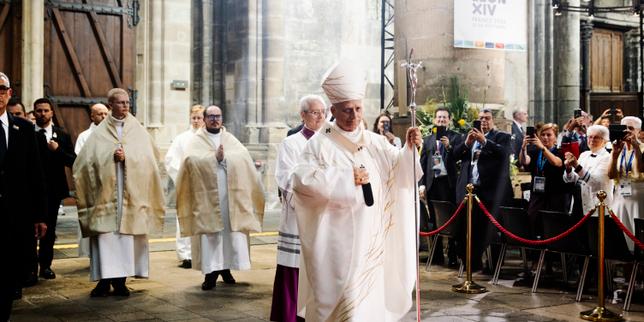
The hand-wringing in the Parisian press over religious demographics is exhausting. Every time a pontiff crosses the border or a high-profile tour touches down, cultural commentators reach for the same tired script about secular erosion, empty basilicas, and the terminal decline of Western belief. It is a lazy narrative built on a fundamental category error. They look at Sunday morning attendance numbers and confuse institutional real estate management with spiritual vitality.
Let us dispense with the pious fiction right now. The health of a tradition is not measured by headcounts at dawn mass or the balance sheets of parish coffers. If it were, the Roman church would have folded during the Enlightenment. What the secular pessimists miss is that cultural architecture operates on centuries, not quarterly fiscal cycles. A shrinking flock does not mean a vanishing footprint; it often means a more concentrated, potent core. Read more on a similar topic: this related article.
I have spent years watching cultural analysts misread the metrics of belief. They treat religion like a retail chain suffering from shifting consumer habits, as if parishioners are just shoppers defecting to online alternatives. That analogy collapses the moment you walk into Chartres or Notre-Dame on a Tuesday afternoon.
The Fallacy of the Headcount
The standard lament goes like this: fewer baptisms, aging congregations, converted chapels, and the quiet march of secularization. It sounds convincing until you look at how cultural transmission actually functions in Europe. Additional analysis by The New York Times explores related views on this issue.
Belief in France has never been strictly about enthusiastic doctrinal adherence. It is structural. It is woven into the legal codes, the national holidays, the aesthetic vocabulary, and the very shape of the horizon from Brittany to the Pyrenees. When a Pope visits, the media treats it as a political gauge of religious approval ratings, as if the faithful are voting in a popularity contest.
That frame is completely backward.
Secularism did not destroy belief; it privatized and sharpened it. People stop attending boring administrative liturgies when they have intellectual options, yes. But they do not stop grappling with transcendence, guilt, mortality, and community. They simply stop performing rituals out of social compliance. When social coercion vanishes, what remains of a religious tradition is either genuine conviction or profound cultural heritage. Both are far more resilient than a packed room of bored suburbanites going through the motions.
The Asset Paradox of Sacred Real Estate
Let us talk about the physical plant. Critics point to decaying rural churches as proof of institutional rot. They argue that maintaining thousands of stone monuments across depopulated villages is an economic anchor dragging down the modern state and the diocese alike.
They have the economics entirely upside down.
Scarcity breeds value. In an era of hyper-digitized, frictionless, disposable culture, physical permanence is the ultimate luxury. Those stone walls outlast empires, revolutions, and ideological fads. When a community repurposes an old abbey or watches a cathedral fill with tourists rather than communicants, they assume it is a defeat. It is actually a pivot.
Stone remembers what algorithms forget. The modern obsession with efficiency demands that every square meter must monetize its existence or face the wrecking ball. Cathedrals reject that logic by simply standing there, massive and useless in the eyes of a utility-maximizer, forcing modern minds to confront a scale entirely detached from human convenience.
When millions of secular Europeans crowd into historic basilicas not to pray, but to gawk at stained glass and vaulted ceilings, they are participating in a secular pilgrimage. They are seeking the exact same psychological architecture of awe that their ancestors sought, just under a different cognitive banner. To call that "decline" is to misunderstand the psychology of human longing.
The Myth of Neutral Secularism
Another favorite delusion of the secular pundit class is that public space can ever be truly neutral. We are told that France’s strict laïcité creates a blank slate where citizens operate purely on rational, post-religious principles.
Nonsense.
Laïcité itself is a theological byproduct. It is a distinctly Latin, Catholic-inflected way of organizing society, carving out a strict boundary between the spiritual and the temporal that only makes sense within a Christian historical framework. You cannot scrub five hundred years of Catholic mental software out of the French psyche simply by banning headscarves in classrooms or removing crucifixes from courtrooms.
The moral intuitions driving modern secular humanism—universal human dignity, the preferential option for the weak, individual conscience—did not drop out of the sky courtesy of the French Revolution. They were hammered out over millennia inside the very institutions critics love to dismiss as obsolete. Pretending that contemporary Western ethics can float freely without the anchor of its historical metaphysical substrate is like cutting down a tree and expecting the branches to keep hovering in mid-air.
What Real Adaptation Looks Like
If the church wants to survive the coming decades, it needs to stop apologizing for its past and stop trying to chase the latest cultural fads. The worst thing an ancient institution can do is try to look cool, relevant, and modern. Nobody goes to a two-thousand-year-old institution for contemporary styling tips. They go for gravity, permanence, and answers that do not shift with the news cycle.
The future does not belong to mega-churches with fog machines and acoustic guitar bands trying to mimic corporate culture. It belongs to whatever institutional forms can preserve intellectual rigor, historical memory, and uncompromised transcendence in a world drowning in digital noise.
Stop measuring spiritual vitality with spreadsheets. Stop confusing political posturing with the quiet, subterranean persistence of belief. The cathedral is not falling down; it is simply outliving its critics, as it always has.


