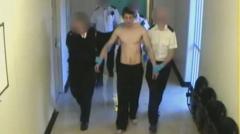
The media has caught another case of camera worship. Every time a new frame of grainy CCTV footage leaks from a high-profile prison incident, the narrative machine shifts into overdrive. The latest outcry screams that newly surfaced footage "contradicts" the established evidence of a custody death. The public laps it up because we have been conditioned to believe that a lens cannot lie.
It is a comforting delusion. It is also entirely wrong.
As someone who has spent a career auditing security architecture and forensic video pipelines inside correctional infrastructure, I watch these media cycles with deep exhaustion. The lazy consensus assumes that video is a neutral arbiter of truth. The reality is that raw security footage is an fragmented, easily misread, and highly distorted medium that regularly manufactures false narratives. The public is looking at 15 frames per second of compressed data and inventing a conspiracy out of a technical limitation.
Stop expecting a security camera to act as a moral jury. To understand what actually happens behind those concrete walls, you have to understand exactly how badly the technology fails us.
The Optical Deception of the Fish-Eye Lens
Most prison corridors and cell blocks are monitored using ultra-wide-angle or hemispherical fish-eye lenses. They are designed for a single purpose: maximum spatial coverage with zero blind spots. They are not designed for forensic accuracy.
When an incident occurs at the periphery of an ultra-wide lens, severe barrel distortion stretches and warps the geometry of the room. A guard stepping forward to stabilize an inmate can look like an aggressive lunge because the relative speed of movement accelerates artificially near the edges of the frame. Conversely, a genuine compression of force can look entirely benign if it happens directly beneath the camera hub where depth perception flattens out entirely.
Imagine a scenario where a technician tests an identical camera setup in a controlled studio. If two actors stand six feet apart near the edge of the lens, a slight lean forward by one actor appears on screen as an immediate physical closure of space. If you base your legal or ethical conclusions entirely on that spatial rendering, your conclusion is built on an optical illusion.
The Deadly Math of Framerates and Compression Artifacts
The average citizen watches movies at 24 frames per second (fps) or streams high-definition video at 60 fps. They expect smooth, continuous motion. Prison CCTV systems routinely operate at 4 to 8 fps to conserve storage arrays that must hold months of data across thousands of channels.
When you drop the framerate, you lose the connective tissue of human movement.
Between frame A and frame B, a quarter of a second passes. In high-stress, combative environments, a massive amount of physical data is completely lost in that black box. A sudden medical episode—like a seizure or a sudden cardiovascular collapse—can look like a violent struggle simply because the missing frames remove the micro-movements that signal distress rather than aggression.
Add heavy H.264 or H.265 block compression to the mix. When a camera detects rapid movement in low-light environments, the compression algorithm struggles to update the macroblocks fast enough. The result is "ghosting" or motion blur. This artifacting blends distinct objects together. A hand reaching for a radio can easily fuse with an inmate's clothing, creating the visual impression of a physical strike where none existed.
The False Promise of "Enhanced" Footage
Whenever controversial footage emerges, the immediate demand is to "enhance it." This is where the public understanding completely falls apart.
You cannot extract information that was never captured. Forensic video enhancement isn't magic; it is mathematical interpolation. When software sharpens a grainy image or increases the contrast of a dark cell block, it uses predictive algorithms to guess what the missing pixels should look like based on surrounding data.
In a high-stakes investigation, relying on enhanced CCTV means you are letting an AI algorithm's best guess dictate the facts of a human death. True forensic experts, like those certified by the Law Enforcement and Emergency Services Video Association (LEVA), spend half their time in court explaining why "clearing up" a video actually introduces artificial artifacts that bias a jury.
Why Body-Worn Cameras Aren't Saving Us Either
The immediate counter-argument is always the same: switch to body-worn cameras.
I have overseen the deployment of these systems, and they introduce an entirely new set of systemic biases. A body camera mounted on an officer's torso captures a highly subjective viewpoint. Because the camera is pressed against the officer's chest, it exaggerates the proximity and scale of the inmate, making the inmate appear significantly larger and more threatening than they are in reality.
Furthermore, during a physical altercation, the body-cam footage becomes an unreadable blur of fabric, floor tiles, and static audio. It creates a vacuum of context. It tells you exactly what the officer is facing, but it tells you absolutely nothing about what the officer is doing with their own limbs or weight distribution.
The Uncomfortable Truth About Systems, Not Scapegoats
The obsession with finding the "smoking gun" frame in a CCTV leak blinds us to the actual mechanics of institutional failure.
When an inmate dies in custody, the public wants a villain caught on tape. It makes for clean headlines. But the vast majority of custody deaths are the result of compounding, unphotogenic systemic failures:
- Chronic understaffing leading to missed welfare checks that happen just off-camera.
- Failure to recognize the clinical signs of positional asphyxia during a standard restraint.
- Broken internal medical triage systems that ignore protocol hours before a camera even starts recording.
A video clip cannot capture a systemic lack of training. It cannot capture the toxic culture of an underfunded facility. By focusing entirely on whether a guard's hand was at a certain angle in a pixelated frame, we ignore the structural rot that guaranteed the crisis would happen in the first place.
Stop treating security footage as an objective mirror of reality. It is a deeply flawed, highly compressed, geometrically warped data stream that requires brutal skepticism to interpret. If you want to understand why people are dying in prisons, look at the medical logs, the staffing ratios, and the policy failures. Turn off the video.