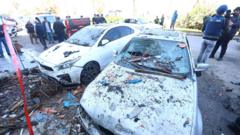
The ink on the US-Iran brokered ceasefire wasn't even dry before the sirens started screaming in southern Lebanon. The mainstream press is currently scrambling to frame the Israeli strikes as a "violation" or a "fragile setback." They are wrong. This isn't a failure of diplomacy; it is the inevitable outcome of a diplomatic framework built on a fundamental misunderstanding of regional kinetic reality.
If you believe a signed document in D.C. or Tehran dictates the security calculus of a commander in the Galilee, you haven't been paying attention for the last forty years. The "lazy consensus" suggests that ceasefires are the goal. They aren't. In the Levant, a ceasefire is merely a logistical pause—a chance for one side to reload and the other to recalibrate their targeting data.
The Flaw of the Triangulated Peace
The current narrative treats the US, Iran, and Israel as rational actors sitting at a three-sided table. This is a boardroom fantasy. In reality, we are looking at a disconnected ecosystem of proxies, ideological imperatives, and domestic survival tactics.
Washington wants a "win" for the news cycle. Tehran wants to preserve its regional "Shield of Resistance" without inviting a direct strike on its nuclear infrastructure. Israel, meanwhile, is operating on an existential clock that doesn't care about American election cycles or Iranian diplomatic overtures.
When Israel strikes southern Lebanon post-ceasefire, they aren't breaking a deal. They are enforcing a red line that the deal was too cowardly to address: the physical presence of entrenched militia infrastructure on their immediate border.
Why Diplomacy Fails the Geography Test
Most geopolitical analysts love to talk about "de-escalation." It’s a comfortable word. But de-escalation is a luxury of the distant. For a resident of Metula or Kiryat Shmona, de-escalation is a death sentence if it means Hezbollah remains ten miles away with a garage full of Kornet missiles.
The competitor articles focus on the timing of the strikes. They ask, "Why now?" The better question is, "Why would they ever stop?"
- The Buffer Zone Imperative: No amount of diplomatic paper can replace ten kilometers of empty dirt. Israel has realized that international observers (UNIFIL) are effectively decorative. If the IDF doesn't clear the bush, the bush belongs to the militia.
- The Pre-emptive Necessity: In modern urban warfare, the defender has already lost. If you wait for the "first shot" of a new war to respond, you’re counting bodies in your own streets.
- The Proxy Paradox: Tehran can sign anything it wants. It can promise to "restrain" its allies. But Hezbollah has its own internal logic. If they move a single rocket launcher into a forbidden zone, the Israeli "strike" is actually a defensive maintenance act.
Stop Asking if the Ceasefire is Broken
People keep asking, "Will the ceasefire hold?" This is the wrong question. It’s like asking if a band-aid will stop internal bleeding.
The premise of the question is flawed because it assumes the ceasefire was a solution. It wasn't. It was a temporary alignment of interests that has already diverged. Israel’s security establishment has a long memory. They remember 2006. They remember UN Resolution 1701, which was supposed to keep southern Lebanon weapon-free. It failed spectacularly.
I’ve stood on those hills. I’ve seen the "civilian" houses that serve as missile silos. When a general sees a threat being rebuilt under the cover of a "peace deal," he doesn't call a diplomat. He calls a squadron leader.
The Brutal Logic of "Mowing the Grass"
There is a term in Israeli security circles: Mowing the Grass. It’s cynical, it’s grim, and it’s the only strategy that actually reflects the reality on the ground. You don't "win" these conflicts. You don't find a "holistic" solution. You simply reduce the enemy's capability periodically so that life can continue for another few years.
The recent strikes in southern Lebanon are a textbook example of grass-mowing.
- The Target: Research and development facilities, smuggling routes, and command bunkers.
- The Message: A ceasefire with Iran does not grant immunity to Lebanon.
- The Risk: Escalation is a possibility, but for Israel, the risk of not striking is a certainty of future catastrophe.
Critics argue this approach is "short-sighted." They claim it creates more insurgents. This is the classic "hearts and minds" fallacy applied to a region where the "minds" are already committed to your destruction. You don't win over an ideological militia by showing restraint; you only convince them of your weakness.
The US-Iran Delusion
The biggest lie being sold right now is that the US and Iran can "manage" this conflict.
The US is trying to manage a world that no longer exists—a world where American hegemony could freeze a border by sheer will. Iran is playing a much longer game. They are happy to sign a ceasefire because it removes the immediate threat of American or Israeli strikes on the Iranian mainland, while their proxies in Lebanon, Yemen, and Iraq continue to bleed their enemies by a thousand cuts.
By striking Lebanon now, Israel is effectively telling the Biden administration: "Your deal is not our destiny." It is a move of radical autonomy. It’s an admission that the interests of a superpower and the interests of a small state under siege are no longer aligned.
Hard Truths for the "Peace" Industry
If you want to understand what is actually happening, ignore the spokespeople in suits. Look at the flight paths of the F-35s.
Peace, in the Western sense, is the absence of conflict. Peace, in the Middle Eastern sense, is the equilibrium of fear. The moment one side loses its fear, the "peace" ends. The Israeli strikes are an attempt to restore that equilibrium.
They are loud. They are violent. And from a purely strategic standpoint, they are the only thing keeping the "ceasefire" from becoming a total tactical rout.
We need to stop viewing these strikes as "violations." View them as the cost of doing business in a region where a signature is worth less than a concrete bunker. The status quo isn't being disrupted; it is being enforced.
The "peace" didn't fail. The "peace" was never there. There is only the pause, and the pause just ended.
Get used to it. The grass doesn't mow itself.