Charles Spencer has never been a man inclined to whisper when a roar will do, particularly when the honor of his lineage or the memory of his sister is perceived to be under siege. When the 9th Earl Spencer steps into the public arena to signal his displeasure with the House of Windsor, it is rarely an accidental outburst. It is a calculated detonation rooted in decades of inherited resentment, aristocratic duty, and a protective instinct over the legacy of Diana, Princess of Wales. The latest friction surrounding the fractured relationship between Prince William and Prince Harry is not merely a family disagreement playing out in tabloid headlines. It is the continuation of a centuries-old institutional war between the crown and the collateral branches that dare to challenge its absolute dominance.
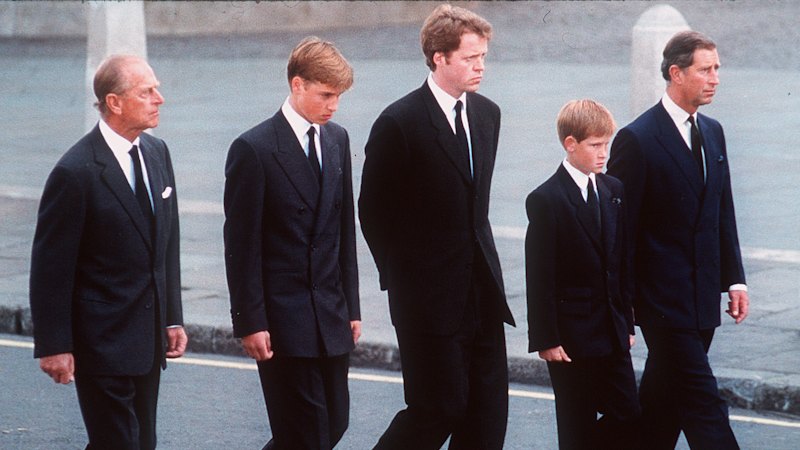
To understand why Earl Spencer’s reported fury at King Charles carries such structural weight, one must examine the mechanics of the British monarchy as an existential corporation. The institution does not process grief; it processes public relations. When Diana died beneath the Pont de l'Alma tunnel in Paris in August 1997, Charles Spencer delivered a blistering funeral eulogy inside Westminster Abbey that directly indicted the press
The Broken Circle Behind Palace Walls Why Charles and Earl Spencer Are Colliding Over Harry and William For an alternative view, check out: this related article.
celebs, news
Decades after the chapel at Westminster Abbey fell silent following the funeral of Diana, Princess of Wales, the shockwaves of her absence continue to fracture the house of Windsor. When Earl Spencer broke protocol to voice quiet indignation over the treatment of Prince Harry and Prince William, he was not merely acting as an aggrieved maternal uncle. He was exposing a structural fault line in how the modern British monarchy handles grief, public relations, and collateral damage. Related analysis on this trend has been provided by Wall Street Journal.
Charles Spencer knows intimately how the institutional machine operates. He watched it chew up his sister, metabolize her tragedy for public consumption, and then attempt to seal the vault. Now, watching the generational feud between his nephews play out on a global stage, his frustration is entirely rational. The core premise is stark. The royal institution prioritizes the survival of the crown over the preservation of family, leaving young heirs and spares to absorb the blow. Earl Spencer recognizes that the cold management style Prince Charles—now King Charles—historically applied to domestic crises is precisely what pushed Harry into exile and left William isolated behind a wall of protocol.
To understand why this friction persists, one must examine the mechanics of royal crisis management. For generations, the Firm has relied on a singular operational strategy when internal discord threatens public standing. Silence, endurance, and strategic distraction. When Diana died, that strategy nearly collapsed under the weight of public fury. Millions realized that institutional survival had superseded basic human empathy. Earl Spencer delivered a blistering eulogy in 1997 precisely because he saw the machinery working in real-time to sanitize a tragedy.
Fast forward to the current era, and the machinery has not evolved. It has merely digitized. The rift between William and Harry is treated by palace aides as a public relations containment exercise rather than a human emergency. When Earl Spencer expresses fury, he is pointing out that the king holds the ultimate institutional leverage to heal or exacerbate the break, yet chooses procedural coldness.
The asymmetry between the two brothers is staggering. Prince William carries the heavy burden of the direct line, insulated by courtiers who manage his image with surgical precision. Prince Harry, cast out into the commercial wilderness of California, found himself stripped of institutional armor while battling the same media beast that hunted his mother. The tragedy is that both men are victims of the same upbringing. They were raised inside a gilded pressure cooker where vulnerability was treated as a structural threat.
Charles Spencer understands this dynamic because he grew up alongside Diana in the same emotionally stunted aristocratic environment. He knows that ignoring a wound does not heal it. It only causes the tissue to scar over improperly. When he critiques how the current monarch handles the fractured relationship between his sons, he is highlighting a generational failure of leadership. A king is supposed to be the anchor of the realm, capable of transcending petty court politics to mend domestic breaches. By allowing the estrangement between Harry and William to calcify into permanent hostility, the palace reveals an inability to manage its own internal human capital.
Critics of the Spencer intervention often argue that family matters should remain private. This argument collapses under the weight of historical reality. The British monarchy is publicly funded and symbolically central to national identity. The private lives of its principals are inextricably linked to public stability. When the heir to the throne and his younger brother refuse to speak, it is an institutional crisis. Earl Spencer’s intervention is a reminder that external accountability is sometimes the only weapon available against an institution built on absolute emotional opacity.
Look at the mechanics of the Sussex departure. It was handled with the same bureaucratic ruthlessness that characterized the royal response to marital breakdowns in the nineties. Titles stripped, security withdrawn, communications locked down. There was no elder statesman step-in, no grandfatherly intervention, no attempt at genuine reconciliation. Just a swift administrative excision designed to protect the brand. That is what infuriates observers who remember Diana. The institution learned nothing about humanity while mastering the art of public relations.
William finds himself trapped in a different kind of trap. To maintain his status as the loyal son and future king, he must completely freeze out his brother. Any sign of softness toward Harry is framed by the press as a betrayal of the crown. This dynamic creates a cruel zero-sum game where familial love is treated as disloyalty to the institution. Charles Spencer sees this and recognizes the cruelty of a system that forces brothers to choose between their blood and their duty.
The king faces a profound historical judgment. Monarchs are rarely remembered for their administrative efficiency. They are remembered for their moral clarity during moments of profound societal and familial transition. By permitting the ongoing alienation of his younger son, and ignoring the legitimate distress flagged by figures like Earl Spencer, the sovereign projects an image of modernizing irrelevance. You cannot project warmth and national unity while your own family resembles a war zone managed by communications directors.
The collateral damage extends far beyond the immediate participants. The British public is left to pick sides in a soap opera manufactured by institutional stubbornness. Every leaked story, every snub at a state event, and every calculated absence from family gatherings erodes the mystique that keeps the monarchy afloat. People do not expect perfection from royal families, but they do expect a baseline of human decency. When that baseline is sacrificed on the altar of protocol, the institution ceases to command respect.
Earl Spencer’s indignation is a flare sent up from a sinking ship of traditional norms. He is naming the elephant in the room. The Windsor establishment has never known how to process independent thought or emotional honesty from within its own ranks. Anyone who steps outside the approved script is isolated, neutralized, and painted as unstable. Diana lived that nightmare until the end. Harry and Meghan narrowly escaped its physical manifestation, only to face its reputational fallout across the Atlantic.
The path toward reconciliation was never easy, but it required a leader willing to break protocol for the sake of peace. That leadership has been entirely absent. The king remains insulated by courtiers who measure success in positive press cycles rather than familial harmony. As long as that mindset dictates palace strategy, the ghost of Diana will continue to haunt the corridors of power, personified by an uncle who refuses to let the world forget how the machine operates.
The rift between the brothers will not heal through time alone, because time merely hardens the barriers built by pride and institutional protectionism. It requires an active dismantling of the grievances that both sides have nursed in public view. Until the crown acknowledges its role in exacerbating the fracture rather than healing it, the tragedy of the house of Windsor remains unfinished, playing out scene by bitter scene on the global stage.