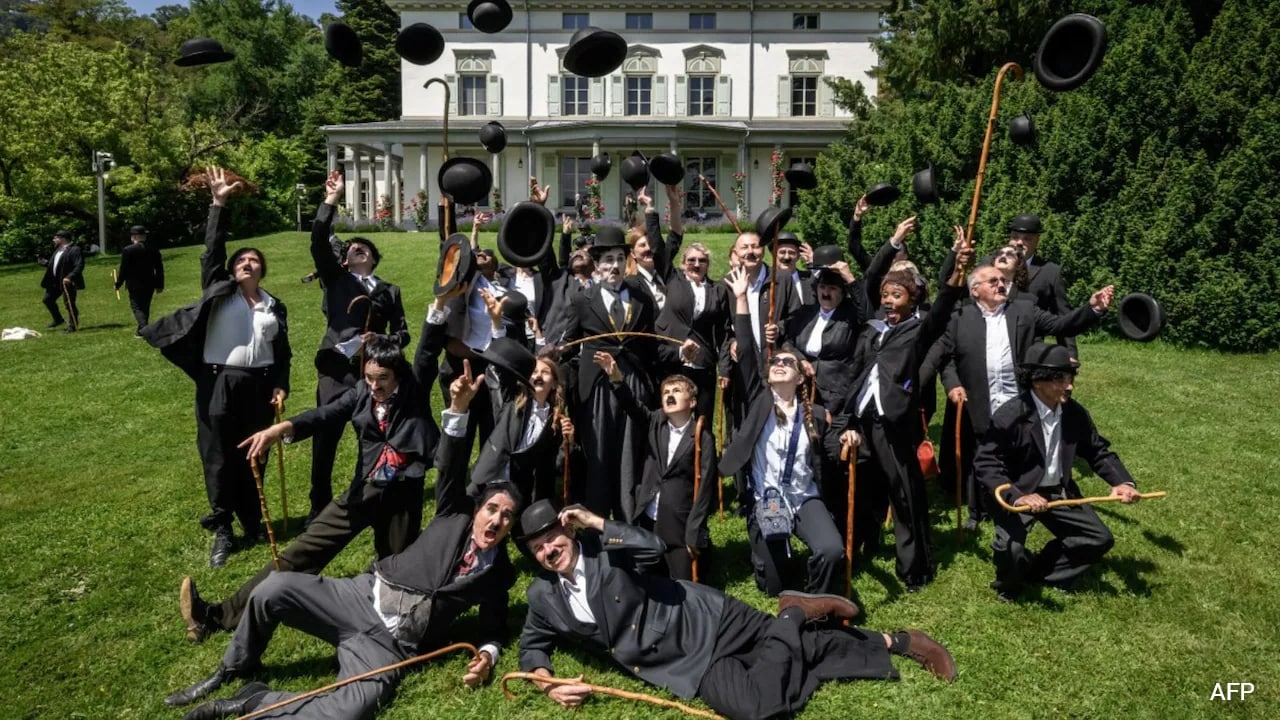
Hundreds of adults just put on baggy pants, glued on toothbrush moustaches, and stood under a blazing Swiss sun to form a giant number ten. The media wants you to look at this gathering at the Chaplin’s World museum in Corsier-sur-Vevey and feel a warm surge of nostalgia. They call it a celebration of a cinematic genius. They focus on the quirky joy of 429 people failing to break a world record.
They are missing the entire point.
This isn't a celebration of Charlie Chaplin. It is the definitive proof of how modern culture flattens complex, radical art into empty, comfortable marketing stunts. The "lazy consensus" of the entertainment press is that the Little Tramp remains a universal symbol of pure, unadulterated joy. But stripping Chaplin of his sharp political edges to turn him into a safe, family-friendly costume party is an insult to everything the man actually stood for.
The Myth of the Safe Icon
I have spent decades watching cultural institutions sanitize brilliant, dangerous artists to boost gift shop sales. The Manoir de Ban estate, where Chaplin lived his final 25 years after being effectively exiled from the United States, is now an interactive playground.
The real Charlie Chaplin was not a harmless mascot. He was a fierce critic of industrial capitalism, fascism, and mechanized society.
- Modern Times (1936): A brutal satire on how the assembly line chews up the working class and spits them out into mental institutions.
- The Great Dictator (1940): A direct, career-risking attack on Adolf Hitler when Hollywood was still terrified of losing the German distribution market.
- Monsieur Verdoux (1947): A pitch-black comedy equating the murders committed by a bank clerk to the state-sanctioned mass slaughter of modern warfare.
When you pack 429 people onto a lawn in Switzerland to pose for a promotional photo op, you are not engaging with that legacy. You are actively burying it under a mountain of bowler hats and cheap bamboo canes. The Tramp was born out of economic desperation, starvation, and the harsh realities of the early 20th-century underclass. Turning that specific, painful archetype into a whimsical corporate dress-up day is a profound cultural irony.
The Record That Failed and the Failure of Nostalgia
Let us look at the hard data from this latest event. The organizers openly admitted they were chasing a milestone: trying to beat the 2017 record of 662 lookalikes set at the same venue. They fell short by more than 200 people.
The media covered this with a collective shrug, quoting participants who insisted the lower turnout "did not dampen the mood." But the shrinking numbers tell a much more brutally honest story about consumer engagement.
Nostalgia has a shelf life. You cannot sustain a cultural legacy purely through aesthetics. When you strip away the substance of an artist's work, the visual markers lose their power. A younger generation doesn't connect with a toothbrush moustache because a museum tells them to. They connect with urgency, rebellion, and truth. By turning Chaplin into a static brand, the curators of his legacy are ensuring his slow slide into cultural irrelevance.
Imagine a scenario where a museum dedicated to a radical punk band celebrated its anniversary by hosting a contest for the neatest safety-pin placement. It would be laughed out of the room. Yet, because Chaplin worked in the silent era, we treat his artistic legacy like an open-source intellectual property designed to sell tickets.
The Cost of Corporate Canonization
The downside to this critique is obvious: museums need funding, and stunts drive foot traffic. Chaplin’s World drew roughly 300,000 visitors in its inaugural year, wildly exceeding its initial projections. Mass participation events create high-visibility press clippings that keep the lights on.
But we must calculate the exact cost of that attention.
When you prioritize aesthetic mimicry over artistic literacy, you create a superficial fandom. It becomes an exercise in narcissism. Actors show up because they look the part and want to declare themselves "the happiest man alive" to a television crew. The focus shifts entirely from the creator to the consumer.
True artistic reverence does not look like mass production. It looks like subversion. If you want to honor the spirit of the Little Tramp in 2026, you don't buy a plastic cane at a Swiss gift shop. You make art that makes the powerful uncomfortable. Anything less is just a costume party on a dead man's lawn.

,webp/013/792/629/2560x1440.4.webp)