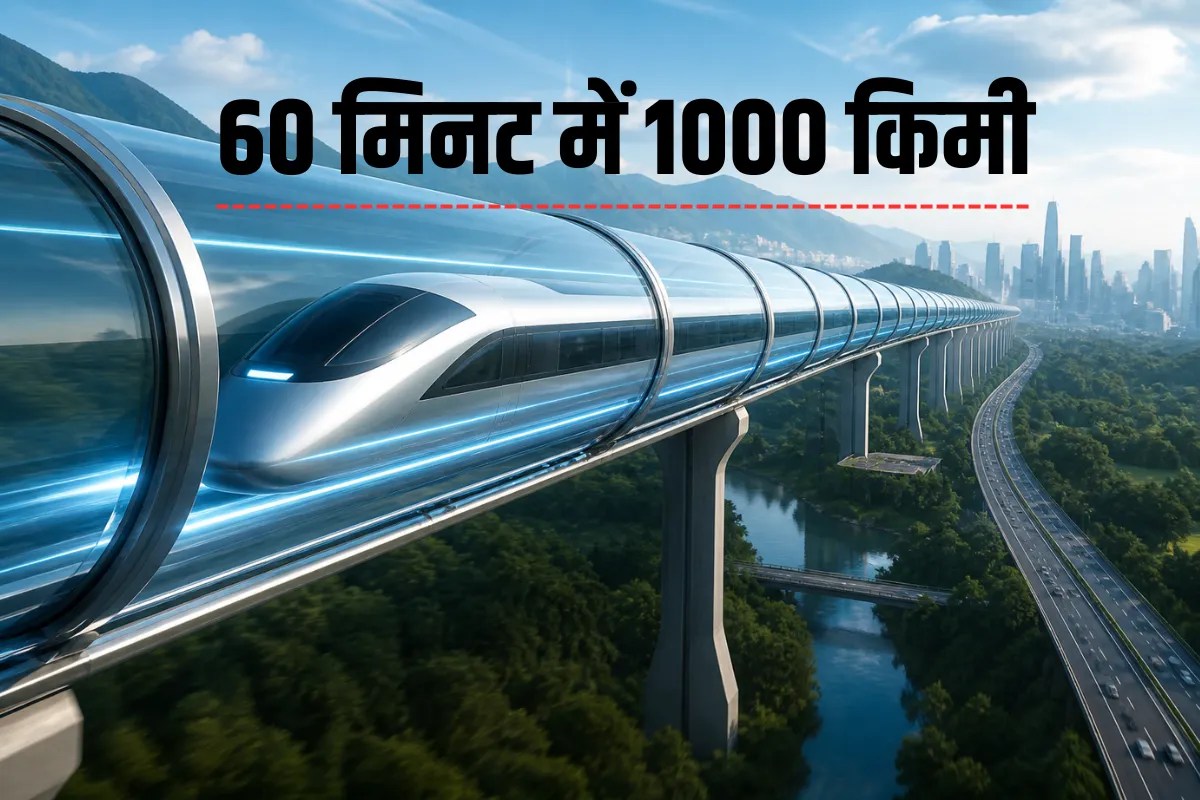
China is currently testing a transportation system that aims to move passengers at 1,000 kilometers per hour. To put that in perspective, a standard Boeing 787 cruises at about 900 kilometers per hour. If the China Aerospace Science and Industry Corporation (CASIC) succeeds, they will have created a "ground-based airplane" that renders domestic flight paths obsolete. Recent tests in Shanxi province have confirmed that the T-Flight maglev can maintain stable navigation and vacuum integrity, moving us closer to a reality where a trip from Beijing to Shanghai takes less time than a morning commute.
This isn't just about speed. It is about a fundamental shift in how kinetic energy is managed in a world restricted by friction and air resistance.
The Physics of the Vacuum Tube
Traditional high-speed rail is hitting a wall. That wall is literal air. Once a train passes 400 kilometers per hour, the energy required to push through the atmosphere increases exponentially. You aren't just fighting gravity; you are fighting a physical fluid—the air—that becomes as thick as water at high velocities.
CASIC solves this by removing the air. The T-Flight operates within a low-pressure pipeline. By pumping the air out of these massive tubes, the system eliminates aerodynamic drag. The vehicle doesn't touch the tracks. It uses magnetic levitation (maglev) to float, removing mechanical friction. When you remove both air resistance and wheel-to-rail contact, the power requirements drop significantly even as speeds soar.
The recent test runs in a 2-kilometer pipeline have proven that the magnets can handle the weight of the capsule while maintaining a precise gap between the vehicle and the guide rail. This is the "high-speed flying train" concept that engineers have dreamed of since the early 20th century, finally moving out of the lab and into the dirt of northern China.
Why the Hyperloop Failed and T-Flight Might Not
We cannot discuss vacuum-tube transport without mentioning the ghost of the Hyperloop. A decade ago, Western venture capitalists poured billions into similar concepts, only to see companies like Hyperloop One collapse into bankruptcy. The West failed because of the infrastructure gap.
Building a vacuum tube that spans hundreds of miles is an engineering nightmare. The tube must expand and contract with temperature changes without losing its seal. A single leak can cause the entire system to fail, or worse, create a "piston effect" that destroys the vehicle.
China has an advantage that private startups do not: state-backed industrial muscle. CASIC is a defense contractor. They specialize in missiles and aerospace. They are applying rocket-grade precision to civil engineering. While Western firms struggled with land rights and private funding rounds, the Chinese government integrated this project into its national "Transportation Power" strategy. They aren't looking for a quick return on investment. They are looking for a century of technical dominance.
The Thermal Expansion Problem
Steel expands when it gets hot. Over a 500-mile track, that expansion adds up to hundreds of feet. If the tube isn't flexible, it buckles. If it is too flexible, it leaks. CASIC is reportedly using a modular joint system that allows for micro-adjustments in real-time. This is the "unsexy" part of the tech that actually determines if the project lives or dies. If they can’t keep the vacuum tight over long distances, the 1,000 km/h dream stays in the 2-kilometer test track.
The Human Factor at 600 Miles Per Hour
What does it feel like to be inside a windowless pod traveling at near-supersonic speeds? This is the hurdle that marketing departments often ignore. Humans are sensitive to acceleration, not speed. You can travel at 2,000 km/h and feel nothing, provided the speed is constant.
However, any slight curve in the track at those speeds generates massive G-forces. To keep passengers from vomiting or passing out, the T-Flight tracks must be incredibly straight. This limits where the tubes can be built. You cannot weave a 1,000 km/h vacuum tube through a mountain range or around a city center. You have to blast through everything in a straight line.
- Acceleration: The system uses linear induction motors. It feels like the push of a take-off in a jet, but sustained for several minutes.
- The "Window" Problem: Looking at a screen instead of a real window is a necessity. To combat claustrophobia, designers are using high-definition 8K displays that simulate a landscape passing by, synced with the actual GPS position of the pod.
Economic Warfare on the Tracks
The business case for the T-Flight isn't just about moving people; it is about devaluing the short-haul aviation market. If you can move from the center of one city to another in 60 minutes—avoiding airport security, taxiing, and delays—the airline industry loses its most profitable customers.
This is a direct challenge to the global aerospace status quo. China is already the world leader in high-speed rail, possessing over 45,000 kilometers of track. By pushing into the 1,000 km/h range, they are creating a new exportable standard. They want to sell this technology to the world, just as they sold their 350 km/h rail systems to Southeast Asia and Eastern Europe.
But the costs are astronomical. Estimates suggest that building a vacuum maglev costs several times more per mile than traditional high-speed rail. For the T-Flight to be viable, it needs massive throughput. It cannot be a luxury toy for the elite; it has to move thousands of people every hour.
Safety Risks in the Void
The biggest "what if" remains the safety of the vacuum. If a pod loses power, it is stuck in a tube with no air. If the tube cracks, the air rushing in at the speed of sound could crush the pod like a soda can. CASIC claims to have multi-redundant life support and emergency braking systems that can stop the pod even without power. They are testing "magnetic braking" which uses the vehicle's own momentum to generate a counter-force that slows it down safely.
The Strategic Reality
China's pursuit of the 1,000 km/h train is often dismissed as a vanity project. Critics argue that the 350 km/h trains already in service are "fast enough." This misses the point of industrial evolution. You don't build a supersonic train because it is easy; you build it because the process of solving those problems creates new materials, better magnets, and more efficient vacuum pumps that can be used elsewhere in the economy.
The T-Flight is a laboratory disguised as a train. Every successful test run in Shanxi is a signal to the world that the era of relying on 19th-century rail physics is ending. We are entering an age where the ground and the sky become indistinguishable.
The next phase involves extending the test track to 60 kilometers. That is where the real physics will happen. At that distance, the heat generated by the magnets and the stability of the vacuum over long durations will be laid bare. If the pod holds together and the sensors stay green, the domestic flight as we know it is a dead man walking.
Focusing on the speed alone is a mistake; the real story is the mastery of a controlled environment that defies the natural limits of our atmosphere.