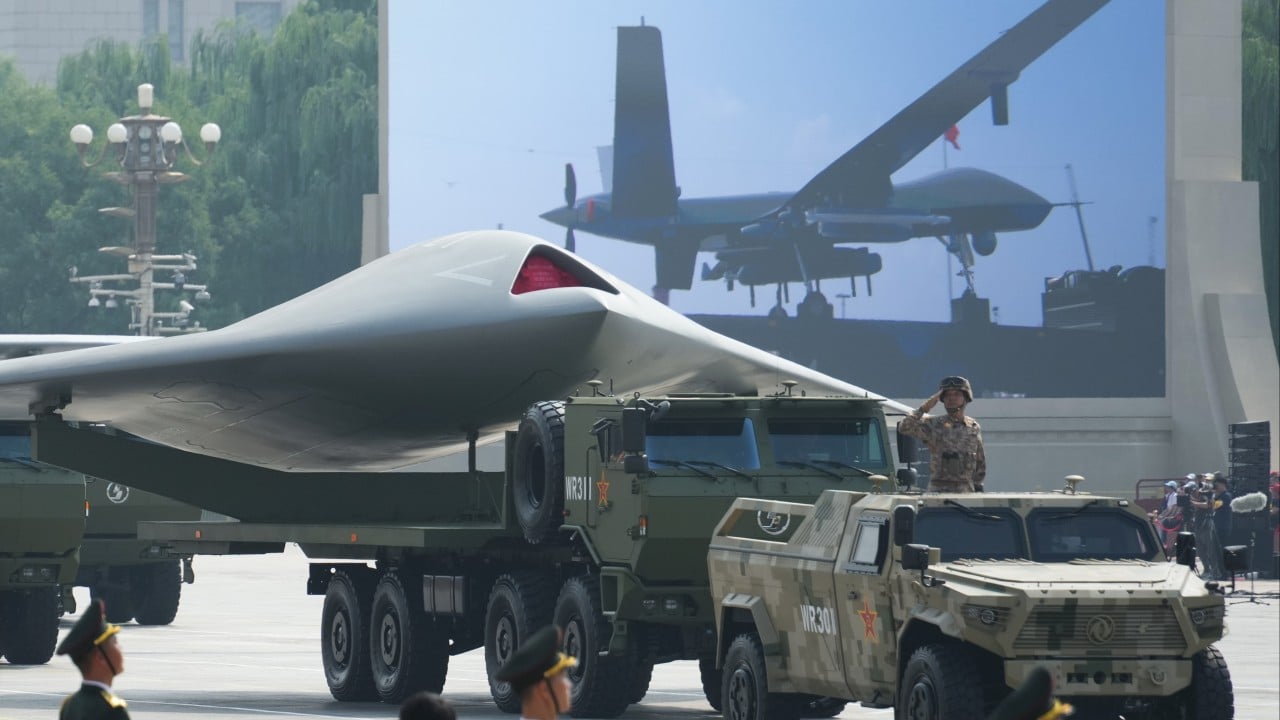
The recent demonstration of a Chinese "land aircraft carrier" using high-energy microwave beams to charge a drone in mid-flight isn't just a flashy tech demo. It is a blunt signal that the logistical tether of battery life—the single greatest weakness of modern unmanned aerial vehicles (UAVs)—is being severed. Developed by researchers at the University of Electronic Science and Technology of China, this system allows a mobile ground vehicle to track a flying drone and blast it with a concentrated stream of electromagnetic energy, converting it into electricity via a specialized "rectifying antenna" or rectenna.
This leap forward addresses the primary failure point of small-scale drone warfare. Current tactical drones are essentially disposable batteries with wings; they spend more time returning to base or charging than they do on station. By eliminating the need to land for a battery swap, China is moving toward a reality of "infinite loiter" capabilities. If a drone never has to come down, the entire calculus of border surveillance and urban suppression changes overnight.
The Physics of the Microwave Tether
To understand why this matters, you have to look past the "land aircraft carrier" marketing fluff. The vehicle is essentially a ruggedized command center equipped with a high-gain antenna array. The magic happens through microwave power transmission (MPT).
The ground station emits a beam in the microwave spectrum, likely within the S-band or X-band, focusing a tight cone of energy on the drone’s underside. The drone doesn't just receive a signal; it captures raw wattage. This is achieved through a Schottky diode-based rectenna that converts the oscillating electromagnetic field back into direct current (DC) to top off the onboard lithium-polymer cells.
Overcoming the Inverse Square Law
The technical hurdle has always been atmospheric attenuation and beam divergence. Under normal circumstances, energy density drops off rapidly as distance increases. To counter this, the Chinese team utilized an adaptive phase-conjugate beamforming system. By using a pilot signal from the drone, the ground station can "lock" the beam with surgical precision, even if the drone is buffeted by wind or performing evasive maneuvers. This keeps the energy transfer efficiency high enough to be more than just a novelty.
The Tactical Shift from Swarms to Sentinels
For years, the Pentagon has obsessed over drone swarms. The logic was simple: overwhelm defenses with sheer numbers. But swarms are logistically heavy. They require massive transport, constant maintenance, and a revolving door of charging stations.
The microwave-powered drone flips this. Instead of a hundred drones flying for twenty minutes each, a commander can maintain a single, high-altitude "sentinel" that stays up for days. This provides a persistent eye in the sky that doesn't blink. In an active combat zone, the most dangerous moment for a drone operator is the retrieval phase. When a drone flies back to its point of origin to recharge, it leaves a digital and physical breadcrumb trail straight back to the pilot. Wireless charging allows the ground vehicle to stay hidden or on the move while the drone stays deep in enemy territory.
The Land Carrier as a Mobile Power Node
The vehicle itself is designed for off-road durability, resembling a modular armored truck. By integrating the charging tech into a mobile platform, the PLA (People's Liberation Army) ensures that their "power grid" is as mobile as their frontline. This creates a moving bubble of energy. Any drone within a certain radius of the carrier becomes a permanent fixture of the airspace.
The Dirty Reality of Microwave Warfare
Despite the propaganda, this technology is far from perfect. We are talking about high-energy beams being fired into the open air. This presents two massive problems that Beijing is likely downplaying: interference and signature.
The Giant Electronic Flare
Firing a high-wattage microwave beam is the electronic equivalent of lighting a signal fire in a dark forest. Any modern Electronic Support Measures (ESM) suite will pick up that transmission from hundreds of miles away. While the drone might be "invisible" to traditional radar, the charging beam is a loud, constant scream on the spectrum.
Enemy forces don't need to find the drone; they just need to follow the beam back to the "land carrier." For a near-peer adversary like the United States, this makes the charging vehicle a high-priority target for anti-radiation missiles. China is betting that their beam-steering is fast enough to minimize this window, but the laws of physics suggest otherwise.
Thermal Management and Safety
Then there is the issue of heat. Converting microwaves to DC electricity isn't 100% efficient. A significant portion of that energy is lost as waste heat. On a small carbon-fiber drone, dissipating that heat without melting the internal avionics is a nightmare. Furthermore, any bird, tree branch, or—heaven forbid—human that crosses the path of a high-intensity charging beam will be instantly cooked. This limits the "land carrier" to desolate environments or strictly controlled military corridors. It is not a tool for a crowded city unless you don't care about collateral damage.
The Global Arms Race for Energy Dominance
China isn't the only player in this space, but they are the most aggressive in deploying it to the field. The U.S. Naval Research Laboratory (NRL) has experimented with "Power Beaming" for years, successfully transmitting kilowatts of power over a kilometer at research sites in Maryland. However, the American approach has been bogged down by safety regulations and a focus on long-range satellite-to-ground power.
Beijing has skipped the cautious phase. By mounting this on a "land carrier," they are prioritizing immediate battlefield utility over long-term safety protocols. They are looking for a solution to the "First Island Chain" problem—the need to maintain constant surveillance over vast stretches of water and rugged coastline where landing strips are non-existent.
Why This Isn't Just Another Prototype
Critics often dismiss these announcements as vaporware designed to scare regional neighbors. That is a mistake. The components for MPT are now off-the-shelf. High-efficiency Gallium Nitride (GaN) semiconductors, which are essential for generating these beams, are a sector where China has invested billions to achieve self-sufficiency.
This isn't about one truck and one drone. It's about the modularity of the system. Imagine a convoy where every third vehicle is a power node. You create a persistent, rechargeable net of sensors that can move across a continent.
The Countermeasure War
As this tech matures, expect a surge in specialized electronic warfare. If you can’t shoot down the drone, you "poison" the beam. By flooding the area with noise on the same frequency as the charging beam, an adversary could potentially overload the drone’s rectenna, causing a catastrophic electrical fire mid-air. The battle for the skies is no longer just about kinetic projectiles; it is about who controls the flow of electrons through the air.
The End of the Battery Bottleneck
The "land aircraft carrier" proves that the era of the battery-limited drone is ending. We are entering a phase where the air itself is energized. For the soldier on the ground, this means the drone hovering overhead isn't going away in fifteen minutes. It isn't going away at all.
Military planners must now account for a persistent overhead threat that functions more like a low-orbit satellite than a traditional aircraft. The logistical chain has moved from the fuel truck to the microwave emitter. This shift requires a total overhaul of how we think about "holding" territory. If you can't kill the power source, you can't clear the sky. The microwave beam is the new umbilical cord of the modern battlefield, and it’s one that is incredibly hard to cut without getting burned.