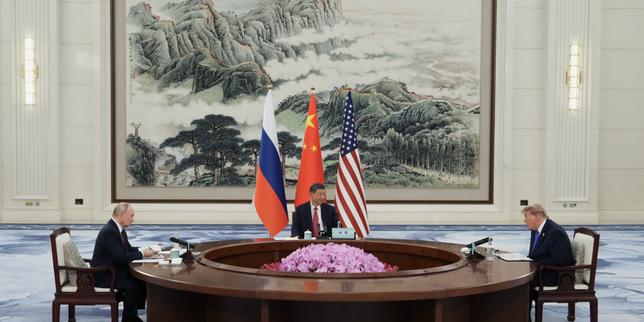
When leaders from Washington, Beijing, and Moscow convene at the same table, the immediate public takeaway is almost always ambiguity. A historic summit involving Xi Jinping, Donald Trump, and Vladimir Putin ends without a sweeping treaty or a neat diplomatic scorecard because high-stakes trilateral diplomacy is rarely designed to produce instant public clarity. Instead, the real outcome of such a gathering lies in the structural friction between three competing views of global order, where bilateral concessions on trade, security, and spheres of influence are traded quietly while official communiqués remain deliberately vague.
To understand why an outcome appears unclear on the surface, you have to look at the mechanics of three-body diplomacy. Bilateral negotiations are hard enough. Adding a third superpower introduces a dynamic where every concession to one party immediately alters the leverage of the other two.
The Structural Trap of Three-Way Diplomacy
In traditional diplomatic history, summits between two rivals—like the Cold War meetings in Reykjavik or Geneva—operated on a relatively straightforward ledger of nuclear parity and regional containment. A tripartite summit fundamentally breaks that math. Neither Washington, Beijing, nor Moscow enters the room with identical priorities, yet each holds veto power over the others' core objectives.
Consider the baseline asymmetry at the table:
- Washington's transactional focus: Under Trump’s approach to foreign policy, bilateral trade deficits, tariff leverage, burden-sharing among allies, and rapid, visible deal-making take precedence over multilateral frameworks.
- Beijing's long-horizon stability: Xi’s administration prioritizes regime security, technological self-reliance, steady access to global export markets, and preventing a unified Western-led containment bloc in the Indo-Pacific.
- Moscow's security architecture: Putin’s primary objective revolves around formal recognition of a post-Soviet sphere of influence, relief from Western financial sanctions, and fracturing the cohesion of NATO.
When these three agendas collide in a single venue, ambiguity is not a failure of diplomacy. It is the only way all three leaders can walk out of the building and claim domestic success without immediately alienating their respective power bases or junior allies. If a joint statement sounds noncommittal, that is by design.
Why Ambiguity Is the Preferred Currency
Seasoned diplomats know that the communiqué released to the press is often the least informative document produced during a summit. When a meeting concludes with an "unclear" outcome, analysts look at what was omitted rather than what was announced.
In high-level talks among these three capitals, public vagueness serves three practical functions. First, it prevents immediate backlash from domestic hardliners. In Washington, any perceived softening toward Moscow or Beijing triggers instant bipartisan pushback on Capitol Hill. In Beijing, appearing to yield to American tariff pressure undermines the nationalist narrative of strength. In Moscow, offering compromises on European security without concrete sanctions relief looks like retreat.
Second, strategic ambiguity protects third-party relationships. Beijing cannot afford to look as though it is abandoning its "no-limits" partnership with Moscow to strike a trade deal with Washington, nor does it want to sacrifice its massive trade volume with the United States and Europe solely to subsidize the Russian economy. Similarly, Washington must manage the anxieties of allies in Tokyo, Seoul, Brussels, and Kyiv, who watch any direct trilateral dialogue with deep suspicion that their security interests are being used as bargaining chips.
Third, unclear outcomes buy time for technical implementation. Leaders agree on broad frameworks—or simply agree to pause escalation—while leaving the grueling details of verification, tariff schedules, or troop deployments to lower-level working groups that can stall or advance quietly out of the camera's glare.
The Invisible Leverages on the Table
Looking past the handshakes and photo opportunities, any serious engagement between Xi, Trump, and Putin rests on a set of interlocking pressures that have built up over years of economic decoupling and proxy conflicts.
Trade, Tariffs, and Industrial Supply Chains
For Beijing and Washington, the economic relationship remains the central axis of both friction and interdependence. Decades of deeply integrated supply chains cannot be unwound overnight without severe domestic inflation and industrial disruption on both sides of the Pacific. Trump has consistently treated tariffs not merely as protective measures, but as primary instruments of geopolitical coercion. Xi, facing structural headwinds in China’s domestic property sector and demographic shifts, needs predictable external demand to keep manufacturing hubs running.
Russia sits on the periphery of this economic equation, yet plays a vital role as a discounted supplier of energy, grain, and raw materials to China. While Moscow relies heavily on Chinese dual-use goods and payment channels to weather Western sanctions, Beijing remains acutely aware of the risk of secondary sanctions from the U.S. Treasury. Any discussion at the summit inevitably touches on this delicate triangle: how much economic latitude Washington will tolerate between Beijing and Moscow in exchange for Chinese cooperation on trade balances or fentanyl precursors.
Regional Flashpoints and Deterrence
Security guarantees are far harder to trade than tariff rates. Across Eastern Europe, the Taiwan Strait, and the Korean Peninsula, the three powers operate with conflicting definitions of deterrence.
In Europe, Moscow views the eastward expansion of Western military infrastructure as an existential threat, while Washington and its European partners view Russian territorial revisionism as a direct challenge to post-1945 international law. Trump has repeatedly signaled skepticism toward open-ended American financial and military commitments abroad, creating both an opening and a point of uncertainty for Putin.
In East Asia, the dynamic flips. Washington maintains formal treaty alliances with Japan, South Korea, and the Philippines, alongside unofficial security commitments to Taiwan. Beijing views these alliances as Cold War relics designed to encircle China. Yet China also shares a long border with Russia and has little interest in seeing Moscow destabilize Northeast Asia through deeper military technology transfers to Pyongyang.
| Core Domain | Washington Priority | Beijing Priority | Moscow Priority |
|---|---|---|---|
| Trade & Finance | Bilateral deficit reduction, reshoring manufacturing, tariff leverage | Unfettered market access, technology transfer protection, avoiding secondary sanctions | Sanctions relief, access to alternative payment systems, energy export stability |
| Security & Alliances | Allied burden-sharing, nuclear arms control updates, Indo-Pacific deterrence | Non-interference in Taiwan and South China Sea, preventing regional NATO-style blocs | Sphere of influence in Eastern Europe, halting NATO expansion, strategic parity |
| Global Governance | Bilateral deal-making over multilateral constraints | Reforming global institutions to reflect multipolarity without collapsing existing trade rules | Dismantling Western-led institutions and dollar dominance |
Historical Precedents for Unclear Summits
The instinct to label a summit a failure because it lacks an immediate, sweeping resolution ignores the reality of diplomatic history. Some of the most consequential shifts in global power began with meetings that contemporary observers dismissed as inconclusive.
Take the 1972 Shanghai Communiqué signed by Richard Nixon and Zhou Enlai. At the time, the document was remarkable precisely because it did not resolve the core dispute over Taiwan. Instead, it codified the disagreements side by side, establishing a framework where both nations acknowledged their differences while agreeing to normalize relations in other areas. The immediate outcome looked messy and unresolved, yet it permanently altered the strategic balance of the Cold War.
Conversely, the 1986 Reykjavik Summit between Ronald Reagan and Mikhail Gorbachev ended in visible disappointment when talks collapsed over the Strategic Defense Initiative. Reporters at the time treated the outcome as a dead end. Within a year, however, the frameworks discussed in those closed rooms laid the direct foundation for the Intermediate-Range Nuclear Forces Treaty.
In both cases, the absence of an immediate, tidy headline masked a fundamental recalibration of how the leaders understood each other's red lines.
What Observers Actually Watch in the Aftermath
When a trilateral summit concludes without clear pronouncements, veteran analysts stop listening to the speeches and start tracking behavioral shifts across specific indicators over the following months.
- Sanctions enforcement and financial flows: Watch whether the U.S. Treasury Department accelerates or pauses secondary sanctions against Chinese banks and logistics firms facilitating Russian trade. A quiet slowdown in enforcement actions often signals an unwritten understanding reached behind closed doors.
- Military signaling and freedom of navigation: Monitor the frequency and proximity of naval and air patrols in the Taiwan Strait, the South China Sea, and the Baltic region. A reduction in aggressive intercepts usually indicates that military-to-military deconfliction channels were quietly restored.
- Tariff exemptions and agricultural purchases: Track commodity flows, particularly American soybean, liquefied natural gas, and aircraft orders destined for China, alongside quiet exclusions on specific industrial tariffs.
- Rhetoric in state media: State-controlled outlets in Beijing and Moscow calibrate their tone with precision. A sudden drop in hostile framing toward Washington—or a shift toward emphasizing "pragmatic cooperation"—is rarely accidental.
The Limits of Personal Diplomacy
There is a persistent temptation in modern media coverage to reduce global geopolitics to the personal chemistry between strongmen. While leader-to-leader rapport can break bureaucratic deadlocks, it cannot erase structural realities.
Xi, Trump, and Putin each operate within distinct institutional and historical constraints. Even if personal rapport is established across the table, the underlying friction between a rising industrial superpower, an entrenched global hegemon, and a revisionist regional power remains intact. Domestic political cycles in the United States, economic restructuring in China, and the long-term costs of protracted conflict in Russia all place hard ceilings on how much any single leader can concede.
A hypothetical scenario illustrates this constraint clearly: imagine all three leaders agreeing verbally to freeze tensions across two major regional flashpoints in exchange for broad tariff reductions. The moment those commitments hit the implementation phase, legislative oversight in Washington, industrial ministries in Beijing, and security hawks in Moscow begin litigating the fine print, slowing momentum to a crawl.
That is why the immediate aftermath of a historic summit between Xi, Trump, and Putin almost always feels anticlimactic. The real test is never what gets said at the podium when the doors open, but which quiet escalations fail to happen six months later.