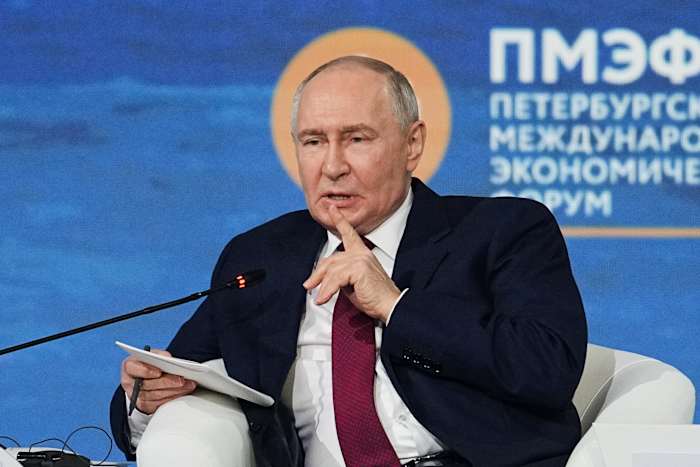
Vladimir Putin has flatly rejected Volodymyr Zelenskyy’s offer for direct, face-to-face negotiations, stating there is "no point" in such a meeting. This refusal is not merely a diplomatic snub. It is a calculated geopolitical strategy designed to deny the Ukrainian presidency political legitimacy while Moscow attempts to dictate terms through military leverage and back-channel pressure on Western allies. By freezing out Zelenskyy, the Kremlin aims to signal that it views Ukraine not as an independent sovereign actor, but as a Western proxy with whom direct terms cannot be meaningfully struck.
Surface-level analysis often chalks this up to simple stubbornness or wartime posturing. The reality runs much deeper.
For months, diplomatic circles have floated the idea of a summit between the two leaders to establish a baseline ceasefire. Zelenskyy has repeatedly signaled his readiness to sit across the table, calculation being that direct dialogue could strip away the layers of bureaucratic propaganda and force Moscow to state its baseline demands. Putin’s public, dismissive shrug effectively shuts that window. To understand why, one must look at the mechanics of Kremlin diplomacy, which historically disdains negotiating from any position other than total dictate.
The Legitimacy Trap
A primary reason for the refusal centers on the concept of political recognition. In the Kremlin's view, sitting down with Zelenskyy as an equal validates the current Ukrainian administration. Moscow has spent years constructing a narrative that portrays the Kyiv government as an illegitimate entity. A high-profile, televised summit would instantly shatter that illusion, cementing Zelenskyy’s status as the sole, rightful representative of the Ukrainian state on the global stage.
Putin prefers ambiguity. By refusing a meeting, he keeps the door open for a future scenario where Moscow might try to bypass the current Ukrainian administration entirely. The Kremlin prefers dealing with Washington or a fractured European coalition, operating under the assumption that Ukraine’s fate will ultimately be decided by its financial and military backers rather than the people living in Kyiv or Kharkiv.
This strategy carries significant risks for Russia. It solidifies Ukrainian resolve and unifies Western allies who see the snub as proof of Moscow's total lack of interest in a peaceful resolution. Yet, the Russian leadership appears willing to absorb that cost to maintain its ideological stance.
Military Realities Dictate the Diplomatic Timeline
Diplomacy rarely happens in a vacuum, divorced from the mud and steel of the battlefield. The timing of this rejection aligns precisely with Russia’s broader military calculus.
Kremlin Strategic Options:
├── Direct Talks with Kyiv (Rejected) -> Grants legitimacy to Zelenskyy
└── Protract the Conflict (Chosen)    -> Exhausts Ukrainian infrastructure
                                      -> Tests Western political endurance
Moscow believes time is on its side. By prolonging the conflict and refusing high-level diplomatic off-ramps, the Kremlin hopes to achieve several concrete objectives:
- Attrition of Ukrainian Resources: Constant pressure on Ukraine's energy grid and economy designed to force domestic discontent.
- Testing Western Political Will: Waiting out election cycles in the United States and Europe, hoping for shifts toward isolationism.
- Consolidation of Occupied Territories: Digging in defensive lines to turn temporary frontlines into permanent borders.
When a state believes its long-term position will improve by waiting, it has zero incentive to negotiate today. Putin sees "no point" because a negotiation right now would require compromise on territorial ambitions that he believes can still be secured through a protracted war of attrition.
The Failure of Back Channel Diplomacy
Public rejections often mask intense, private communications. While the public hears only the definitive "no," intelligence agencies and neutral third-party intermediaries—such as Turkey, Saudi Arabia, and the United Arab Emirates—have consistently tried to broker lower-level talks.
These back channels have occasionally yielded results, specifically regarding prisoner exchanges and grain corridors. However, translating these localized successes into a grand peace framework has proven impossible. The gap between the two sides remains an unbridgeable chasm. Ukraine demands the total withdrawal of Russian forces to its internationally recognized borders, while Russia insists on the recognition of its annexed territories as a precondition for any formal paperwork.
Because neither side is willing to blink on these core tenets, a leadership summit would yield nothing but a PR disaster for Moscow. If Putin met Zelenskyy and left without concessions, it would signal weakness to his domestic hardliners.
Beyond the Propaganda
We must look past the theatrical rhetoric coming out of Moscow's state television channels. The refusal to meet is not about a lack of preparation or scheduling conflicts. It is a structural rejection of the current international order.
By refusing to engage with Ukraine directly, Russia is attempting to rewrite the rules of modern sovereignty. It is an assertion that smaller nations do not possess the agency to negotiate their own survival; that their borders and leadership are merely chips to be traded between major empires. This is the underlying philosophy driving the Kremlin's current foreign policy.
Zelenskyy’s offers to meet will likely continue, served up as proof to the world that Ukraine remains the party seeking a rational exit from the violence. Moscow will likely continue to reject them, waiting for a moment when they believe they can dictate a surrender rather than negotiate a peace. The battlefield will continue to serve as the true arbiter of when, or if, these two men ever sit in the same room.