The mud in northern Europe has a memory. If you stand in the quiet forests outside Ādaži, Latvia, where the pine trees grow straight and the moss dampens the sound of your boots, you can almost hear the ghosts of the twentieth century whispering through the branches. For decades, this land was defined by what it lacked: a buffer, a shield, a guarantee that history would not repeat its darkest chapters.
Then came the mechanical roar. It was a sound that didn't belong to the past, but rather to a very deliberate, heavily armored future. If you found value in this piece, you might want to read: this related article.
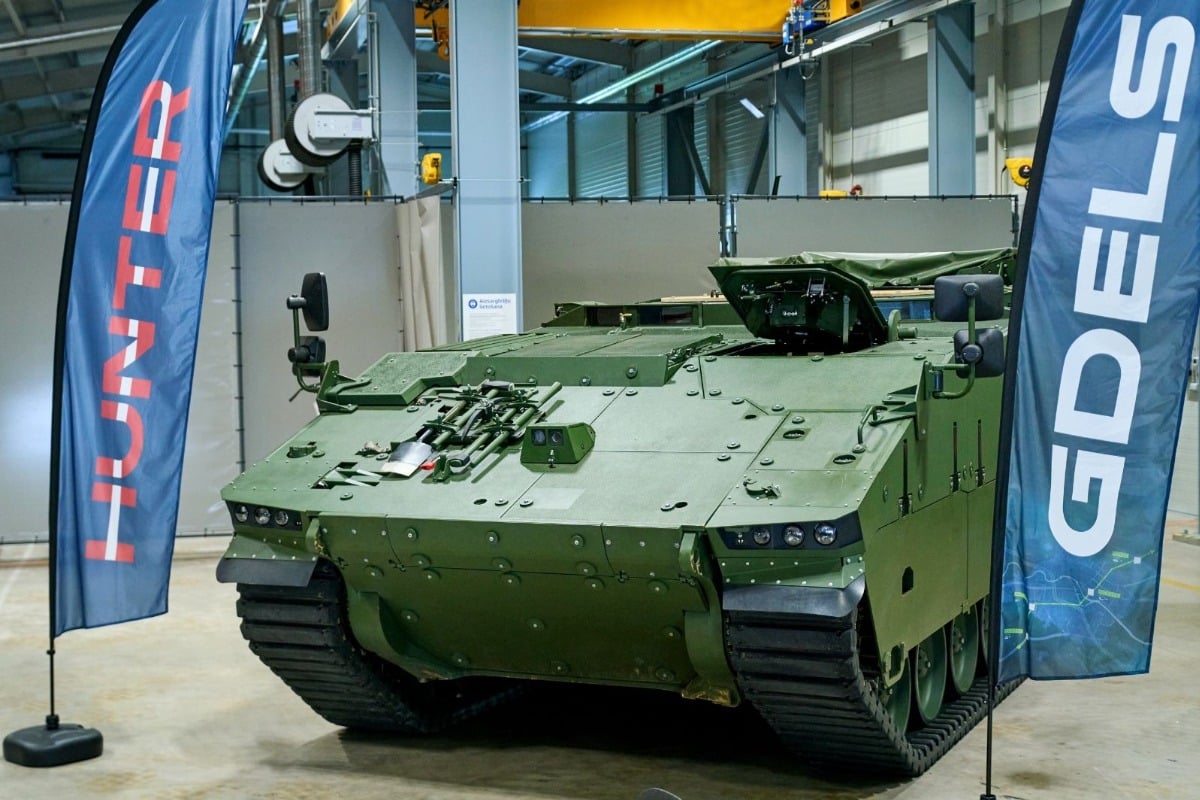
When Latvia officially took delivery of its first Hunter Infantry Fighting Vehicle, the international press treated it like a standard ledger entry. A line item in a defense budget. A transaction between governments and defense contractors. They listed the weight, the caliber of the cannon, and the dollar amounts. They missed the entire point.
Equipment is just steel and wires until it crosses a border that has spent generations feeling exposed. For the people who live along the Baltic crest, the arrival of this specific machine is not a footnote in a military journal. It is a profound shift in the psychological gravity of the region. For another angle on this event, see the latest coverage from NBC News.
The Weight of the Open Horizon
To understand why a single vehicle matters, you have to look at the geography through the eyes of a local farmer or a young lieutenant stationed near the eastern frontier. Latvia is beautiful, but it is flat. Its borders are lines drawn across meadows and rivers, offering few natural barriers to anyone who might wish to cross them uninvited. For years, defense strategy in this part of the world was plagued by an uncomfortable, unspoken reality: the concept of a tripwire.
The old thinking went like this. If an adversary crossed the border, the local forces would do their best to slow them down, acting as a human alarm system until larger, more distant allies could mobilize and launch a counteroffensive weeks or months later.
Imagine living in a house where the security system doesn't stop a burglar, but merely records the theft while you wait for the police to drive from three states away. It is an anxiety that seeps into the bones. It affects how communities plan, how businesses invest, and how parents look at their children sleeping at night.
The Hunter changes that equation entirely. It signals a transition from "tripwire defense" to "deterrence by denial." The goal is no longer to survive long enough to be rescued. The goal is to ensure that any attempt to cross the line is stopped cold at the threshold.
Inside the Hull
Let us step away from the abstract strategy and climb inside the machine itself.
Step onto the track. Pull yourself up past the sloped armor plate. The air inside a modern infantry fighting vehicle smells distinct: a mixture of hydraulic fluid, fresh paint, and the ozone scent of high-end electronics. It feels less like a traditional tank and more like a pressurized, mobile command center designed to survive an apocalypse.
Consider a young Latvian soldier. Let’s call him Juris. He grew up in a country that regained its independence in 1991, inheriting a military that relied on donated, secondhand gear and legacy systems left behind by a departing empire. For much of his career, Juris trained on vehicles that required constant maintenance, machines where the crew had to rely on basic optics and sheer grit to understand the battlefield.
Now, Juris sits in a digital cockpit.
The Hunter is a masterclass in situational awareness. It features an array of external cameras and sensors that feed data directly to the crew's displays, effectively making the thick steel walls transparent. In the old days, looking out of an armored vehicle meant squinting through a narrow glass periscope, seeing only a tiny, distorted slice of the world.
A crew today sees everything. They see through the smoke. They see through the pitch-black Baltic winter nights using advanced thermal imaging. They see threats kilometers away, long before those threats can see them.
The vehicle’s primary weapon, a formidable autocannon, is paired with an advanced fire control system that tracks targets automatically, even while bouncing across uneven terrain at fifty kilometers per hour. But the real lethality isn’t just the gun. It’s the network. The Hunter doesn’t operate in a vacuum; it acts as a digital node, sharing real-time battlefield data with artillery units, aircraft, and infantry squads on the ground.
When Juris looks at his tactical screen, he isn't just looking at his own square meter of the forest. He is looking at a unified, living map of the entire defense sector.
The Human Cost of Security
There is a temptation to romanticize machinery like this. The sleek angles, the camouflage paint, the raw horsepower. But anyone who has ever worn a uniform will tell you that technology is a burden as much as a blessing.
The arrival of the Hunter means a grueling, relentless cycle of training for the Latvian troops. This isn't a vehicle you learn to operate in a weekend. It requires mechanics who understand complex digital diagnostics, drivers who can handle a massive platform on treacherous ice, and commanders who can process a deluge of data in the heat of a simulated crisis.
The financial cost is equally real. Buying modern defense technology requires sacrifice. Every Euro spent on an infantry fighting vehicle is a Euro that cannot be spent on healthcare, education, or infrastructure. The citizens of Latvia know this. They pay the price willingly because they understand the alternative. They know that without a secure house, everything inside it is temporary.
This isn't about aggression. It is about creating a space where peace is normal, where a society can thrive without constantly looking over its shoulder.
The Changing Shadow on the Forest Floor
The true value of the Hunter isn’t measured by the rounds it fires in anger, but by the rounds it never has to fire at all. Deterrence is a quiet art. It is the art of being so visibly prepared, so undeniably capable, that the argument is settled before it ever begins.
As the first Hunter rolls through the training grounds of Ādaži, kickstarting a larger modernization effort that will reshape the Baltic defense landscape, the atmosphere in the region shifts. The horizon doesn't feel quite as vulnerable as it did yesterday.
The pine trees still stand straight in the cold northern air. The moss still dampens the sound of footsteps. But beneath the canopy, there is a new reality. A heavy, iron certainty that the dirt beneath those trees belongs to the people who stand upon it, and they now possess the teeth required to keep it that way.