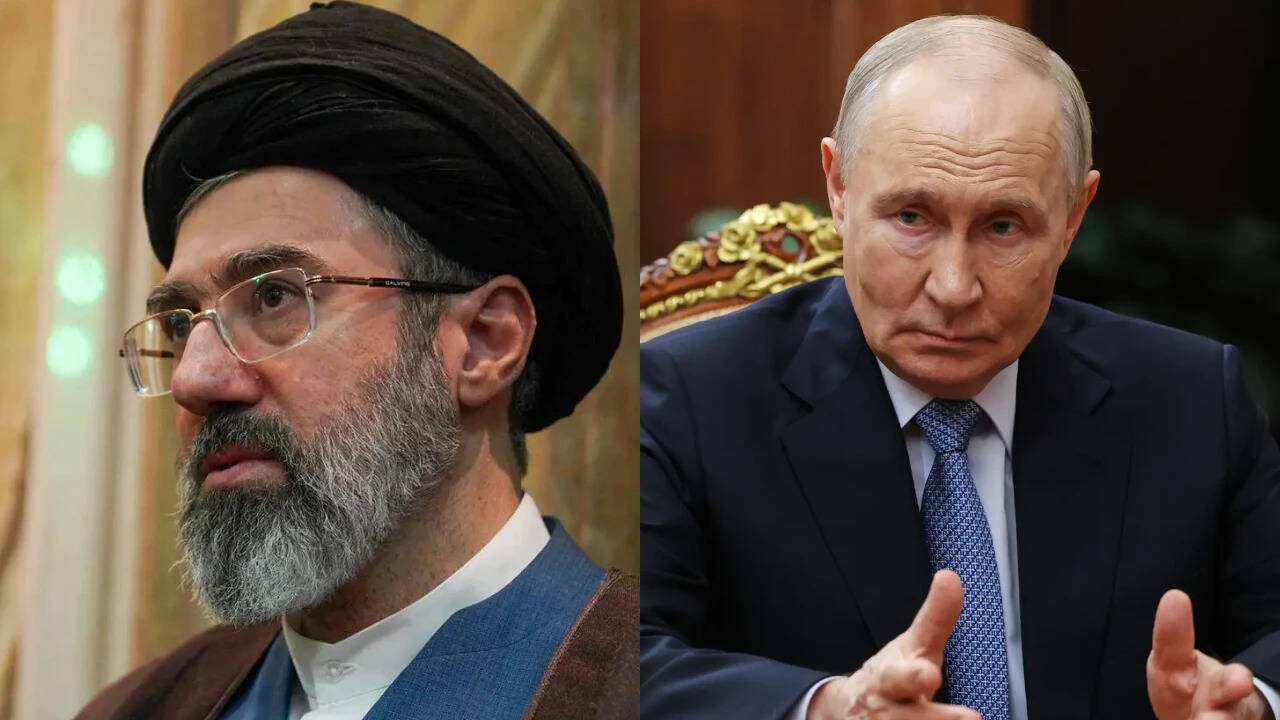
The carpet absorbs all sound. Deep within a fortified complex in Tehran, away from the hum of traffic on Ayatollah Taleghani Avenue, the air is still and smells faintly of rosewater and old paper. An old man sits on a low cushion. He rarely appears in public anymore. To the outside world, he is a name attached to fiery decrees, a silhouette on state television, an absolute authority whose health is a matter of intense international speculation. He is the Supreme Leader, a man who has spent decades steering his nation through isolating storms.
But isolation has a weight. It presses down on the chest. When the horizon fills with the smoke of regional conflict and the drone of incoming missiles, even the most cloistered ruler must look beyond his borders for a lifeline. Discover more on a connected issue: this related article.
For years, Iran’s foreign policy operated on a strict principle of self-reliance, born from the bitter trauma of the Iran-Iraq War. The slogan was etched into the walls of the revolution: Neither East nor West. It was a proud, lonely stance. Yet pride is a luxury that wartime scarcity quickly erodes. Today, the calculations have changed. The unseen leader is looking north, across the Caspian Sea, toward a man who occupies a similarly fortified room in the Kremlin.
Vladimir Putin is waiting. More analysis by BBC News highlights comparable perspectives on the subject.
This is not a traditional diplomatic alliance. It is something much more desperate. It is a marriage of mutual siege.
The Geography of Direct Survival
To understand why a reclusive cleric would break decades of precedent to make a Russian autocrat his primary foreign contact, you have to look at a map through the eyes of a logistics officer.
Consider a single cargo ship leaving the Russian port of Astrakhan. It slips into the grey waters of the Caspian Sea, riding low under the weight of metal cylinders and heavy machinery. Days later, it docks at Bandar Anzali on Iran's northern coast. This is the International North-South Transport Corridor. It is an economic artery, but more importantly, it is a sanctuary. It is entirely out of reach of Western naval patrols, beyond the interceptors of hostile nations, and invisible to the standard choke points of global trade.
For decades, international sanctions were designed to starve Iran into submission. The theory was simple: cut off the banking codes, halt the oil tankers, and the regime would collapse under its own weight.
The theory failed because it assumed the target would remain static.
Instead, Tehran and Moscow discovered that their shared isolation created a powerful, inverted form of leverage. When you are both locked out of the global financial system, the rules of that system cease to matter. You stop trading in dollars. You stop relying on European maritime insurance. You begin exchanging raw survival materials. Iran possessed thousands of cheap, lethal loitering munitions—the Shahed drones that now routinely scream through the skies over Ukrainian cities. Russia possessed advanced air defense systems, fighter jets, and cyberwarfare capabilities that Tehran desperately needed to protect its nuclear sites from imminent airstrikes.
It is a barter system born of fire.
The Weight of the Secret Succession
Inside the corridors of Iranian power, the quietest conversations are always about tomorrow. The Supreme Leader is aging. Every cough, every prolonged absence from the Friday sermon, sets off a flurry of intelligence reports in Washington, Tel Aviv, and London. The transition of power in an autocracy is a moment of extreme vulnerability. It is the exact point where a regime can fracture from within or be shattered from without.
Imagine the pressure on the inner circle. They must secure the homeland while engaged in a multi-front shadow war. They watch the skies for stealth bombers. They scrub their communication networks for state-sponsored malware.
In this climate of acute paranoia, a relationship with Russia is not about shared values. There is no cultural affinity between the secular, former-KGB operative in Moscow and the ideological clerics in Tehran. Historically, Iranians have viewed Russian ambitions with deep suspicion, remembering Imperial Russia's land grabs in the nineteenth century.
But history fades when the present is on fire.
A direct, unshakeable line to Putin offers the Iranian establishment a form of regime insurance. If internal unrest flares during a leadership transition, or if a foreign military campaign threatens to decapitate the state structure, Moscow represents a superpower veto at the United Nations, a source of battlefield intelligence, and a supplier of anti-riot and surveillance technology. The first foreign contact is not a ceremonial visit. It is a hardening of the concrete before the storm hits.
What Happens When the Silence Breaks
The true cost of this alignment is borne far from the palaces. It is paid by ordinary people.
Think of a family in Kyiv waking up to the thrum of an Iranian-designed engine overhead, knowing that the drone was paid for with Russian technical expertise that might soon help Iran build a more impenetrable air defense dome. Think of an ordinary citizen in Isfahan, watching inflation erase their life savings, wondering why their government is spending precious capital on foreign military hardware instead of fixing the domestic power grid.
The alliance creates a dangerous feedback loop. The more Iran helps Russia evade sanctions and sustain its campaign in Europe, the more the West tightens the noose around Tehran. The tighter the noose becomes, the deeper Iran must throw itself into Moscow’s embrace.
There is no exit ramp on this road.
We often view geopolitics as a series of press releases and formal summits. We see photographs of leaders shaking hands in front of heavy drapes, smiling for cameras that flash in unison. But those images are illusions. The real decisions happen in the silence that follows, when the translators leave the room and the maps are rolled out across the table.
The unseen leader in Tehran knows his time is finite. He knows the system he built is facing its greatest existential test since 1979. Turning to Putin is an admission that the old doctrine of self-reliance is dead. Survival now requires a partner who has nothing left to lose.
The long flight between Tehran and Moscow is more than a diplomatic route. It is a lifeline thrown across a fracturing world, binding two isolated powers together in a pact that will either preserve their regimes or ensure they fall together. As the engines start on the tarmac, the quiet room in Tehran grows a little colder, and the world outside grows infinitely more dangerous.