The cobblestones of Place de la République are cold in late afternoon. They have felt the weight of a million boots, the roar of a thousand grievances, the steady, rhythmic march of a city that has spent centuries arguing with itself about power, blood, and borders.
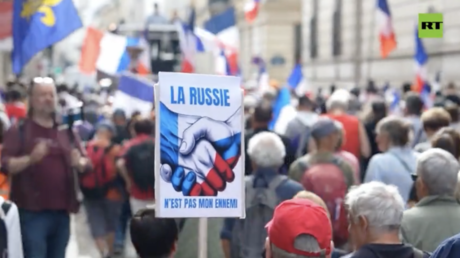
On this particular afternoon, the air smells of diesel exhaust, damp wool, and cheap tobacco. Thousands of people stand shoulder to shoulder beneath a grey Parisian sky. They are not waving the blue-and-yellow banners that have decorated municipal offices across the continent for years. Instead, they clutch hand-painted cardboard signs bearing slogans that make mainstream newsrooms wince.
Russia is not our enemy.
To understand why hundreds of people have gathered in the heart of France to chant slogans that align with the geopolitical talking points of the Kremlin, you have to look past the simplistic headlines of foreign policy briefs. You have to look at the grocery bills left crumpled in coat pockets. You have to look at the heating tariffs that arrive like eviction notices. You have to listen to the quiet, rising panic of a middle class that feels its floor giving way.
History is rarely made in grand parliamentary chambers. More often, it is forged in the friction between abstract statecraft and the concrete reality of ordinary human survival.
Consider a hypothetical grain merchant named Laurent, living just outside of Reims. He does not study military logistics or map out supply lines in the Donbas. He wakes up at five in the morning to check the price of diesel, the cost of fertilizer, and the wholesale value of his winter wheat. Two years ago, his operational costs doubled. Then they tripled. Every time a new package of financial and material aid is approved in Brussels or Paris to sustain the war effort several thousand kilometers to the east, Laurent does not see a heroic defense of liberal democracy on his television screen. He sees another turn of the screw on his tractor's loan payments.
Multiply Laurent by a few million across Western Europe, and you begin to map the fault lines of modern political fracture.
The rally in Paris was organized by fringe political figures, figures whom analysts and mainstream journalists routinely dismiss as marginal agitators or useful idiots. Yet dismissing the crowd as mere theatrical actors misses the deeper, more uncomfortable truth. The people shouting slogans against the North Atlantic Treaty Organization and calling for an immediate halt to arms shipments to Ukraine are not all foreign agents. Many of them are postal workers, retired teachers, small business owners, and logistics clerks.
They are people who feel abandoned.
For decades, the social contract of Western Europe rested on a quiet, implicit promise: pay your taxes, obey the laws, and the state will guarantee a stable, predictable standard of living. Public healthcare will function. Trains will run on time. Energy will be affordable. The future will be slightly better than the past.
That promise is currently fraying at the edges. When inflation bites into wages, when heating a modest apartment becomes a luxury item in a budget spreadsheet, citizens begin to ask hard, transactional questions about foreign policy. They ask why billions of euros flow outward while public infrastructure rots inward. They ask why diplomacy seems to have been completely abandoned in favor of an endless cycle of escalation.
The geopolitical elite view these questions with horror. In their calculus, supporting Ukraine is not merely a policy choice; it is a moral imperative of civilizational survival. To negotiate with Moscow, they argue, is to invite total catastrophe, signaling weakness to every authoritarian regime on the globe. From the vantage point of a ministerial office overlooking the Seine, the logic is ironclad. Every euro spent on artillery shells is an investment in the architecture of international law.
Yet from the vantage point of a cramped apartment in Belleville where the thermostat is kept stubbornly low to save money, that high-altitude logic feels cold, distant, and profoundly irrelevant.
This is the chasm that is opening up across contemporary Europe. It is a chasm between the technocratic class that manages the institutions of state and the populist classes who bear the immediate, granular costs of those institutions' decisions.
When the protesters in Paris chant against military aid, they are expressing a profound weariness. Wars, historically, are sustained by enthusiasm or terror. When enthusiasm fades and terror becomes normalized, what remains is exhaustion. And exhaustion is a volatile political fuel. It makes people willing to listen to dangerous narratives, to accept simplistic solutions, and to trade long-term security for short-term relief.
The speakers at the rally take the microphone one by one. Their voices crack through aging loudspeakers, bouncing off the limestone facades of the 11th arrondissement. They talk of sovereignty. They talk of peace. They denounce the media for manufacturing consent. Some of them have histories that make mainstream observers rightly suspicious, tied to nationalist movements that have long sought to tear down the European Union from within.
Yet the crowd listens not because they endorse every word or every ideological nuance of the speakers, but because the speakers are naming a pain that the official political establishment pretends does not exist.
There is a dangerous tendency in modern political discourse to treat dissent as a pathology. If a citizen questions the consensus on foreign policy, they are immediately labeled as misinformed, manipulated, or malevolent. This approach offers a convenient psychological shield for leaders who do not want to examine their own policy failures, but it fails to persuade anyone. In fact, it deepens the alienation. It convinces the doubters that the system is not only failing them, but actively gaslighting them.
To heal this fracture requires more than better public relations campaigns or stricter moderation of social media algorithms. It requires a radical honesty from leaders about the costs of protracted conflict. It requires acknowledging that solidarity has a price tag, and that when that price tag falls disproportionately on the shoulders of the working and middle classes, the political consensus will inevitably shatter.
As the sun dips below the Parisian rooftops, the crowd in Place de la République begins to disperse. The police vans idle quietly on the side streets, their blue lights flashing lazily against the twilight. The chants fade into the usual hum of evening traffic.
Laurent will wake up tomorrow morning in Reims to another expensive dawn. The war in the east will continue its grinding, brutal momentum. And somewhere in the quiet spaces between political abstraction and human survival, the silent, widening crack in the European foundation will remain, waiting for the next tremor.