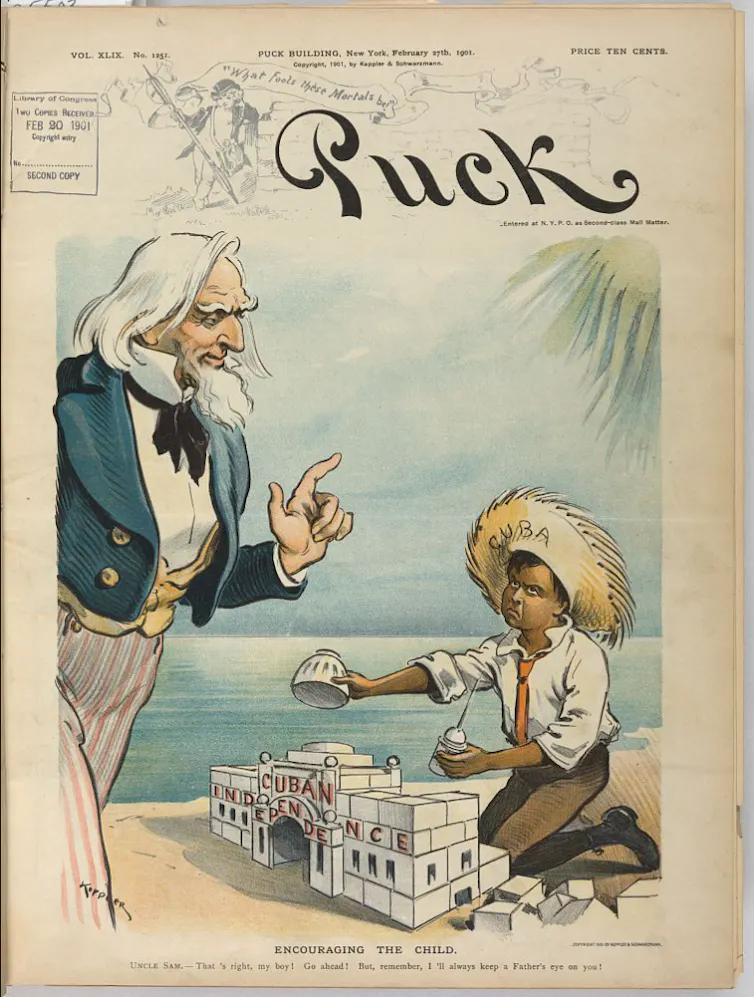
The United States maintains a sixty-year fixation on a Caribbean island of eleven million people because Cuba represents the ultimate unfinished chapter of American hegemony. While the rest of the world views the island as a struggling socialist experiment or a sun-drenched tourist destination, Washington treats it as a persistent domestic political crisis and a symbolic frontier of the Monroe Doctrine. This obsession is not rooted in modern military threats or economic competition, but in a self-perpetuating cycle of electoral math in Florida, historical embarrassment, and the rigid inertia of bureaucratic policy. To understand why the U.S. remains locked in a standoff with Havana while trading freely with communist Vietnam, one must look past the rhetoric of democracy and examine the machinery of American power that refuses to let the 1960s die.
The Florida Strait Logic
The most immediate driver of American policy toward Cuba is not found in the State Department, but in the voting booths of Miami-Dade County. For decades, a highly organized and financially potent bloc of Cuban-Americans has effectively held a veto over Caribbean diplomacy. This is a matter of practical electoral survival. Candidates from both parties have long believed that any softening toward the Cuban government would result in losing Florida, a state that until recently was the ultimate "swing" prize in presidential elections.
This creates a feedback loop. Politicians promise hardline measures to secure votes; once in office, they codify those measures into law, making them nearly impossible to undo without a massive political cost. The Helms-Burton Act of 1996 took the power to lift the embargo away from the President and handed it to Congress, ensuring that any change in direction requires a consensus that polarized American politics can no longer produce. It is a policy trapped in amber, preserved by the fear of a specific demographic’s wrath.
The Monroe Doctrine in the Twenty First Century
Beyond domestic politics, the obsession stems from a deep-seated geopolitical ego. Since 1823, the United States has viewed the Western Hemisphere as its exclusive sphere of influence. Cuba’s revolution in 1959 was more than a change in government; it was a public defiance of American regional authority just ninety miles from Key West.
The U.S. has spent over a century ensuring that no foreign power gains a foothold in the Americas. When Cuba invited the Soviet Union to station missiles on its soil in 1962, it validated the darkest fears of the American defense establishment. That trauma remains the foundational DNA of the U.S. Southern Command. Even though the Soviet Union has been gone for over thirty years, the presence of Russian intelligence ships or Chinese infrastructure projects in Cuba triggers an immediate, visceral reaction in Washington. It is viewed as a breach of the "neighborhood watch," a crack in the wall of American continental security that must be patched at any cost.
The Double Standard of Communist Trade
If the American goal were truly about the collapse of one-party communist states, the U.S. would not be the primary trading partner of Vietnam. The inconsistency is glaring. The U.S. fought a bloody, protracted war against Vietnamese communists, yet today the two nations share a "Comprehensive Strategic Partnership."
The difference lies in utility. Vietnam serves as a strategic counterweight to Chinese expansion in the Pacific. Cuba, conversely, offers no such strategic "bribe" to the American interest. Because Cuba is small and lacks massive manufacturing hubs or rare earth minerals, there is no powerful corporate lobby pushing for normalization. In the absence of a "Business Case for Cuba," the ideological hawks and the Florida lobbyists face zero resistance from the private sector. The embargo remains because it is the path of least resistance for a government that finds it easier to maintain a failed status quo than to explain a new approach to a skeptical public.
The Sanctions Industry
We must also acknowledge the "sanctions industrial complex." Over sixty years, a massive infrastructure of enforcement has grown within the Treasury and Commerce Departments. Thousands of man-hours and millions of dollars are dedicated to tracking Cuban financial transactions and preventing the sale of American goods to the island.
When a policy exists for this long, it creates its own economy. Law firms, compliance officers, and lobbyists make a living navigating the complexities of the Cuban Assets Control Regulations. This bureaucracy does not want the policy to change because the policy is the reason for its existence. It is easier to add a name to a restricted list than it is to dismantle a regulatory framework that has become a permanent feature of the American administrative state.
The Weaponization of Migration
Migration is the one area where Cuba possesses genuine leverage over the United States, and it is a leverage that Washington fears. Whenever tensions peak, the Cuban government has historically used the threat of mass migration—opening the ports as they did during the Mariel boatlift in 1980 or the Rafter crisis of 1994—to force the U.S. to the negotiating table.
A sudden collapse of the Cuban state, which the embargo theoretically seeks to achieve, would be a nightmare scenario for American border security. The U.S. is in the paradoxical position of trying to starve the Cuban economy while simultaneously fearing the inevitable result of that starvation: a humanitarian exodus. This tension results in a policy of "controlled pressure"—keeping the island under enough stress to satisfy political donors, but not so much that the rafters start arriving by the tens of thousands during an election year.
The Failure of the Pressure Cooker Theory
The underlying theory of the U.S. embargo is the "pressure cooker" model. The idea is that by denying the island resources, the population will eventually rise up and overthrow the government. History has proven this theory wrong in nearly every instance it has been applied, from North Korea to Iran.
In Cuba, the embargo has actually provided the ruling party with a permanent excuse for its own economic mismanagement. Every failure of the state—from power outages to food shortages—is blamed on the "blockade." By maintaining the obsession, the U.S. gives the Cuban government a powerful nationalist narrative: they are the David fighting the northern Goliath. This allows the regime to frame internal dissent as treasonous collaboration with a foreign enemy.
The Intelligence Obsession
Cuba remains a primary focus of the American intelligence community for reasons that are often classified but easily inferred. The island sits atop some of the most sensitive undersea data cables in the world. Its location makes it an ideal "listening post" for signals intelligence.
For the CIA and the NSA, Cuba is not just a country; it is a permanent aircraft carrier parked at the mouth of the Gulf of Mexico. Even if the political landscape changed tomorrow, the military desire to control or neutralize the island as a platform for foreign intelligence gathering would remain. This isn't about human rights; it's about the physics of signals and the geography of the Caribbean Basin.
Breaking the Cycle
Any attempt to shift this policy requires a level of political courage that is currently absent in Washington. The brief "thaw" under the Obama administration showed that the American public is largely indifferent to or supportive of normalization, but that experiment was easily reversed by the following administration to satisfy the Florida electorate.
The U.S. is not obsessed with Cuba because the island is a threat. It is obsessed because Cuba is a mirror that reflects the limitations of American power. It is a reminder that a small neighbor can survive decades of isolation and remain defiant. Until the U.S. can reconcile its historical desire for regional dominance with the reality of a multi-polar world, the policy will remain a relic—a ghost of the Cold War haunting the modern age.
The real cost of this obsession isn't measured in diplomatic tension, but in the stalled potential of the Caribbean as a whole. As long as the U.S. treats Cuba as a battlefield rather than a neighbor, the region remains fractured, leaving an opening for other global powers to step in and fill the void the Americans have left by focusing on the past rather than the future.