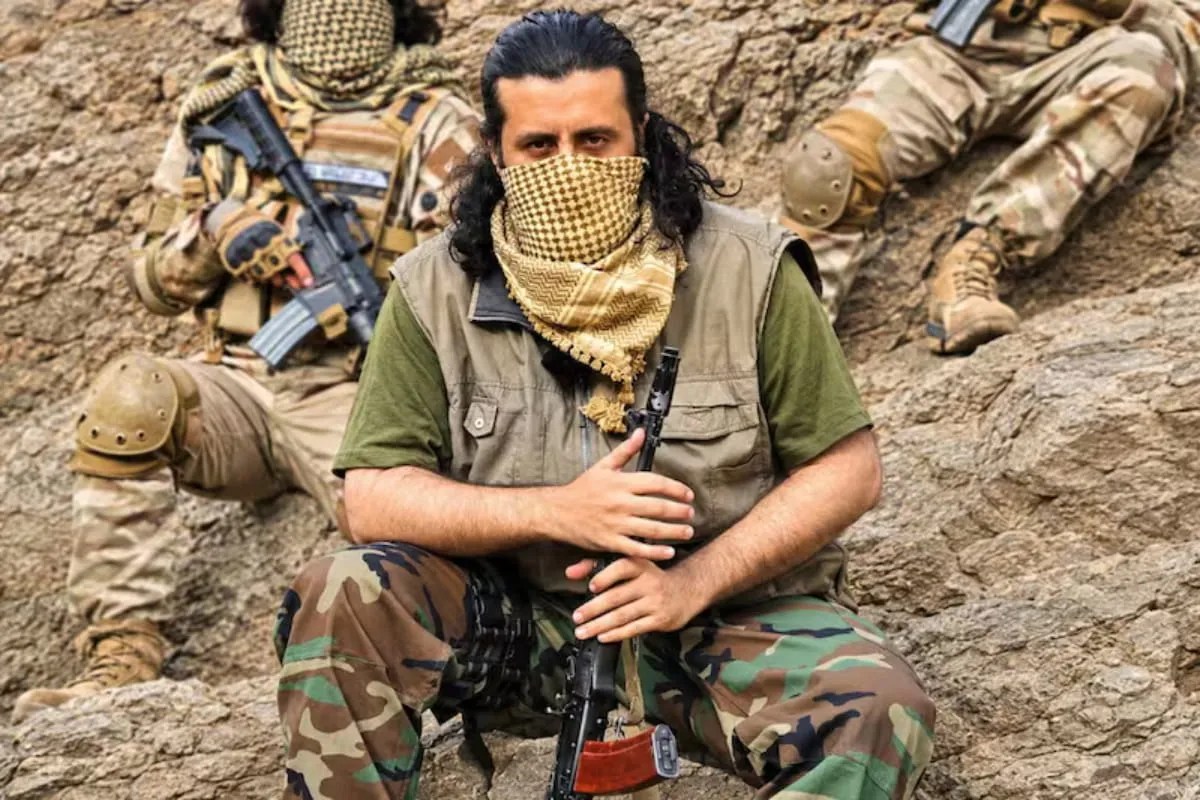
The reported elevation of former Pakistan Army Captain Rehman Gul to the position of Commander-in-Chief of the Baloch Liberation Army (BLA), as circulated in regional media narratives, represents a structural shift in the organizational evolution of the Baloch insurgency rather than a routine personnel change. According to Indian media reports—specifically a widely shared Hindi-language dispatch framing the development as a direct escalation of pressure on Pakistan's Chief of Army Staff, General Asim Munir—the transition signals the integration of formal state military doctrine into an irregular militant network. Analyzing this development requires stripping away sensationalist framing to examine the operational mechanics of leadership transitions within non-state armed groups, the strategic value of defected officer cadres, and the counter-insurgency dilemmas confronting Rawalpindi.
To understand the operational significance of a former commissioned officer assuming command of a separatist organization, one must first distinguish between verified operational realities and unverified media claims. Media outlets in New Delhi have reported that Captain Rehman Gul, identified as a former officer of the Pakistan Army who defected to the insurgency, has taken over top operational command of the BLA. At the same time, independent verification of internal BLA command hierarchies remains inherently constrained by the clandestine nature of militant networks, fragmented faction structures—such as the split between the Bashir Zeb faction and the Hyrbyair Marri-aligned groups—and ongoing information warfare between state intelligence apparatuses and insurgent media wings like Hakkal. Treating the reported appointment as an analytical baseline allows strategists to evaluate the systemic impact such a command profile exerts on insurgent capabilities and state counter-measures. Meanwhile, you can find similar stories here: Inside Prince Harry's Secret Trip to Lviv and the Brutal Reality Behind Ukraine's Invictus 2027 Trials.
The Structural Value of Defected Officer Cadres
In asymmetric warfare theory, insurgencies typically suffer from an organizational ceiling. Guerrilla fighters excel at localized ambushes, improvised explosive device (IED) deployment, and terrain exploitation, yet they frequently fail to scale operations due to deficits in staff planning, logistics synchronization, and formal command-and-control (C2) architecture. When an insurgent group absorbs a formally trained military officer, three primary operational bottlenecks are resolved.
Doctrinal Mirroring and Counter-Doctrine Exploitation
A former Pakistan Army captain possesses intimate familiarity with the standard operating procedures (SOPs), patrolling intervals, quick reaction force (QRF) response times, and communications protocols of regular infantry and Frontier Corps (FC) units deployed across Balochistan. Instead of relying on trial-and-error attrition, an officer-led insurgency designs operations specifically to exploit predictable institutional reflexes. When a state convoy is ambushed, standard military doctrine dictates specific flanking maneuvers and air-support call-in procedures; a commander trained at the Pakistan Military Academy (PMA) Kakul anticipates those exact responses and sets secondary kill zones along the relief corridors. To explore the bigger picture, we recommend the detailed analysis by BBC News.Transition from Tactical Harassment to Operational Campaigning
Traditional tribal or ethno-nationalist insurgencies operate on decentralized, episodic timelines dictated by local grievance cycles or seasonal weather patterns. Formal military training introduces campaign design—linking disparate tactical strikes across districts like Nushki, Panjgur, Mach, and Gwadar into a coherent operational sequence aimed at exhausting state garrison capacity. This shifts the insurgency from a policing problem to a theater-level military challenge.Institutional Credibility and Recruitment Signaling
Within the socio-political ecosystem of Balochistan, the defection of an ethnic Baloch or sympathetic officer from the state's premier institution serves as a potent psychological instrument. Insurgent propaganda networks frame such defections as proof of internal fracture within the state apparatus, lowering the psychological barrier for younger, educated demographics to join militant ranks alongside traditional tribal recruits.
Deconstructing the Threat Matrix for Pakistan's Military Leadership
Regional commentary frequently reduces complex security crises to personalized contests between individual commanders, such as framing the BLA's command shift solely as a personal headache for General Asim Munir. In institutional reality, the pressure falls on the General Headquarters (GHQ) in Rawalpindi as a systemic resource-allocation problem across multiple simultaneous theaters.
The Pakistan Army currently manages a multi-front security posture. Along the western Durand Line, the resurgence of Tehrik-i-Taliban Pakistan (TTP) following the 2021 regime change in Kabul demands continuous kinetic operations in Khyber Pakhtunkhwa and the merged tribal districts. Simultaneously, conventional deterrence along the eastern Line of Control requires fixed troop deployments and heavy armored readiness. Balochistan—comprising roughly 44 percent of Pakistan's landmass while housing a sparse, widely dispersed population—presents an acute force-to-space ratio problem.
The Force-to-Space Deficit
Counter-insurgency doctrine generally requires a high ratio of security personnel to local population to hold territory effectively. In Balochistan, vast desert and mountainous terrain separates isolated population centers and critical infrastructure nodes. When an insurgent commander with formal staff training prioritizes high-visibility, coordinated raids on fortified installations—similar to the complex assaults witnessed in Mach or Gwadar in recent years—the military faces a stark operational dilemma:
- Static Defense Trap: Reinforcing every highway, railway line, and garrison disperses troops into vulnerable static outposts, surrendering the tactical initiative to mobile insurgent cells.
- Offensive Sweep Limitations: Concentrating forces for large-scale clearance operations leaves economic corridors exposed, allowing insurgents to melt across porous borders into Sistan-Baluchestan in Iran or southern Afghanistan, only to re-infiltrate once the sweep concludes.
Economic Chokepoints and the Cost Function of Instability
The strategic stakes in Balochistan extend beyond domestic territorial control because the province anchors Pakistan's primary geo-economic lifeline: the China-Pakistan Economic Corridor (CPEC) and the deep-water port of Gwadar. Insurgent leadership trained in strategic targeting understands that an asymmetric force does not need to defeat a state army on the battlefield; it only needs to raise the cost of capital and security to unsustainable levels.
This operates through a measurable cost function affecting state solvency:
- Direct Security Overhead: Every kilometer of road construction, mining operation (such as the Reko Diq copper-gold project), or port expansion requires dedicated security divisions, armored transport, and intelligence screening, inflating project budgets and draining the federal fiscal deficit.
- Diplomatic Friction and Capital Flight: High-profile attacks targeting foreign engineers and technical personnel create acute friction between Islamabad and Beijing. When insurgent operations demonstrate sophisticated intelligence gathering and tactical coordination, foreign investors demand sovereign security guarantees that the state struggles to underwrite.
- Internal Political Alienation: Heavy-handed kinetic responses—enforced disappearances, collective checkpoints, and communication blackouts—alienate the civilian population, driving local grievances into the arms of the insurgency and validating the separatist narrative.
Evaluating the Limitations of the Defector-Commander Hypothesis
Rigorous intelligence analysis requires accounting for the constraints and vulnerabilities inherent in elevating a former state officer to the apex of an insurgent hierarchy. While media narratives emphasize the threat multiplier effect, operational reality introduces severe friction points that can degrade insurgent cohesion.
First, factional friction and legitimacy deficits frequently plague hybrid militant organizations. The Baloch insurgency is not a monolith; it encompasses secular ethno-nationalist cadres, tribal sardars, and ideological hardliners who have spent decades fighting in rugged terrain. The sudden elevation of an individual perceived as an outsider—or someone previously embedded within the very state apparatus the movement opposes—can trigger internal distrust, intelligence paranoia, and operational splintering. Rival factions often leak location data or withhold logistical support when command authority is contested.
Second, signals intelligence (SIGINT) and human intelligence (HUMINT) exposure increases substantially when a former military officer assumes command. Intelligence agencies such as the Inter-Services Intelligence (ISI) and Military Intelligence (MI) maintain exhaustive psychological profiles, family network maps, service records, and behavioral baselines for every commissioned officer who passes through their ranks. Unlike an anonymous mountain guerrilla whose background is opaque to state analysts, a former captain's command style, decision-making biases, and personal vulnerabilities are thoroughly documented in GHQ archives. This familiarity allows state intelligence to predict operational patterns and target support networks with high precision.
Third, logistical scalability remains bounded by geography and external state tolerance. Even the most brilliant tactical commander cannot manufacture heavy weaponry, night-vision optics, or secure satellite communications out of thin air. The BLA's operational tempo depends heavily on illicit arms markets in post-war Afghanistan and cross-border sanctuaries. Any diplomatic rapprochement between Islamabad and Tehran, or shifting enforcement priorities by the Taliban authorities in Kabul, can rapidly constrict the supply lines required to sustain complex, officer-led campaigns.
Operational Mechanics of Modernized Insurgent Tactics
When former military professionals integrate into irregular formations, the tactical signature on the ground shifts in observable ways. Analysts tracking Balochistan's security incidents look for specific indicators that distinguish an officer-planned operation from a standard guerrilla raid:
- Multi-Axis Synchronized Assaults: Rather than a single hit-and-run ambush, targets are isolated simultaneously through roadblocks, diversionary mortar fire on adjacent posts, and fiber-optic cable cuts to sever communications before the main assault team breaches the perimeter.
- Integration of Commercial Dual-Use Technology: Modern insurgent commanders utilize commercial quadcopter drones for real-time overhead reconnaissance, artillery spotting, and propaganda documentation, compensating for the lack of state air power.
- Calculated Media Exploitation: Operations are timed and filmed specifically to maximize psychological impact during critical diplomatic visits, international summits, or domestic political crises in Islamabad, weaponizing the information space to amplify physical violence.
Strategic Imperatives for Counter-Insurgency Adaptation
If the command structure of the Baloch Liberation Army has indeed internalized formal military planning through defected officers, conventional attrition warfare will yield diminishing returns for Pakistan's security establishment. Relying exclusively on kinetic sweeps and checkpoint expansion plays directly into an insurgent strategy designed to overstretch state forces and deepen civilian alienation.
To neutralize the operational advantage of a formally trained insurgent command, Rawalpindi and Islamabad must execute a three-part structural recalibration:
- Shift from Static Garrisoning to Intelligence-Led Surgical Interdiction: Dismantle vulnerable, isolated Frontier Corps checkpoints that serve as easy targets for synchronized raids. Reallocate personnel into agile, intelligence-driven special operations units backed by persistent drone surveillance to target the command-and-control nodes and logistics hubs of the insurgency rather than chasing decentralized foot soldiers.
- Exploit Institutional Knowledge of the Defected Cadre: Task dedicated counter-intelligence cells with building predictive behavioral models based on the former officer's academy training, past postings, and known associates, turning their institutional background from an insurgent asset into a targeting liability.
- Decouple Political Grievances from Militant Recruitment: Kinetic operations cannot succeed in a political vacuum. Addressing forced disappearances, restoring provincial administrative autonomy, and ensuring transparent local revenue sharing from mega-projects like Reko Diq and Gwadar are essential to starving the insurgency of its domestic support base and halting the steady flow of educated youth into militant ranks.


