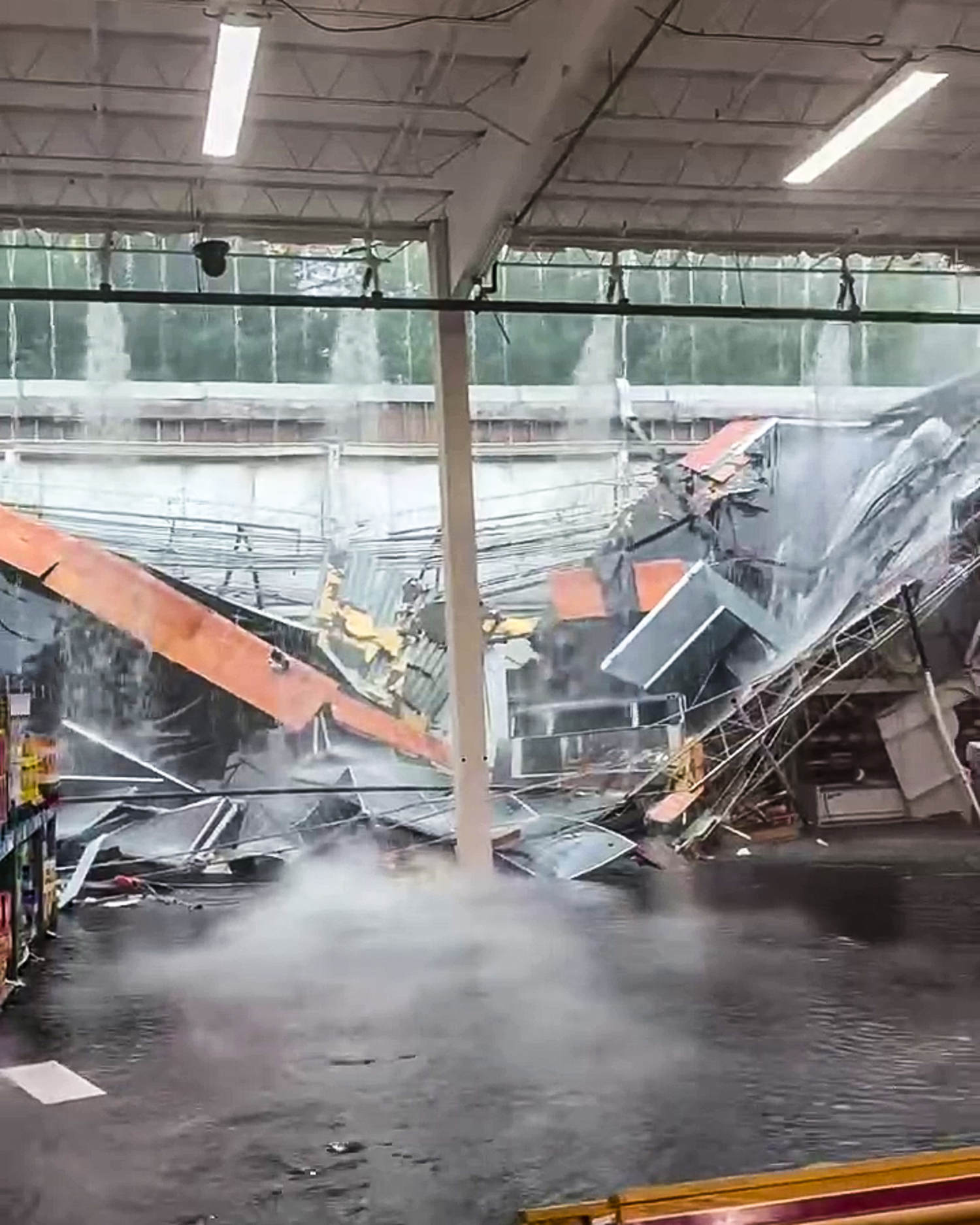
Every time a commercial flat roof caves in during a storm, the corporate PR machine wheels out the exact same script. They blame an act of God. They call it unprecedented rainfall. They point at the sky and pretend a standard low-pressure system was a once-in-a-century anomaly that no building could possibly survive.
The media swallows it whole. When a BJ’s Wholesale Club roof failed in New Jersey under heavy rain, the headlines immediately framed it as a weather disaster.
That narrative is a lie.
Heavy rain does not destroy a properly designed, properly maintained commercial building. Water is heavy, yes. A single inch of water over an acre of roof weighs roughly 113 tons. But commercial building codes already account for this. Engineers design these structures to handle predictable live loads, dead loads, and environmental stressors.
When a roof collapses, the weather is simply the trigger that pulls the pin on years of systemic corporate negligence, value engineering, and deferred maintenance. The collapse did not start when the clouds opened up over New Jersey. It started years ago in a corporate boardroom when a chief financial officer decided to slash the facilities budget to hit a quarterly earnings target.
The Myth of the Flat Roof Weather Anomaly
Commercial real estate has a dirty secret: large-format retail boxes are engineered down to the absolute absolute minimum safety margins allowed by local law. This process is euphemistically called value engineering. In reality, it means stripping out structural redundancy to save a few dollars per square foot during construction.
A typical big-box store utilizes a wide-span steel joist system topped with a corrugated steel deck, rigid insulation, and a single-ply rubber or plastic membrane. It is cheap. It is fast to build. And it turns the top of the building into a giant, flat swimming pool.
Because these roofs are flat, they rely entirely on active drainage systems to keep from collapsing under their own weight. If a roof has a slight slope, gravity handles the runoff. If a roof is flat, gravity works against you. The water accumulates.
This triggers a mechanical phenomenon known as structural ponding.
Imagine a scenario where a couple of primary roof drains become clogged with leaves, plastic bags, or debris because the store skipped its biannual roof inspection. When a heavy downpour hits, the water cannot escape. It begins to pool in the lowest spots of the roof deck.
As the water pools, its immense weight causes the steel joists beneath it to deflect downward. This deflection creates a deeper depression in the roof. A deeper depression invites more water to flow into that exact spot. More water means more weight, which causes deeper deflection, which pulls in even more water.
This is a runaway, compounding failure loop. The steel does not fail because the rain was historic. The steel fails because the drainage system was neglected, allowing a localized pool of water to exceed the ultimate load capacity of the joist system. Blaming the rain for a ponding failure is like blaming the final drop of water that overflows a glass. The problem is that the glass was already full.
How Corporate Accounting Dictates Structural Integrity
To understand why these failures happen, you have to look at the balance sheet, not the blueprint. I have spent decades analyzing asset management strategies in commercial real estate, and the pattern is identical across the entire retail sector.
Corporate accounting treats facility maintenance as a cost center. When a retail chain faces squeezed margins, high inflation, or fierce e-commerce competition, executives look for immediate ways to preserve cash flow. You cannot easily cut labor without hurting store operations. You cannot easily cut inventory without empty shelves.
So, you cut the invisible expenses. You defer roof maintenance.
A standard commercial roof membrane lasts fifteen to twenty years. Throughout that lifespan, it requires regular inspection, clear drains, flashing repairs, and immediate remediation of blisters or punctures. When you defer this work, you do not see the consequences immediately. The roof looks fine from the parking lot. The store keeps ringing up sales.
But beneath the surface, moisture begins to infiltrate the rigid insulation. Water gets trapped between the membrane and the metal deck. The steel joists begin to rust, slowly corroding their structural capacity year after year.
By the time the heavy storm arrives, the building is already structurally compromised. The corporate executive who cut the maintenance budget three years ago has already taken their bonus and moved on to another company. The current management team gets to blame the weather, file an insurance claim, and escape accountability. It is a perfect system for privatizing profits and socializing structural risk.
Dismantling the Empty Arguments About Inspections
Whenever a high-profile failure occurs, the immediate public response is to ask why local building inspectors did not catch the problem. This question fundamentally misunderstands how municipal code enforcement works.
Government building inspectors check a facility during construction or major renovations. They do not conduct ongoing structural health assessments of private commercial properties. Once a Certificate of Occupancy is issued, the burden of structural integrity falls squarely on the property owner or the long-term corporate tenant under a triple-net lease.
If you ask a commercial property manager why they do not install advanced automated monitoring systems, they will tell you it is too expensive. They will claim that visual inspections are sufficient. Yet, those visual inspections are often performed by low-bid contractors who spend twenty minutes walking a multi-acre roof, clearing a few leaves, and signing off on a checklist.
True risk mitigation requires real-time data. Deflection sensors, electronic leak detection systems, and automated smart scuppers exist. They are highly effective. But implementing them across hundreds of stores costs millions of dollars. For a retail giant focused on short-term stock performance, that capital expenditure is a non-starter. They would rather roll the dice on an insurance policy and accept the occasional catastrophic failure as a cost of doing business.
The True Cost of Value Engineering
The ultimate irony of this race to the bottom is that it costs more in the long run. When a roof caved in at the New Jersey BJ's, it did not just destroy a piece of real estate. It disrupted supply chains, destroyed inventory, endangered workers, and halted revenue generation instantly.
The conventional wisdom says that building to the minimum allowable code is the most efficient use of capital. That wisdom is broken. Building codes are not design guides for excellence; they are the absolute legal minimum required to keep a structure from killing its occupants immediately. They represent a D-minus grade in engineering.
If the commercial real estate sector wants to stop these failures, it must abandon the flat-roof paradigm for massive structures. Incorporating a mandatory minimum pitch of a quarter-inch per foot across all large-format retail construction would eliminate structural ponding entirely. Relying on gravity rather than mechanical drains is a foolproof engineering principle that cannot be undermined by a deferred maintenance budget.
Of course, a pitched roof requires more materials, more complex engineering, and a higher upfront investment. It forces corporations to think in twenty-year cycles rather than three-month quarters. Until the financial incentives shift—either through massive insurance premium hikes or strict criminal liability for structural negligence—companies will continue to build cheap boxes, skip maintenance, and pray that the clouds do not break over their heads.
Stop looking at the weather radar. The rot is in the system.