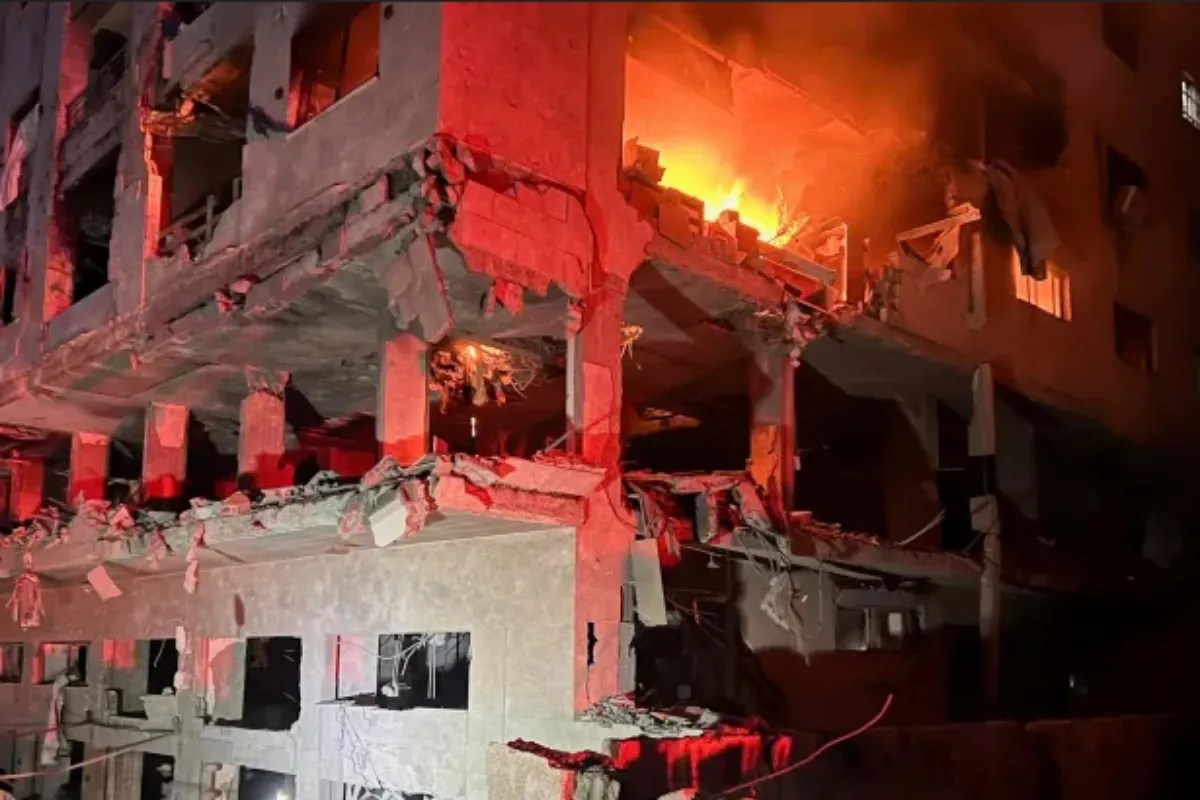
The sound of a collapsing building does not resemble the neat, cinematic explosions we watch on screens. It is a wet, heavy thud. It is the sound of thousands of tons of concrete, rebar, personal photographs, unwashed dishes, and human lungs colliding with the earth at terminal velocity.
Then comes the silence. A thick, choking quiet wrapped in a gray shroud of pulverized stone.
In Gaza, this sound has become the rhythm of existence. It is a metronome of loss. When an Israeli airstrike tore through an apartment building in the heart of Gaza, it wasn't just structural pillars that gave way. An entire ecosystem of human connection vanished in less than three seconds. Eight people died. To the world, they are a headline, a push notification quickly swiped away to reveal a social media feed. To those digging through the rubble with bare fingernails, those eight names represent the boundary line between a life of memory and an eternity of absence.
Statistics are a shield. We use them to protect ourselves from the blinding glare of individual suffering. When we read "eight dead," our brains categorize the information, file it under the geopolitical conflict folder, and move on. But reality happens in the particulars.
The Geography of a Living Room
To understand what was lost, one must understand the anatomy of a Gaza apartment. These are not just spaces of transit; they are multi-generational fortresses of survival. Due to decades of confinement and economic strangulation, families do not scatter. They build upward. A father lays the foundation. A decade later, the eldest son builds a second floor. A daughter’s family takes the third.
When a missile strikes, it does not just kill individuals; it erases a family tree vertically, collapsing generations into a single layer of debris.
Let us speak of the ordinary things that filled that specific structure before the sky fell. There was a teapot, likely dented at the base, that had whistled through three separate military escalations. There was a school uniform, freshly pressed and hanging on the back of a plastic chair, waiting for a morning that would never arrive. There was a grandmother’s wedding chest, smelling of old rosewater and displacement, carried from a village that no longer exists on any modern map.
These objects are the anchor points of sanity in a world that has lost its mind. When the airstrike hit, these anchors were atomized.
Consider the physics of the strike. The Israeli military often cites precision-guided munitions, technological marvels designed to minimize collateral damage while neutralizing targets. But when a high-explosive warhead meets a residential apartment block, precision becomes a semantic cruelty. The blast wave moves faster than the speed of sound. It shatters the eardrums before the brain can register the noise. The negative pressure wave that follows sucks the air out of surrounding rooms, collapsing the delicate alveoli in human lungs.
Those who survive the initial blast are often trapped in the darkness of the "void spaces"—small, accidental caverns formed by tilted concrete slabs. Inside these voids, the struggle is not against an army, but against the air itself. Every breath draws in fine concrete dust that hardens like wet cement inside the respiratory tract.
The Anatomy of the Aftermath
Outside, the neighborhood awakens to a nightmare that has become entirely predictable. There are no heavy excavators here. Fuel is a luxury reserved for ambulances, and even those are running on fumes. The rescue operation relies on human hands, plastic buckets, and the desperate, high-pitched screams of men calling out names into the cracks in the stone.
"Ahmad!"
"Mariam!"
"Is anyone there?"
Sometimes, a voice answers. It is usually a child’s voice, muffled and thin, sounding as though it is coming from the bottom of a deep well. The rescuers dig until their fingers bleed, peeling back layers of jagged iron and shattered tile.
The military communiqués issued hours later will speak of targets, intelligence, and operational necessity. They will use sterile language designed to distance the act of violence from its corporeal result. They will talk about "infrastructure."
But an apartment building is not infrastructure. A bridge is infrastructure. A power grid is infrastructure. An apartment building is a repository of first steps, midnight arguments, secret recipes, and the quiet, desperate prayers of parents trying to soothe children who have developed chronic stutters from the constant thud of artillery.
The eight individuals who perished in this strike were not abstractions. They were people who, just an hour before the strike, were likely arguing about who would fetch the limited supply of clean water available that day. They were checking the battery levels on their phones, calculating how many hours of electricity they might receive before the grid went dark again. They were living in the agonizing, suspended animation that defines contemporary life in the Gaza Strip.
The Weight of Surviving
What happens to the ones who do not die?
We rarely talk about the survivors of an airstrike, except to count them among the wounded. But the injuries sustained in these events extend far beyond the lacerations and compound fractures treated in overwhelmed hospital corridors. The true damage is neurological, psychological, existential.
Imagine standing on a street corner, holding a plastic bag containing a single shoe and a water-damaged identity card—the sum total of everything you own and everyone you loved. The mind cannot process this level of sudden vacancy. It snaps.
Psychiatrists working in the region speak of a phenomenon unique to Gaza: the complete absence of post-traumatic stress disorder. It is not because the population is miraculously resilient, but because the trauma is never "post." It is continuous. It is a permanent condition of the environment, as palpable as the humidity or the smell of burning plastic that hangs over the refugee camps.
The human body is not designed to live under the constant threat of aerial annihilation. When the drone engines buzz overhead—a sound resembling a giant, mechanical mosquito that never sleeps—the adrenal glands secrete a steady stream of cortisol. Over months and years, this chemical bath alters the brain's architecture. The amygdala, the fear center, enlarges. The prefrontal cortex, responsible for logic and long-term planning, shrinks.
A population living under these conditions is not planning for five years from now. They are not thinking about careers, university degrees, or retirement funds. They are thinking about the next twenty minutes.
The Rhetoric and the Reality
The debate surrounding these strikes always devolves into a war of words. One side speaks of human shields and tactical deterrence. The other speaks of war crimes and collective punishment. The international community issues statements expressing "deep concern," a phrase so thoroughly laundered of meaning that it now functions as a form of bureaucratic punctuation.
But on the ground, the semantics matter less than the stones.
When we strip away the political alignments, the historical grievances, and the endless cycles of recrimination, we are left with a fundamental question about the value of a human life. Does the location of a birth dictate the degree of grief allowed upon a death? Is a mother’s scream in Gaza inherently different from a mother’s scream in Tel Aviv, Kyiv, or New York?
The international order is built on the premise that certain rules are universal. The Geneva Conventions, the declarations of human rights, the laws of armed conflict—these are not sentimental documents. They are pragmatic frameworks designed to prevent humanity from sliding back into total savagery. They exist to protect the non-combatant, the person who has no say in the geopolitical machinations of generals and politicians.
Yet, with every apartment building that collapses into a gray hill of dust, those universal rules feel more like a cruel joke whispered to the dispossessed.
The sun begins to set over Gaza, casting a long, amber glow across the ruins of the building. The search has slowed down now. The bodies of the eight victims have been recovered, wrapped in white sheets, and carried away on the hoods of civilian cars because the ambulances were needed elsewhere.
A young boy, no older than seven, stands at the edge of the cordoned-off area. His face is streaked with soot, his shirt torn at the shoulder. He is not crying. His eyes are wide, glassy, fixed on a specific spot in the debris where a brightly colored plastic toy tractor peeks out from beneath a slab of reinforced concrete.
He does not reach for it. He just watches it, as if waiting for the toy to move on its own, while the dust settles around him in the darkening air, coating everything in a fine, uniform layer of oblivion.