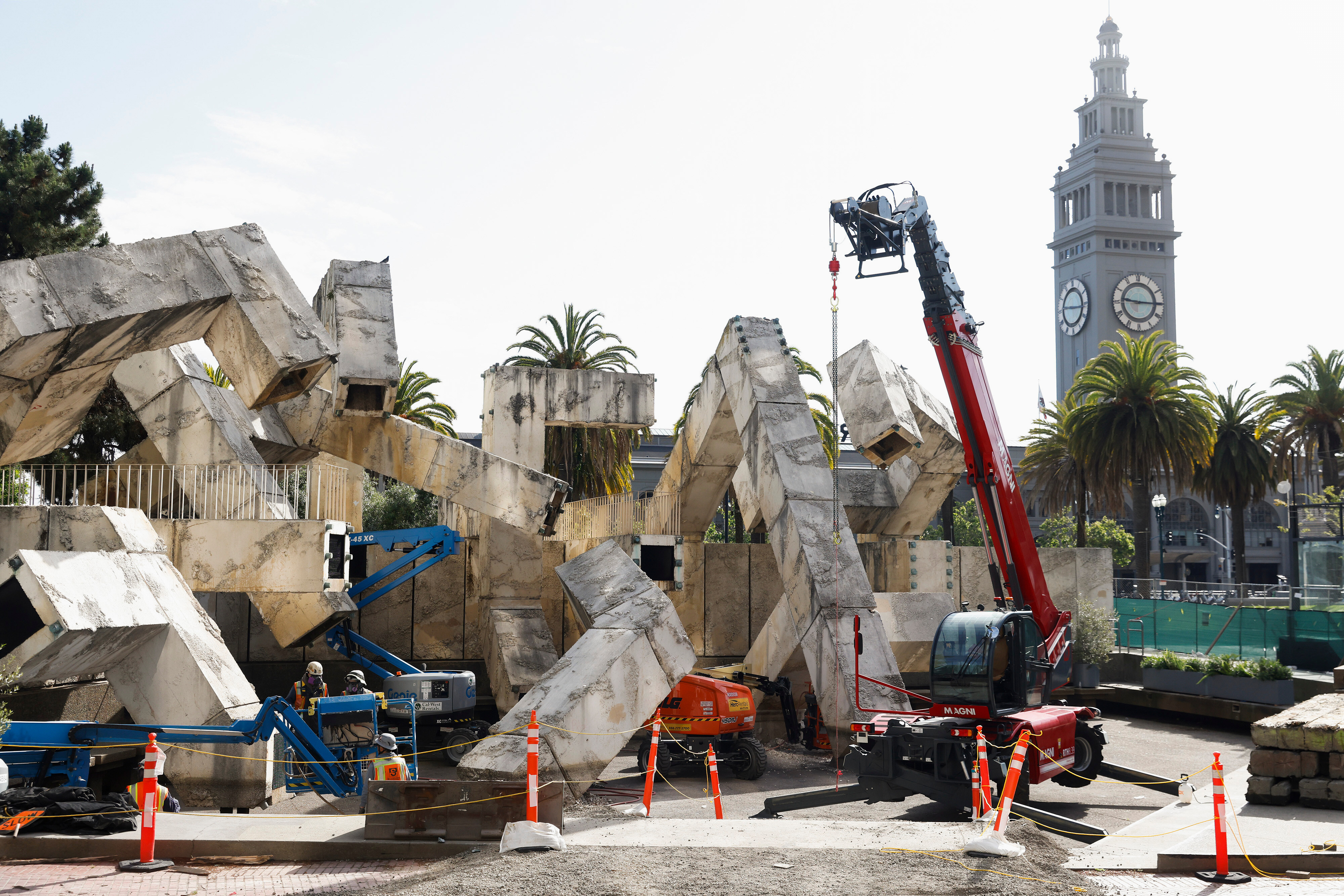
The wrecking ball arrived at Vaillancourt Fountain with the clinical precision of an executioner. For decades, the towering, tangled web of precast concrete pipes had loomed over Justin Herman Plaza in San Francisco, a brutalist monolith that defied the very concept of prettiness. It was loud. It was defiant. To some, it was a masterpiece of urban confrontation. To others, a dripping, grey eyesore that looked like it had been discarded by an industrial giant. Now, it is becoming dust.
Stand at the edge of the plaza and you can still taste the salt air blowing off the Embarcadero. Close your eyes, and if you listen past the hum of the modern city, you might hear the phantom splash of water that once roared through those hollow, jagged arteries.
I remember walking past it in the late nineties, a coat collar turned up against the San Francisco chill. The fountain didn't invite you to sit. It dared you to notice it. Armand Vaillancourt, the Quebecois artist who birthed this strange creature in 1971, didn't want a park decoration. He wanted a scream in stone. He wanted to shake people out of their complacency.
He succeeded.
The story of the fountain is not really about concrete or plumbing. It is a story about the messy, uncomfortable collision between art and the public’s desire for order. When Vaillancourt designed it, he was reacting against the polished, sterile aesthetics of the mid-century. He poured his frustration with the status quo into those molds. He wanted a structure that felt lived-in, a playground for the bold that echoed the frantic energy of a city in flux.
But cities grow tired. They grow weary of friction.
Consider the life of a public space. It starts with an idea—a vision of how we should inhabit a corner of the world. Then comes the reality of maintenance, of changing demographics, of the slow, inevitable creep of deferred repairs. For years, the fountain sat silent, its pumps broken, its concrete staining under the relentless coastal sun. It became a graveyard for discarded coffee cups and a canvas for graffiti. It wasn't just neglected; it was orphaned by a city that no longer understood the aggressive intent of its creator.
The decision to dismantle it feels final. It feels like we are losing a piece of our collective spine.
Critics will point to the structural integrity issues. They will talk about seismic retrofitting costs, about the need to reclaim the plaza for events, for farmers' markets, for the breezy, unobstructed view of the bay that tourists crave. They are right, in a strictly utilitarian sense. The math of city planning is cold. It demands efficiency. It demands spaces that function like machines, sleek and unencumbered.
But what do we lose when we trade friction for utility?
When you remove a polarizing object, you don't just clear the space. You sanitize the conversation. You make the city a little quieter, a little more predictable. There is a specific kind of bravery in keeping the ugly, challenging things. They remind us that history is not a smooth path of progress. It is a jagged pile of experiments, some of which failed beautifully.
I think of the people who worked in the offices nearby, the ones who spent their lunch breaks leaning against that concrete, reading the newspaper, feeling the spray hit their faces on a windy afternoon. They didn't see a controversial monument. They saw a familiar, strange companion that defined their commute. They knew the way the shadows fell at four in the afternoon. They knew the exact rhythm of the leaks.
To them, it wasn't a debate about art policy. It was the geography of their daily lives.
Now, the demolition crews are finishing their work. The jagged pipes are being hauled away to a scrap heap or a landfill, destined to become rubble beneath a new, flatter, more manageable vision of the future. The plaza will be smooth. The sightlines will be perfect. The city will feel safer, cleaner, and somehow, smaller.
The fountain was a reminder that we once dared to build things that didn't care if we liked them. It was a relic of a time when architects and artists believed they could shape the human spirit through raw, unyielding mass.
Walking through the empty space today, the air feels thin. The wind moves through the plaza without obstruction, unchecked and unburdened. We have traded the scream for a whisper. The concrete ghost is gone, and for the first time in fifty years, the plaza is perfectly, terrifyingly quiet.


