The air in Slough does not smell like freedom. It smells like hot silicon, recycled ozone, and the faint, persistent exhaust of a Boeing 747 banking low over the rooftops toward Heathrow.
Arthur Pendelton knows that smell better than he knows his own grandchildren's birthdays. For forty-two years, Arthur ran a small auto-repair shop on the edge of the Trading Estate—once the pride of Berkshire, a sprawling monument to mid-century industrial optimism where Mars bars and Hawker Hurricanes were built. Today, the corrugated tin roofs of Arthur's youth are disappearing, swallowed whole by windowless monoliths of gray concrete and steel. They rise silently behind chain-link fences, guarded by biometric turnstiles and armed patrols. No smoke billows from their chimneys. No grease-stained mechanics curse over blown gaskets in their shadows.
Inside those silent fortresses, millions of fans are screaming.
They are not human screams. They are the high-pitched, deafening wails of tens of thousands of computer servers churning day and night, processing the digital lifeblood of Europe. Slough is no longer just a town on the map; it is the unofficial data capital of the continent, the engine room of the cloud. Every time a Parisian checks their banking app, every time a Frankfurt trader executes a millisecond trade, every time a teenager in Madrid uploads a video to the ether, a tiny piece of that transaction echoes through the server racks hummed into existence on Arthur’s old stomping grounds.
And the town is choking on it.
To understand why a community built on grit and manufacturing is suddenly rising up in quiet, bitter rebellion, you have to look past the billion-pound valuation figures tossed around in London boardrooms. You have to look at the electricity bill.
Data centers are gluttons. They eat power the way a blue whale eats krill, gulping down megawatts of electricity to feed rows of processors that must be frozen by massive banks of air conditioners so they do not melt into slag. Slough’s local infrastructure, designed decades ago for light industry and suburban families, is buckling under the strain. Transformer stations hum with a menace that keeps neighborhood dogs awake at night. Residents speak of a low, subterranean vibration that never stops—a tectonic shift in the background noise of existence.
Then there is the water. Millions of liters are drawn from municipal supplies every single day to cool the processors through evaporation. In return, what does Slough get? Jobs? Not really. A data center the size of a football field might employ a dozen security guards and a handful of remote-management engineers who drive in from Surrey and leave before sunset. They do not buy pints at the local pub. They do not apprentice local kids. They are ghost tenants in a physical shell.
Arthur remembers when a factory meant people. It meant a union hall, a Christmas bonus turkey, a shared groan over the Monday morning commute, and a collective stake in the town’s prosperity. These new monoliths offer none of that. They are fortresses of abstraction, wealth extractors disguised as high-tech progress.
Across the United Kingdom, a silent reckoning is unfolding in places like Slough, Dublin, and rural Virginia. We built the digital economy on the promise of weightlessness. We were told that data lived in the cloud, an ethereal realm of pure thought floating somewhere above the weather.
It is a lie. The cloud has weight. It has an address. It runs on heavy copper cables, draws millions of gallons of municipal water, and exhausts staggering amounts of waste heat directly into neighborhoods that never voted for them.
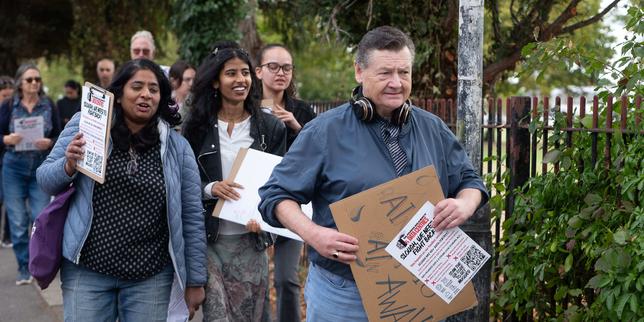
Local council chambers, once sleepy arenas for pothole complaints and park maintenance budgets, have become war zones. Residents are packing town halls, clutching printed electricity bills and pointing to zoning violations with trembling fingers. They are asking a terrifyingly simple question: Who gave you the right to turn our town into a radiator for the world's internet?
The pushback is not anti-technology. Slough knows what progress looks like; its entire history is a testament to adaptation. But there is a profound difference between building things that humans use and building things that replace human presence altogether while consuming the resources required to sustain local life.
Consider the paradox. The very digital tools hosted in these concrete boxes are used by activists in London to organize protests against the very concrete boxes themselves. Pixels on a screen fight the physical reality on the ground.
As dusk settles over Berkshire, the red warning lights atop the data center cooling towers blink in unison against the bruised twilight sky. Planes scream overhead, drowning out the sub-audible hum of the servers for thirty seconds at a time. Arthur locks the rusted iron gate of his former garage, pulls his wool cap down against the chill, and walks home past a towering wall of grey prefab panels that used to be an open field.
The future has arrived in Slough. It is cold, it is vast, and it is starving for more.