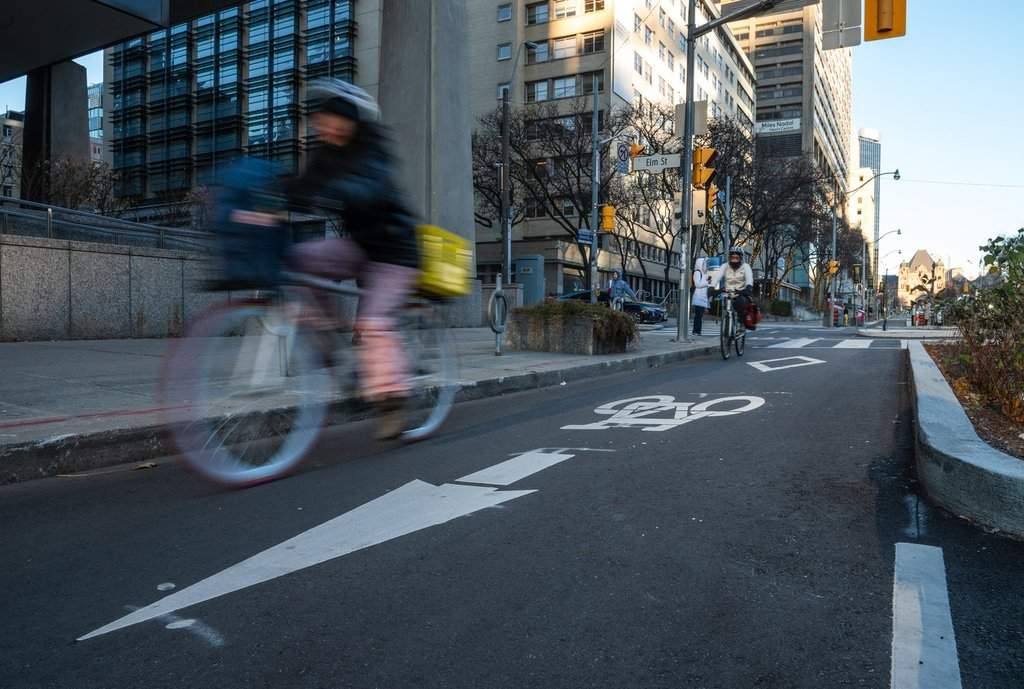
The Court of Appeal for Ontario delivered a decisive ruling that grants Premier Doug Ford’s provincial government the legal authority to rip out 19 kilometres of protected bike lanes along Bloor Street, Yonge Street, and University Avenue in downtown Toronto. This unanimous appellate decision completely overturns a sensational lower court ruling from July 2025, which had temporarily shielded the concrete-separated corridors under the banner of the Canadian Charter of Rights and Freedoms.
For months, urban planners, municipal politicians, and cycling advocacy groups watched the courtroom chess match with white-knuckled intensity. The underlying dispute goes far beyond white paint and rubber bollards. It is a fundamental clash over who holds ultimate authority over metropolitan space: municipal governments trying to design modern, multi-modal streets, or provincial legislatures wielding absolute constitutional supremacy over municipal jurisdiction and highway traffic.
The Anatomy of an Appeal
To understand why the Court of Appeal dismantled the lower court decision, one must look closely at the limits of constitutional law. In the original 2025 decision, Superior Court Justice Paul Schabas ruled that removing the lanes would expose cyclists to heightened risk of severe injury or death. He reasoned that this increased danger directly violated Section 7 of the Charter, which protects life, liberty, and security of the person.
The appellate panel saw things differently. Writing for the court, Justice Grant Huscroft and his colleagues dismantled the notion that traffic engineering choices can be legally micromanaged through the constitution. The court ruled that the Ontario legislature possesses absolute authority to regulate, modify, or completely dismantle public highways.
"The legislature is as free to establish bicycle lanes as it is to remove them or authorize their removal," the three-judge panel wrote.
They noted that weaponizing the Charter to freeze municipal infrastructure in place creates a dangerous legal precedent. If a bike lane is constitutionally mandated because its removal increases statistical risk, then every single road design choice, transit reduction, or sidewalk narrowing could theoretically face endless litigation. The judiciary stepped back, drawing a bright line between bad public policy and unconstitutional state action.
The Political Calculus at Queen's Park
Premier Doug Ford made the bike lanes a personal political crusade in late 2024, frequently blaming them for choking vehicular traffic across the Greater Toronto Area. While traffic engineers often point out that population growth and continuous construction contribute far more to congestion than a handful of separated bike paths, the political narrative struck a chord with suburban commuters.
Queen's Park utilized statutory powers to pass legislation specifically targeting the 19 kilometres of lanes on Bloor, Yonge, and University. When municipal leaders and advocacy networks like Cycle Toronto pushed back with legal filings, the province doubled down. Ford famously labeled the initial lower court injunction "ridiculous," arguing that an unelected judge was substituting personal ideology for the democratic will of the provincial government.
This dynamic exposes the friction inherent in provincial-municipal relations. Ontario operates under a legal framework where municipalities are technically creatures of the province. While cities like Toronto are granted broad powers to manage local affairs, provincial legislation can override municipal bylaws at a moment's notice. When local councils prioritize active transportation and climate resiliency targets, a provincial government focused on automobile throughput can unilaterally reverse course.
The Real-World Safety Fallout
Statistics collected by public health organizations and safety advocates consistently demonstrate that physical separation is the single most effective tool for protecting vulnerable road users. When concrete curbs or bollards separate heavy freight and commuter traffic from bicycles, serious collisions drop significantly.
By greenlighting the removal of these specific corridors, the province opens the door to returning thousands of daily cyclists to mixed traffic conditions or unprotecting major arteries. Michael Longfield, executive director of Cycle Toronto, expressed immediate dismay following the ruling, maintaining that stripping out the infrastructure will place human lives in direct jeopardy.
Consider a hypothetical commuter navigating the Yonge Street corridor during peak afternoon rush hour. Under the protected model, a physical barrier absorbs or deflects erratic vehicular drift. Without that barrier, the margin for error shrinks to zero. A momentary driver distraction translates directly into a catastrophic collision. The appellate court did not dispute these safety realities; instead, it maintained that the judiciary is institutionally unequipped to weigh traffic safety trade-offs against legislative priorities.
What Happens Next on the Street
The legal battle may eventually find its way to the Supreme Court of Canada if advocacy groups decide to seek leave to appeal. However, obtaining a hearing at the country's highest court is notoriously difficult, requiring a question of national public importance rather than a localized dispute over municipal road geometry.
For now, the ball sits squarely in the court of municipal leaders and provincial bureaucrats. The Ford government has not yet published an exact calendar for when heavy machinery will arrive to tear out the asphalt markers and bike signals. Meanwhile, Toronto city council faces the sobering reality that its downtown street design is subject to the immediate political whims of whichever party controls the provincial legislature.
The pavement belongs to whoever holds the legislative pen, and the political cost of reshaping Toronto streets will continue to reverberate far beyond the downtown core.