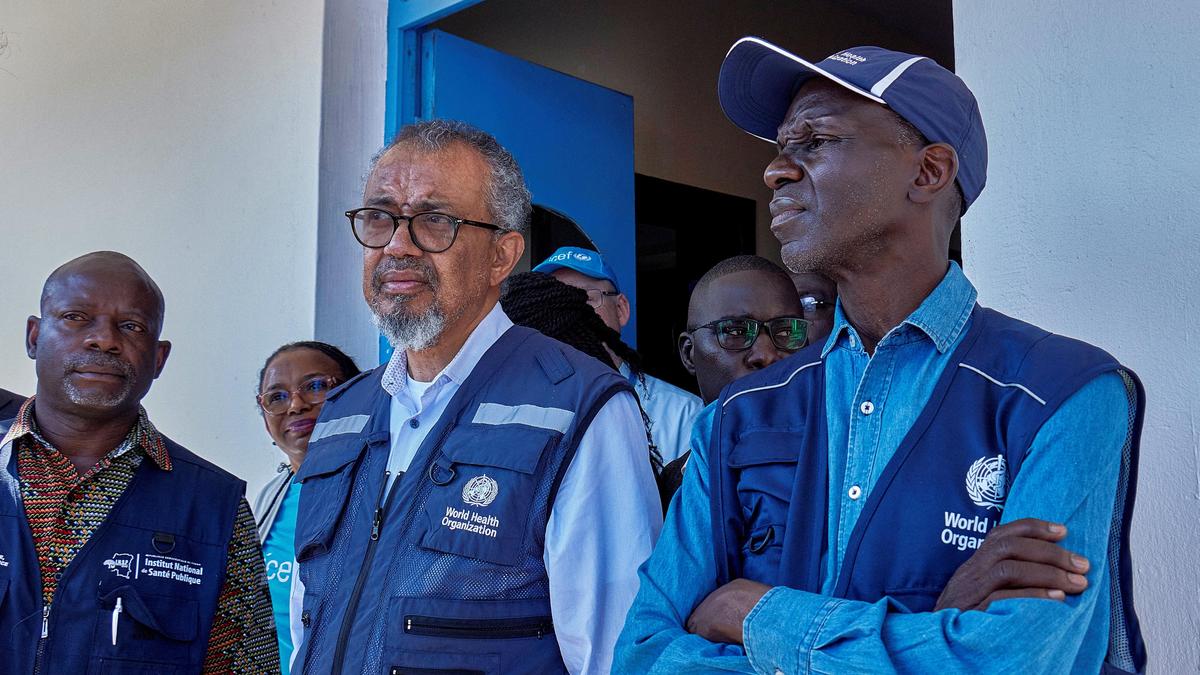
World Health Organization officials recently highlighted five successful patient recoveries in eastern Congo, using the milestone to coincide with the opening of a new treatment center. While these survivors represent a victory for modern medicine, the celebratory tone obscures a grittier reality on the ground. The North Kivu and Ituri provinces remain a volatile theater where clinical success frequently clashes with deep-seated social distrust and relentless militia violence.
Five people walked out of a clinic alive, but hundreds of others are still hiding from the reach of the healthcare system. This disconnect is the primary engine of the current outbreak.
The Mirage of Clinical Progress
In the clinical isolation of a treatment center, the Ebola virus is a known quantity. We have the vaccines and we have the monoclonal antibody treatments like mAb114 and REGN-EB3. When a patient arrives early, their chances of survival now hover around 90 percent. This is a staggering improvement from the early days of the West African epidemic, where an Ebola diagnosis was effectively a death sentence.
However, the "last mile" of delivery is where the strategy is fracturing. The WHO and the Congolese Ministry of Health are operating in a region where the central government’s presence is thin and often resented. For many locals, the sudden influx of international funding and armored SUVs is a source of suspicion rather than comfort. They see millions of dollars poured into a single disease while they continue to die from malaria, measles, and clean water shortages.
This resentment breeds the resistance that allows the virus to circulate under the radar. When a community perceives the medical response as an extractive or colonial force, they stop reporting cases. They bury their dead in secret. They treat the fever at home. Each secret burial is a fresh seeding event, ensuring the outbreak persists regardless of how many state-of-the-art centers open their doors.
Logistics in a War Zone
The new treatment center in eastern Congo is a marvel of modular engineering, but it exists behind a wall of security. Eastern Congo is currently home to over 100 active armed groups. These militias frequently target government infrastructure, and by extension, the Ebola response teams.
Security is not a peripheral concern; it is the core constraint.
- Vaccination teams cannot enter certain "red zones" without armed escorts, which immediately marks them as targets for anti-government rebels.
- Contact tracing becomes impossible when families flee into the dense forest to escape skirmishes between the ADF (Allied Democratic Forces) and the Congolese military.
- Data collection is patchy at best, meaning the official case counts likely represent only a fraction of the actual transmission chains.
The "five recoveries" narrative serves as a necessary morale booster for weary health workers, yet it fails to account for the geography of the conflict. A treatment center is stationary. The virus, carried by displaced populations and gold miners moving through the bush, is mobile.
The Trust Deficit and the Business of Ebola
There is an uncomfortable conversation happening in the markets of Butembo and Beni that rarely makes it into the WHO press briefings. It is the "Ebola Business" theory. Local populations observe that while their neighbors are dying, a new economy has sprouted around the response. Local elites secure contracts for car rentals, catering, and security.
This perception of profiteering creates a perverse incentive for the community to reject the intervention. If the population believes the responders are getting rich off their misery, they have no reason to cooperate with the health measures. This is why we see attacks on health workers. These are not acts of random "ignorance," as some international observers patronizingly claim. They are often calculated political statements against a system that appears to prioritize a high-profile virus over the human beings it infects.
The Biological Reality of Persistent Transmission
We are no longer dealing with a simple spillover event. The Ebola virus can persist in the bodies of survivors, particularly in "privileged" sites like the eyes or the testes, where the immune system is less active. This means that even after an area is declared clear, a new flare-up can occur months later through sexual transmission or a relapse.
The Role of Rapid Diagnostics
The push for better tech is ongoing, but the implementation is stalled by the environment.
- GeneXpert machines allow for rapid testing, but they require a stable power supply—a luxury in rural North Kivu.
- Cold chain maintenance for the Ervebo vaccine requires temperatures of $-60^{\circ}C$ to $-80^{\circ}C$.
- Mobile laboratories are vulnerable to theft and vandalism during civil unrest.
The technical tools are ready, but the social and political infrastructure to support them is crumbling. Opening a center is the easy part of the equation. Keeping it staffed and ensuring people actually choose to enter it is the real challenge.
Beyond the Ribbons and Cameras
The international community tends to view these outbreaks through the lens of emergency management—a sprint to zero cases. But eastern Congo is a marathon of chronic instability. To truly end the cycle, the response must pivot from a vertical, disease-specific model to a horizontal health-strengthening approach.
If the only time a doctor visits a village is when Ebola is suspected, the village will continue to view that doctor with fear. Trust is built in the quiet periods between outbreaks, through the provision of basic maternal care and the treatment of common infections.
The five survivors who walked home this week are a testament to scientific ingenuity. But their survival does not change the fact that the virus is still winning the war of attrition in the forest. The success of the response should not be measured by the number of beds in a new facility, but by the number of people who feel safe enough to occupy them without a soldier standing at the door.
The focus must shift toward local ownership of the response, or we will be back in six months to inaugurate another center for a whole new set of victims. Ground-level engagement is the only variable that actually determines the end date of an epidemic. Without it, the centers are just expensive monuments to a strategy that refuses to learn from its own history.