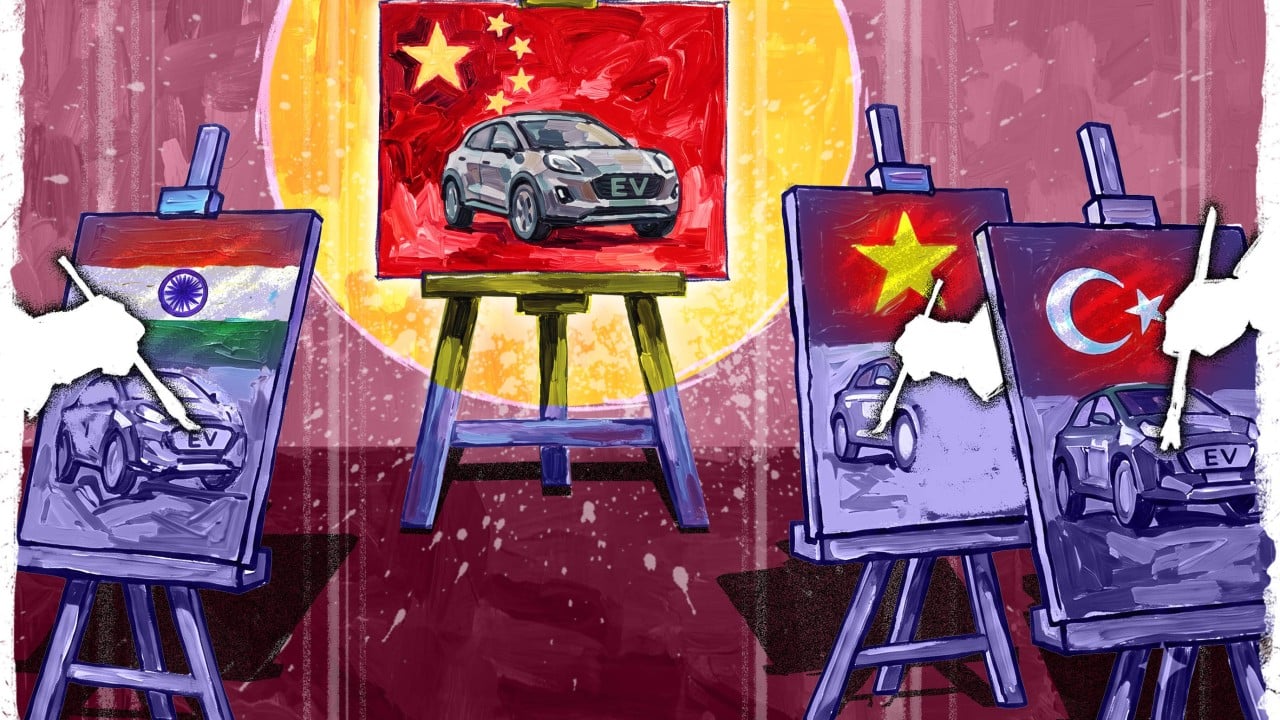
Western policymakers are obsessed with a dangerous myth. They look at China’s overwhelming dominant position in electric vehicles, pull out their notebooks, and convince themselves that a few tax credits, local content requirements, and government subsidies can build a rival automotive titan overnight.
They are dead wrong.
The standard media narrative claims Beijing wrote a clean, masterfully orchestrated blueprint that took its car industry from obscurity to global dominance. Analysts urge Western and emerging governments to simply replicate this state-driven strategy.
That recommendation is not just naive. It is an economic trap.
China did not conquer the global EV market because its bureaucrats were genius planners who drew up a tidy policy playbook. China won because it built an industrial meat grinder, subsidized massive overcapacity, tolerated the brutal bankruptcy of hundreds of domestic companies, and controlled the unsexy, dirty refining of raw materials decades before anyone else cared.
Trying to copy Beijing’s strategy without China’s unique economic structure, captive labor force, cheap coal power, and appetite for industrial waste will not yield a thriving domestic EV industry. It will only yield billions in squandered taxpayer funds and overpriced cars nobody wants to buy.
The Myth Of The Bureaucratic Mastermind
Every Western policy paper on clean energy treats China’s ministry officials like chess grandmasters. They point to consumer purchase subsidies, battery subsidies, and fleet procurement quotas as proof of top-down strategic genius.
I have watched governments try to copy this formula. They pass a sweeping industrial policy, dangle billion-dollar subsidies in front of legacy automakers, and wait for the miracle to happen.
Instead, they get sluggish legacy brands building half-hearted compliance vehicles while sucking up public money.
The central policy mistake is confusing intentional planning with brutal darwinism. Beijing did not pick a few winners and nurture them to maturity. It threw cheap capital at literally hundreds of startups, created a localized hyper-competitive hunger games, and let almost all of them die.
At the peak of China’s EV push, there were over 500 registered electric car manufacturers in the country. Today, only a handful turn a meaningful profit. The vast majority went bankrupt, leaving behind vehicle graveyards filled with thousands of abandoned, rotting electric cars that were built solely to capture government subsidies before the rules shifted.
China’s success was built on top of a mountain of corporate corpses and wasted capital.
Democratically elected governments cannot replicate this model. A Western minister cannot spend tens of billions of public funds knowing that 95% of the recipient companies will go belly up within five years without facing immediate political execution. The political economy of the West rewards safety and risk mitigation, which is the exact opposite of the chaotic, wasteful environment that forged companies like BYD.
It Was Never About The Car
The obsession with assembly lines misses the entire point of the supply chain.
Building an electric vehicle is not fundamentally an automotive challenge. It is an exercise in chemical processing, energy costs, and raw material throughput.
While Western executives spent the last fifteen years debating whether consumers actually wanted touchscreens, Chinese firms quietly cornered the supply chain for lithium refining, synthetic graphite production, cobalt processing, and nickel smelting.
Consider the sheer imbalance in midstream chemical refining:
| Battery Material | China's Share of Global Refining Capacity |
|---|---|
| Graphite | ~90% |
| Rare Earth Elements | ~85% |
| Cobalt | ~75% |
| Lithium | ~65% |
You cannot fix that gap with a $7,500 tax credit at a dealership in Ohio or Bavaria.
When a Western automaker attempts to build an EV, they are buying processed minerals from Chinese firms, using battery cells produced with Chinese technology patents, and assembling the vehicle using equipment sourced from Chinese vendors. The final assembly line—the part Western politicians love to take photo opportunities in—is the least profitable, most capital-intensive segment of the entire enterprise.
China did not win the EV race by making better cars. It won by controlling the dirty processing infrastructure that converts dirt into battery-grade chemicals.
Processing lithium and graphite requires vast amounts of cheap energy and permissive environmental oversight. China powered its early battery supply chain on cheap, high-emissions coal electricity. Expecting Western nations to replicate this cost structure while simultaneously enforcing strict environmental regulations and high energy costs is an exercise in self-delusion.
Overcapacity Is A Feature Not A Bug
The common economic criticism leveled against China today is "overcapacity." Western leaders complain that Chinese factories produce millions more electric cars than their domestic market can absorb, forcing them to dump low-cost vehicles onto international markets.
What the West views as a bug, Beijing treats as a strategic weapon.
China’s industrial strategy accepts domestic overcapacity because it creates a permanent price war. In a price war, scale is the only survival metric. Companies like BYD achieve massive cost reductions not through secret technological breakthroughs, but through vertical integration and pure, unrelenting production volume.
BYD owns its battery supply, its mining operations, its shipping vessels, and its chip fabrication units. When domestic demand slows down, BYD does not shut down assembly lines. It drops prices to floor levels, starves out smaller competitors at home, and exports the surplus abroad.
Imagine a scenario where a European legacy automaker attempts to compete with this dynamic:
- The European automaker spends $5 billion retooling a factory to build 100,000 EVs a year.
- High labor costs, strict supply chain origin rules, and expensive green electricity lock their unit production cost at $35,000 per car.
- A Chinese rival produces the same class of vehicle at a volume of 1,000,000 units per year, with unit production costs at $14,000.
- Even after applying 30% protective tariffs, the Chinese vehicle enters the market thousands of dollars cheaper than the domestic alternative.
Tariffs do not solve this fundamental disparity; they merely hide it while penalizing domestic consumers and driving inflation. If you shield domestic automakers behind massive tariff walls without fixing the cost structure of raw materials, energy, and scale, you simply create lazy domestic monopolies that produce outdated, expensive vehicles for a captive market.
The Flawed Questions Policy Makers Keep Asking
Governments looking to enter the battery ecosystem consistently fall for flawed premises. Here is how the standard line of thinking breaks down under real scrutiny.
Can tax incentives force a transition to electric vehicles?
No. Subsidies manipulate short-term demand among high-income early adopters, but they fail once you hit the mass market. Consumer subsidies distort price signals and encourage automakers to keep retail prices artificially high to capture the government subsidy.
When Germany abruptly cancelled its EV subsidies, electric car sales plummeted overnight. A real market does not vanish the moment the state stops writing checks. True competitiveness requires matching or beating internal combustion vehicles on upfront purchase price and operational reliability without a central bank subsidy masking the margin.
Should developing countries build their own national EV manufacturers?
In almost every case, absolutely not. Building an automotive brand from scratch requires tens of billions in capital, access to proprietary battery IP, and a massive domestic market to absorb initial production inefficiencies.
For most developing nations, trying to build a national champion EV brand is a fast track to balance-of-payments crises and sovereign debt. The smarter strategy for these economies is to avoid manufacturing vehicles entirely and instead focus on securing niche positions in raw material extraction, component recycling, or grid infrastructure adaptation.
The Brutal Reality Of Western Industrial Strategy
If copying China’s state-led playbook is a guaranteed path to failure, what is the alternative?
First, accept the hard truth: you cannot out-China China at its own game. You cannot out-subsidize a state-capitalist system that operates with a lower cost of capital, cheaper power, and zero accountability to short-term shareholder returns or quarterly earnings calls.
Trying to build a fully localized, end-to-end EV supply chain in North America or Europe within a five-year election cycle is a pipe dream.
To build actual resilience, nations must abandon the delusion of complete industrial self-sufficiency. Instead of wasting capital trying to subsidize every component of an EV—from the lithium mine to the seat cushion—governments must focus strictly on deep technological leverage points.
That means investing heavily in next-generation battery chemistries like solid-state or sodium-ion, where China does not yet hold a total patent chokehold. It means radically streamlining environmental permitting for domestic mining and refining so that projects can open in three years instead of fifteen. And it means letting legacy automakers fail if they cannot adapt, rather than turning them into permanent pension-fund-backed welfare recipients.
The race to electrify transport will not be won by the nation that writes the thickest policy playbook or hands out the biggest corporate handouts. It will be won by whoever delivers affordable, durable energy storage at scale.
Stop trying to copy China's past. Start building the supply chain realities of tomorrow, or get out of the way.