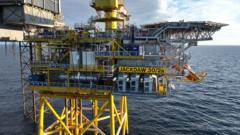
The North Sea Jackdaw gas field will not materially alter global temperature trajectories, according to its operators. This defense argues that because the project’s specific emissions represent a tiny fraction of global totals, its environmental impact is negligible. However, this logic relies on a flawed accounting mechanism that isolates individual fossil fuel projects from the collective energy infrastructure. By analyzing a single field in a vacuum, operators obscure the cumulative impact of keeping aging fossil fuel basins on life support. The true significance of Jackdaw lies not in its isolated mathematical output, but in how it locks in decades of high-carbon infrastructure while delaying the economic transition to cleaner alternatives.
The Scope 3 Blindspot
To understand why the "immaterial" argument fails, one must look at how energy giants categorize their carbon output. Industry standard accounting heavily emphasizes Scope 1 emissions—the direct pollution from drilling, pumping, and processing the gas on-site. For Jackdaw, these extraction-phase emissions are relatively low, particularly with modern efficiency mandates.
The real deception occurs when ignoring Scope 3 emissions, which represent the carbon released when consumers actually burn the gas for heating and electricity. Scope 3 emissions frequently account for more than 80 percent of a fossil fuel project’s total footprint. By excluding downstream combustion from their primary public relations equations, operators can claim a project has a minor footprint.
This accounting trick treats gas as if it disappears into thin air after extraction. It does not. Every cubic meter of gas extracted from the North Sea will eventually enter the atmosphere as carbon dioxide. When multiple operators across the globe all use the same "drop in the bucket" defense for their individual projects, the combined result is a massive, unchecked stream of global emissions.
The Infrastructure Lock-In Effect
Energy projects are long-term capital commitments. They require billions in upfront investment. Once a company pumps that amount of money into a field like Jackdaw, the economic imperative changes from exploration to maximum extraction.
[Upfront Capital Investment]
       │
       ▼
[Decades of Required Extraction to Recover Costs]
       │
       ▼
[Political and Economic Pressure to Protect the Asset]
       │
       ▼
[Delayed Transition to Alternative Energy Infrastructure]
This dynamic creates a multi-decade operational tail. Jackdaw is not designed to operate for just a year or two; it is built to produce gas well into the coming decades. This timeline directly conflicts with national and international carbon reduction targets.
- Capital allocation: Money spent developing new gas fields is capital diverted away from large-scale renewable generation and grid modernization.
- Asset stranding risks: As carbon taxation increases and renewable costs drop, these fields risk becoming economic liabilities, prompting operators to lobby for government protections or subsidies.
- Grid dependency: Prolonging the availability of domestic gas reduces the immediate pressure on grid operators to build out utility-scale battery storage and diverse renewable inputs.
When an operator claims a field is immaterial, they ignore the systemic inertia that the field creates. A network of pipes, processing plants, and supply contracts is reinforced, ensuring the energy economy remains tied to fossil fuels far longer than necessary.
The Fallacy of the Cleaner Displacement Argument
A frequent defense of new domestic gas extraction is that it serves as a cleaner bridge fuel, displacing dirtier coal or imported Liquefied Natural Gas (LNG). The logic states that producing gas domestically in the North Sea generates fewer transport emissions than shipping LNG across the Atlantic on massive tankers.
This argument assumes a perfect, one-to-one displacement that rarely occurs in real-world energy markets. Global energy demand is not a fixed pie. Introducing more supply often suppresses prices, which can stimulate overall consumption rather than forcing dirtier fuels out of the market entirely.
Furthermore, the "bridge fuel" concept was designed as a temporary transition strategy, not a permanent justification for new exploration. With the cost of wind, solar, and storage technologies declining sharply over the past decade, the economic justification for expanding gas infrastructure as a bridge has largely evaporated. Building new extraction sites today means the bridge is being extended indefinitely, long after the destination bank has come into view.
Regulatory Captivity and Public Relations Maneuvers
The approval and defense of the Jackdaw field reveal a deeper pattern of regulatory compliance that prioritizes short-term energy security over long-term climate commitments. In times of geopolitical volatility or regional energy price spikes, political pressure shifts toward securing immediate supply. Operators capitalize on these anxieties to push through projects that would otherwise face intense scrutiny.
By framing the field’s impact as statistically insignificant, companies shift the burden of proof onto regulators and environmental critics. It forces opponents to argue against a single, specific data point rather than the broader pattern of fossil fuel dependency. This strategy effectively fragmentizes environmental policy, forcing courts and regulatory bodies to evaluate projects piece by piece rather than assessing the total carbon budget of the energy sector.
The Economic Realities of the North Sea Basin
The North Sea is a mature, declining hydrocarbon basin. Extracting resources from its maturing fields requires increasingly sophisticated, energy-intensive techniques. The easy-to-reach reserves are gone.
| Factor | Mature Basin Reality (North Sea) |
|---|---|
| Extraction Intensity | Higher energy input required per barrel/cubic meter produced as pressure drops. |
| Infrastructure Age | Legacy pipelines and platforms require high maintenance and suffer from efficiency losses. |
| Decommissioning Liability | Massive looming costs that operators often attempt to defer by extending field life. |
Attempting to wring the final drops of profit from these aging fields by minimizing their climate relevance is a short-term survival strategy for traditional energy companies. It protects quarterly dividends at the expense of structural economic modernization. The claim that one field does not matter is a calculated effort to preserve a fading business model, ensuring that the true cost of carbon remains an externalized problem for the public to solve.
The math used by project defenders works only if you look through a keyhole. Once you step back and view the entire energy architecture, the argument dissolves. Every fractional increase in carbon lock-in matters, because the atmosphere does not respond to corporate definitions of materiality; it responds to the total volume of greenhouse gases trapped within it. Extending the lifespan of fossil fuel extraction under the guise of insignificance is simply a way to ensure the status quo remains profitable for as long as possible.