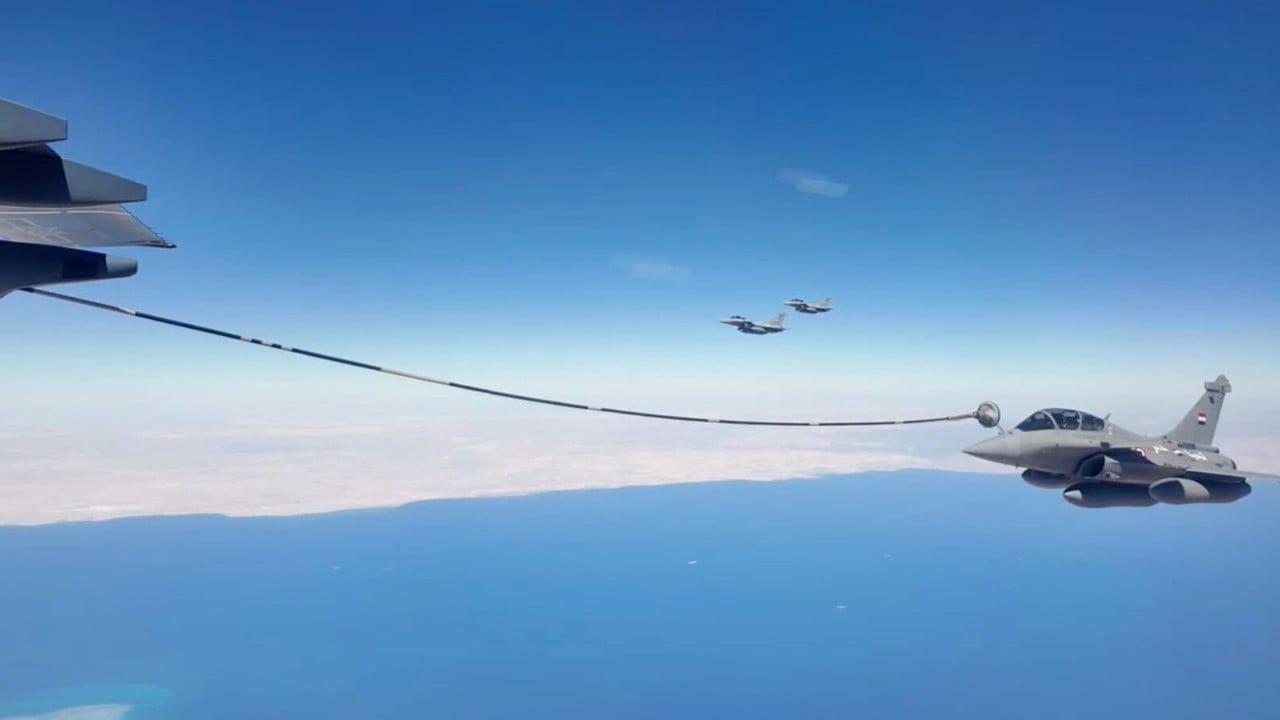
Evaluating the operational implications of the People's Liberation Army Air Force deploying a YY-20A multi-role tanker transport to refuel an Egyptian Air Force Dassault Rafale requires stripping away surface-level diplomatic framing. The event, captured during the Eagles of Civilization 2026 exercise, presents a specific technical intersection between Eastern support architecture and Western-origin tactical aviation. Understanding this development means analyzing the mechanical commonalities, the strict boundaries of operational data-linking, and the logistics of expeditionary force projection.
The Mechanics of Cross-Doctrine Fuel Transfer
Physical compatibility between disparate military aircraft is governed by established refueling standards. Both the Chinese YY-20A and the French-designed Rafale utilize the probe-and-drogue methodology. In this configuration, the tanker extends a flexible hose terminating in a conical basket, while the receiver aircraft maneuvers a fixed structural probe into the aperture. Also making headlines in this space: The Political Risk Calculus of Contested Transitions A Structural Breakdown of Zambia.
The technical baseline relies on standardized parameters:
- Hose pressure and flow rates: The transfer velocity must match the structural limits of the receiver's internal plumbing without triggering overpressure valves.
- Aerodynamic wake turbulence: The receiving aircraft must maintain station within the tanker's stable airflow envelope, minimizing bow-wave interactions that destabilize the drogue basket.
- Closing velocity vectors: The pilot must manage throttle inputs to match the tanker's cruising speed, typically between 300 and 350 knots indicated airspeed at medium altitudes, ensuring a smooth latch without structural shock.
While the mechanical interface is straightforward, hardware connectivity does not imply network or tactical integration. The transfer of fuel addresses mass and endurance constraints, but it leaves electronic identification, cryptographic data-sharing, and sensor fusion entirely isolated. More insights on this are explored by BBC News.
Logistics and Expeditionary Range Extension
The strategic utility of the YY-20A rests on its capability to project power across extended operational radii. During the deployment to Egypt, Chinese forces traversed approximately 6,000 kilometers, relying on intermediate refueling to sustain heavy multi-role fighters like the J-16.
The cost function of long-range air deployments involves three distinct variables:
- Airframe fatigue life: Extended flight hours accelerate structural wear, demanding rigorous maintenance schedules provided by accompanying heavy transport aircraft like the Y-20A.
- Fuel burn penalties: Tanker aircraft consume vast quantities of internal fuel to transport transferable payload, creating diminishing returns on range extension past specific operational thresholds.
- Landing rights and basing dependencies: Aerial refueling mitigates the need for foreign staging bases, decoupling operational reach from diplomatic clearances.
By demonstrating that the YY-20A can service both indigenous platforms (such as the J-16, J-20, and J-35) and foreign acquisitions (such as Egypt's MiG-29M and Rafale fleets), Beijing highlights the versatility of its logistics architecture. For Cairo, integrating a non-standard tanker option diversifies support dependencies without requiring a complete overhaul of frontline combat assets.
Interoperability Limits and Tactical Realities
Observers frequently confuse physical logistics support with coalition warfare capability. True military interoperability requires a tiered framework:
- Tier One (Physical): Shared fuel types, common refueling probes, and basic ground handling compatibility. The YY-20A and Rafale interaction operates strictly at this baseline.
- Tier Two (Procedural): Harmonized communication protocols, standardized phraseology, and synchronized rendezvous patterns. Joint exercises aim to validate this tier.
- Tier Three (Digital/Tactical): Fused sensor networks, common tactical data links (such as Link 16 or equivalent indigenous variants), and unified command structures.
The recent exercises demonstrated success at the first two tiers under controlled conditions, but the third tier remains unbridled. A Chinese tanker can transfer aviation fuel to a French-built airframe, but the Rafale's internal mission computers, electronic warfare suites, and radar systems remain entirely divorced from Chinese tactical networks. The engagement profile emphasizes logistics flexibility rather than integrated combat datalinks.
Air forces operating mixed-origin fleets face permanent friction in maintenance, parts procurement, and specialized tooling. Egypt maintains a uniquely diversified inventory—sourcing platforms from France, the United States, Russia, and engaging in joint training with China. Managing this inventory requires insulated supply chains to prevent cross-contamination of proprietary software and hardware maintenance protocols.
Future operational planning for nations utilizing diversified defense portfolios will depend on modular logistics solutions. As air arms seek flexibility against supply chain vulnerabilities, the ability to plug non-native tankers into a tactical fleet provides a vital operational buffer, provided ground crews manage the distinct maintenance parameters of competing aviation industries.