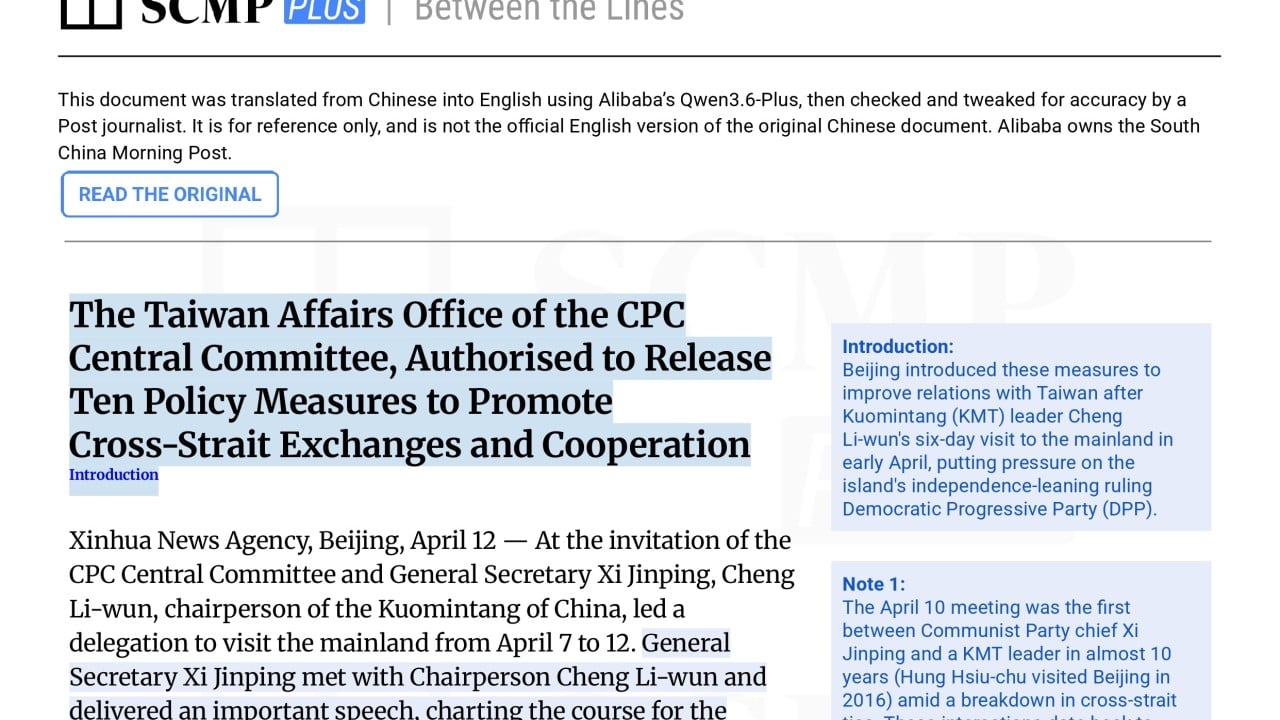
Beijing just dropped a ten-point plan to "boost ties" across the Taiwan Strait, and the financial press is swallowing the bait hook, line, and sinker. They see a roadmap for economic cooperation. I see a sophisticated data-harvesting operation disguised as a regional stimulus package. If you think this is about "peace and prosperity," you aren’t paying attention to the plumbing of modern trade.
These measures aren't a bridge. They are a vacuum.
The consensus view—the one being peddled by every mid-tier analyst from Hong Kong to London—is that these policies are designed to lure Taiwanese capital back into the mainland to offset China’s cooling property market. That is a surface-level reading. The real play is the forced integration of digital infrastructure, financial clearing systems, and supply chain logistics that would make a future decoupling physically impossible.
The Illusion of Economic Incentives
The core of the "Ten Measures" focuses on Fujian province as a "demonstration zone." On paper, it looks like a standard Special Economic Zone (SEZ) play: tax breaks, simplified residency, and streamlined business permits. But look closer at the fine print regarding digital identity and financial data sharing.
Beijing is offering Taiwanese businesses "equal treatment." In the language of the CCP, equal treatment means equal oversight. By integrating Taiwanese firms into the mainland’s social credit and corporate monitoring systems under the guise of "administrative efficiency," Beijing is effectively neutralizing the jurisdictional shield that offshore entities usually enjoy.
I’ve spent fifteen years watching how these "demonstration zones" operate. They aren't laboratories for free enterprise; they are honey pots for intellectual property. When you "streamline" the patent application process for Taiwanese tech firms in Fujian, you aren't helping them protect their ideas. You are giving the state an early-access look at the architecture of next-generation semiconductors and software.
The Digital Integration Trap
One of the most praised measures involves the "facilitation of electronic payments" for Taiwanese residents in the mainland. To the casual observer, this is a convenience win. To anyone who understands the architecture of the Digital Yuan (e-CNY), it is a geopolitical masterstroke.
By moving cross-strait retail transactions onto state-controlled digital ledgers, Beijing achieves three things:
- Total Visibility: Every transaction becomes a data point in a centralized database, bypassing the traditional anonymity of the international banking system.
- Sanction Proofing: If trade is conducted on a closed-loop digital rail, SWIFT becomes irrelevant.
- Behavioral Control: The ability to "switch off" liquidity for individuals or firms deemed "uncooperative" is the ultimate leverage.
If you are a Taiwanese entrepreneur, you aren't just opening a bank account in Xiamen. You are uploading your entire business DNA into a system designed to replace you.
The Talent Grab is a Brain Drain in Disguise
The plan heavily emphasizes "youth exchanges" and "professional certification recognition." The lazy consensus says this is a soft-power move to win over the hearts and minds of the next generation. It’s not. It’s a targeted strike on Taiwan’s human capital.
Taiwan is currently facing a massive demographic crunch and a shortage of skilled engineers in the hardware sector. By offering subsidized housing and high-status positions in Fujian, Beijing is effectively "acquiring" the R&D departments of Taiwanese startups without having to buy the companies.
They don't need to invade an island if they own the minds that build its economy.
The Fallacy of the "Fujian-Kinmen" Bridge
The physical infrastructure projects mentioned—bridges, electricity grids, and gas pipelines connecting Fujian to Kinmen and Matsu—are the most visible parts of the plan. They are also the most deceptive.
In the world of logistics, connectivity equals dependency.
- Energy: Once a territory is plugged into your grid, you own their thermostat.
- Water: Once they drink your water, they follow your rules.
- Transport: A bridge is a two-way street, but the gatekeeper is always on the mainland side.
Building this infrastructure creates a "sunk cost" fallacy for the residents of these islands. Once the capital is deployed and the pipes are laid, any political friction becomes an existential threat to daily life. It’s "integration" by way of a hostage situation.
Why the Market is Wrong about the Risks
Most institutional investors are looking at the "Ten Measures" through the lens of ESG or standard geopolitical risk assessments. They are asking: "Will this lead to war?"
That is the wrong question.
The real question is: "At what point does the Taiwanese economy become a subsidiary of the Fujian Provincial Government?"
If you are invested in Taiwanese tech, you need to understand that every "cooperative" R&D center built in Xiamen is a point of failure for the parent company’s autonomy. We have seen this movie before with the joint ventures of the early 2000s. Western firms traded their IP for market access, only to find themselves competed out of existence by state-backed domestic rivals five years later.
Taiwanese firms are now being invited to the same table, but the stakes are higher because the tech is more critical. We are talking about sub-7nm logic, advanced packaging, and AI accelerators.
The Strategic Counter-Intuition
The smart move for Taiwanese firms isn't to reject the mainland entirely—that’s a fantasy—but to treat these "Ten Measures" as a stress test.
If a policy requires "deep data integration," it’s a threat.
If a policy offers "subsidized R&D space," it’s an IP trap.
If a policy focuses on "unified standards," it’s an attempt to dictate the rules of the future.
The "lazy consensus" thinks Beijing is playing a game of checkers, trying to move pieces across a board to gain territory. In reality, they are playing a game of Go, slowly surrounding the opponent’s economic vital organs until the game is over before a single shot is fired.
Stop looking at the press releases and start looking at the APIs. The integration isn't happening in the halls of government; it's happening in the server rooms of Xiamen.
Accepting these measures at face value is like inviting a Trojan Horse into your city because you liked the craftsmanship of the wood. The economic "boost" is the gift; the structural dependency is the army inside.
Don't buy the "peace through trade" narrative. In the 21st century, trade is the weapon.