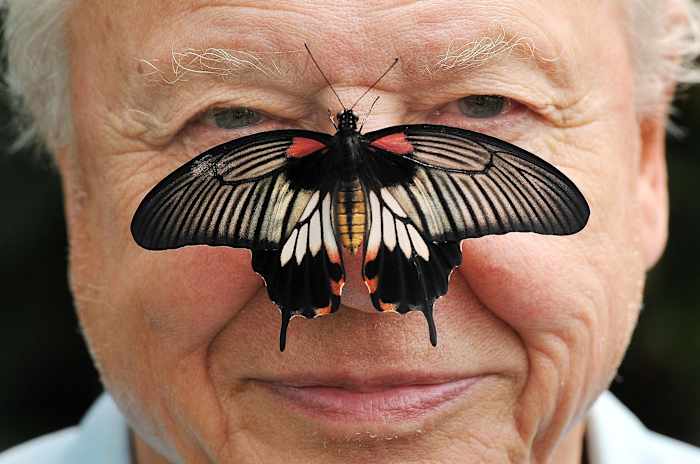
David Attenborough just turned 100 and he’s still the most important person in any room he enters. Think about that for a second. Most of us are lucky to remember where we put our keys at 80, but here’s a man who has spent an entire century witnessing the slow-motion destruction and miraculous resilience of our planet. He didn’t just survive the television era. He invented it. If you’re looking for a reason why he remains the gold standard for nature broadcasting, it isn't just that iconic, hushed whisper. It's the fact that he actually cares more than you do.
He has seen the world change in ways we can barely wrap our heads around. When he started at the BBC in the early 1950s, television was a flickering box in a few living rooms. Programs were broadcast live because recording technology was basically nonexistent. He wasn’t even allowed on screen at first because a producer thought his teeth were too big. Can you imagine? The man who would become the face of the natural world was almost sidelined because of a dental critique. If you enjoyed this piece, you should look at: this related article.
A Century of Witnessing the Wild
Most people think of Attenborough as the guy who talks to gorillas or hangs out with penguins. That’s a massive oversimplification. He’s a witness. There’s a specific kind of authority that comes from being alive long enough to see a glacier disappear or a species blink out of existence. He doesn't just read scripts. He tells us what he has seen with his own eyes.
His career began with Zoo Quest in 1954. It’s hard to grasp how revolutionary that was. Before then, nature films were mostly staged in studios or used grainy, disconnected footage. Attenborough went into the field. He went to Sierra Leone and Indonesia. He brought the wild into the British living room when the "wild" was still a mystery to most of the world. He wasn't just a presenter; he was a pioneer of the "blue-chip" nature documentary format we take for granted today. For another angle on this event, check out the recent coverage from IGN.
He didn't stop there. He became the Controller of BBC Two in 1965. This is the part of his resume people often forget. He introduced color television to the UK. He commissioned Monty Python’s Flying Circus. He’s responsible for Snooker becoming a televised hit because he wanted to show off what color TV could do. The man has a brain that understands both the intricacies of a bird’s mating dance and the logistics of global broadcasting.
The Shift from Discovery to Advocacy
For decades, Attenborough was criticized for being too neutral. Scientists and activists felt he was showing a "pristine" version of nature that didn't exist anymore. They wanted him to talk about climate change and habitat loss. For a long time, he stayed quiet on the politics of it. He believed that if you show people how beautiful something is, they’ll want to save it. You don't need to scream at them.
Then, something changed.
If you watch his work from the last fifteen years—think Our Planet or A Life on Our Planet—the tone is different. It’s urgent. He realized that showing the beauty wasn't enough. He had to show the scars. He’s used his 90s and now his 100th year to become the world’s most effective advocate for the environment. He isn't a radical. He’s a realist. When he spoke at COP26 or addressed the UN, he didn't use jargon. He used the simple, direct language of someone who knows the clock is ticking.
Why the Voice Works
Let’s talk about that voice. It’s been parodied a million times, but no one can truly replicate it. Why? Because it isn't a performance. It’s genuine curiosity.
When he whispers while standing three feet from a silverback gorilla, he isn't doing it for dramatic effect. He’s doing it because he doesn't want to disturb the animal. He has a profound respect for the subject matter that most modern influencers or TV hosts lack. He doesn't make the show about himself. He’s the lens, not the object.
His delivery relies on perfect timing. He knows when to shut up. That’s the secret. Modern television is terrified of silence. It fills every second with swelling orchestral music or fast cuts. Attenborough lets the wind howl. He lets the animal breathe. He understands that nature is dramatic enough on its own.
The Evolution of the Blue Chip Documentary
The "Blue Chip" style is what we see in Planet Earth or The Blue Planet. These are high-budget, cinematic experiences. Attenborough didn't just narrate them; he shaped their philosophy.
- Focus on Behavior: It isn't just a list of facts. It’s a story about survival, mating, or hunting.
- Technical Innovation: He pushed for the use of drones, thermal imaging, and ultra-high-speed cameras.
- Global Scope: These shows aren't about one forest. They’re about how the deep ocean affects the high mountains.
Living Through a Technological Revolution
Attenborough’s 100 years track almost perfectly with the evolution of media technology. He went from black-and-white film to 8K digital video. He went from radio to VR experiences. He’s always been an early adopter. Most people his age struggle with a smartphone, but he was narrating 3D documentaries when that was the new trend.
His willingness to adapt is why he hasn't become a relic. He isn't a "legacy" act. He’s still relevant because he stays curious about the tools used to tell the story. He understands that to reach a younger generation, you have to use the platforms they inhabit. That's why he joined Instagram in 2020 and broke the record for the fastest account to reach one million followers. He did it to send a message about the climate, not to post selfies.
The Attenborough Effect
There’s a measurable impact to his work. After Blue Planet II aired, there was a massive spike in public awareness regarding plastic pollution in the oceans. It led to policy changes in the UK and beyond. People call it "The Attenborough Effect."
It’s rare for a documentary to actually change how people live. But when David Attenborough shows a mother albatross accidentally feeding plastic to her chick, it hits differently. It isn't a lecture. It’s a tragedy. He makes the abstract feel personal. That’s his superpower. He bridges the gap between scientific data and human emotion.
Common Misconceptions About His Career
Many people think he’s a trained biologist. He actually studied Natural Sciences at Cambridge, but he spent much of his early career as a producer and executive. He’s a communicator first.
Another mistake is thinking he’s always been an environmentalist. As mentioned, his early work was much more focused on the "adventure" of finding animals. His transition into a "witness" for the planet happened gradually as he saw the places he loved change for the worse. He’s honest about his own delay in speaking up, which makes his current urgency feel more authentic.
What a 100 Year Old Voice Teaches Us
At 100, David Attenborough represents something we’re losing: patience.
We live in a world of ten-second clips and instant gratification. Attenborough’s work requires time. It requires sitting still and watching a plant grow or a predator wait for hours. He teaches us that the world is worth paying attention to. He teaches us that detail matters.
He has outlasted every trend. He’s seen the rise and fall of countless "nature experts" who tried to be louder or more extreme. He stayed the course. He kept his dignity. He kept his curiosity.
Moving Forward in a Changing World
We can't rely on one man to be the conscience of the planet forever. Even at 100, he’s still working, but the responsibility is shifting. If you want to honor his legacy, don't just watch his shows. Change how you interact with the world.
Start by paying attention to your local environment. You don't need to go to the Serengeti to see nature. It’s in your backyard or the cracks in the sidewalk. Attenborough’s message has always been that everything is connected. Your choices in the grocery store affect the oceans he filmed in The Blue Planet.
Next, support conservation efforts that focus on biodiversity. We’re losing species at an alarming rate, and protected areas are our best bet for stopping the slide. Don't just feel bad about the planet. Do something. Donate to the World Land Trust or similar organizations that Attenborough himself supports.
Finally, keep the conversation going. Talk about the things he’s shown us. Don't let the "Attenborough Effect" fade away as a trend from a few years ago. The best way to celebrate a century of David Attenborough is to ensure the world he spent his life filming actually survives for another hundred years. Turn off the TV, go outside, and look at something living. Really look at it. That’s what he’s been trying to tell us all along.