On a quiet afternoon in Harding County, South Dakota, Gary "Gus" Licking walked his ranch. For decades, his boots kicked up the dust of the Hell Creek Formation, a sweeping expanse of sun-baked earth that holds the secrets of the late Cretaceous period like a locked vault. Gary was a cattle rancher. He understood weather, livestock, and the slow, grinding passage of seasons. He also knew his land was haunted.
Over the years, Gary had found things. A strange bone fragment here, an unusually sharp, dark tooth there. He knew they were old, but ranching leaves little time for chasing ghosts. You might also find this related article useful: The Myth of the Blocked Defence Bill and the Real Threat to National Security.
Then, in 2021, a commercial fossil-hunting crew from Theropoda Expeditions came to the ranch. They had just wrapped up another dig nearby and decided, on a whim, to spend a couple of days surveying Gary’s property. Within hours, a field prospector named Cole Jacobs walked up a dirt road, looked down, and stopped. Poking out of the ancient dirt was a single metatarsal bone.
It was the foot of a king. As highlighted in recent articles by The Guardian, the results are significant.
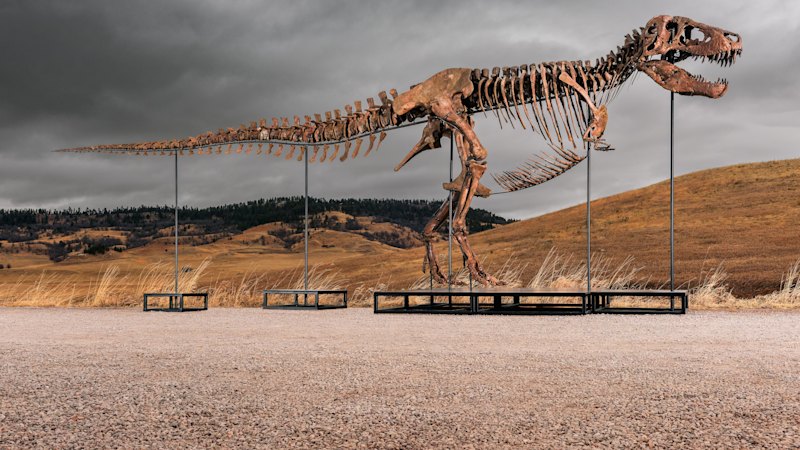
What followed was a painstaking, five-year obsession. Excavators chipped away at the rock, mapping, consolidating, and lifting nearly 1,000 individual fossil pieces. They weren't just finding bones; they were unearthing a titan. Standing 12.5 feet tall and stretching 38 feet from snout to tail, this Tyrannosaurus rex was a marvel. It was 61% complete by bone count, representing roughly 80% of the animal's actual bone mass. It was one of the most intact T. rex specimens ever pulled from the Earth.
They named him "Gus," in honor of the rancher who had protected the land he slept under.
But the earth demands a toll. Gary Licking never got to see Gus stand. In 2022, only a year into the massive excavation, Gary passed away. As his widow, Dana Licking, grieved, the diggers kept working, bringing her newly restored pieces of the beast as they emerged from the stone. It was a strange, bittersweet communion: a husband gone, while a 67-million-year-old giant was slowly brought back to life in his place.
When the restoration was finally complete, the team faced a absurdly modern problem. Where do you put a fully mounted, predatory-posed Tyrannosaurus rex in rural South Dakota?
The answer was a local pickleball court.
There, beneath low ceilings and fluorescent lights, the ancient predator stood. Its dark, mineral-stained bones were held together by a complex armature of steel, its terrifying jaws open in a silent, eternal roar. It was a jarring contrast—prehistoric violence meet modern leisure.
But Gus was never destined to stay in a South Dakota sports complex. The machinery of high finance was already turning.
On a humid Tuesday in July 2026, the scene shifted from the dust of Harding County to the sleek, brutalist architecture of Sotheby’s Breuer building in New York City. The contrast was absolute. In South Dakota, the fossil was dirt, sweat, and the memory of a dead rancher. In Manhattan, it was high art, a status symbol, and liquid capital.
Because the real skull of Gus was so heavy and fragile, Sotheby’s couldn't risk mounting it on the steel armature upstairs. Instead, they placed the genuine 54-inch skull in the lobby. Visitors entering the auction house walked past those terrifying, dagger-like teeth, a stark reminder of natural savagery housed within the temple of luxury. Upstairs, a lightweight replica head sat on the skeleton, which was listed simply as "Lot 20."
The pre-sale estimate was a staggering $20 million to $30 million. But the art market, fueled by tech billionaires and hedge fund barons, has developed an insatiable appetite for the prehistoric. Dinosaurs are the new Picassos.
The bidding began.
It was a brief, violent storm of money. For ten minutes, seven bidders clashed. Phone lines crackled. Online portals blinked. The price blew past $30 million. It climbed through the $40 millions, chasing the ghost of "Apex," a Stegosaurus that had set the previous record of $44.6 million in 2024.
"Try a bigger bite," the auctioneer, Phyllis Kao, coaxed the room, her voice echoing off the walls. "It's a T. rex, after all."
The hammer fell at a jaw-dropping $50.1 million.
The winner was a mystery. An anonymous phone bidder, shielded by attorneys and representatives, had purchased a king.
While the auction house celebrated the historic sale, a quiet dread settled over the scientific community. To a paleontologist, a fossil sold to a private collector is a tragedy.
"A fossil not in a recognized museum collection cannot be studied and is therefore lost to research," lamented Professor Richard Butler, a vertebrate paleontologist.
The tension is deeply systemic. In countries like Mongolia or Brazil, fossils are state property. They belong to the public. But in the United States, the law of the land is absolute: if you find it on private property, it is yours to sell, destroy, or keep in your living room.
Scientists fear that Gus will disappear into a private mansion, far from the reach of graduate students and high-tech scanners. They argue that the true value of a fossil isn't in its bones, but in the data it holds. Gus's skeleton tells a brutal story. His bones show healed fractures in the ribs and clear tyrannosaurid bite marks on his skull—scars of battles fought 67 million years ago. If those bones are locked away, that story is silenced.
There is, however, a fragile thread of hope. Ken Griffin, the billionaire who bought Apex the Stegosaurus, loaned the fossil to the American Museum of Natural History. Perhaps Gus’s new owner will do the same.
For now, the ranch in Harding County is quiet again. The dust has settled over the empty pit where Gus lay for millions of years. Dana Licking still looks out over the land she and Gary loved, knowing that a piece of their quiet life now belongs to a shadow on the other end of a phone line.