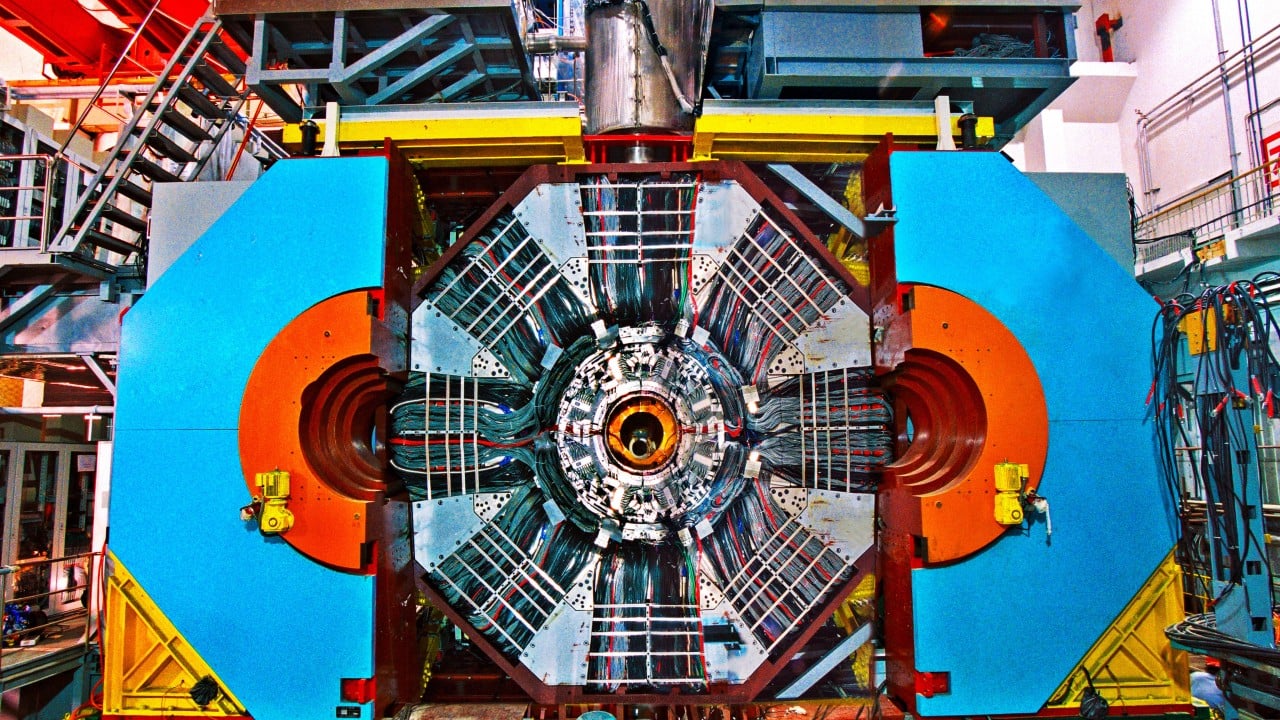
The recent announcement from the Beijing Spectrometer III collaboration marks a turning point in particle physics, resolving a fifty-year experimental drought regarding the existence of glueballs. By identifying the particle designated as X(2370) as a structure dominated by a pseudoscalar glueball state, researchers have provided empirical weight to foundational predictions of Quantum Chromodynamics. Standard matter relies on quarks bound by gluons, but the theoretical framework of Quantum Chromodynamics permits gluons to interact with one another independently, forming bound states devoid of valence quarks entirely.
Understanding the weight of this finding requires deconstructing the architecture of the strong interaction, the operational parameters of the Beijing Electron Positron Collider, and the specific evidentiary criteria that separate a theoretical candidate from a confirmed physical reality.
The Structural Mechanics of Quantum Chromodynamics
In the Standard Model, forces are mediated by vector bosons. Photons mediate electromagnetism without carrying electrical charge themselves, meaning photons do not interact directly with other photons at tree level. The strong nuclear force, governed by Quantum Chromodynamics, operates under a fundamentally different mathematical structure known as a non-Abelian gauge theory. The vector bosons of the strong force—gluons—carry color charge themselves.
This self-interaction property creates a unique physical mechanism:
- Color Charge Retention: Because gluons possess color charge, they exert forces on other gluons.
- Non-Linear Field Equations: The equations governing gluon fields contain cubic and quartic self-interaction terms, unlike Maxwell's equations for electromagnetism.
- Confinement and Bound States: This self-coupling leads directly to confinement, where free color charges cannot exist in isolation, and permits the theoretical formation of glueball states composed strictly of pure gauge field energy.
Without explicit experimental isolation of these states, Quantum Chromodynamics remained unverified in its low-energy, non-perturbative sector. The X(2370) particle functions as the empirical key that unlocks this sector.
The Experimental Cost Function and Data Volume
Isolating a glueball is an exercise in signal-to-noise optimization. Glueballs mix readily with conventional quark-antiquark mesons that share identical quantum numbers, obscuring their pure-gluon origin. To overcome this background contamination, the Beijing Spectrometer III experiment utilized a high-statistics dataset comprising approximately ten billion J/psi particle decays.
The production of J/psi particles via electron-positron collisions provides a gluon-rich laboratory. When a J/psi particle decays, the annihilation of its charm quark and anti-charm quark proceeds primarily through a three-gluon intermediate state. This topology creates an optimal environment for producing glueballs while suppressing standard quark-model states.
The analytical progression required fifteen years of systematic data acquisition and refinement:
- Initial Detection (2011): The discovery of the X(2370) state during the analysis of radiative J/psi decays provided the raw candidate signal.
- Quantum Number Determination (2024): Measurement of the spin, parity, and charge conjugation properties established that the particle possesses zero spin and negative parity, matching theoretical lattice calculations for a pseudoscalar glueball.
- Flavor-Singlet Verification (2026): Mapping multiple new decay modes allowed researchers to confirm the flavor-singlet nature of the particle, ruling out significant quark contamination and proving that its dominant constituent is pure gluon matter.
Comparative Methodologies in High-Energy Physics
The historical search for glueballs spans multiple facilities, each constrained by distinct technical boundaries. Understanding why prior facilities failed to definitively isolate these states clarifies the magnitude of the recent milestone.
| Facility / Experiment | Primary Energy Range | Collision Mechanism | Primary Limitation in Glueball Search |
|---|---|---|---|
| Beijing Electron Positron Collider | Tau-Charm Region ($3$ to $5$ GeV) | Electron-Positron Annihilation | Limited by luminosity growth curves, overcome via long-term accumulation of $10^9$ to $10^{10}$ J/psi events. |
| Large Electron-Positron Collider | High Energy ($Z$ pole and above) | Electron-Positron Annihilation | Optimized for electroweak precision measurements rather than high-statistics gluon-rich radiative decays. |
| Super Proton Synchrotron / LHC | High Energy Frontier | Proton-Proton / Heavy Ion | High background noise from complex hadronic jets obscures narrow glueball decay signatures. |
The strategic advantage of the Beijing facility lies in its specialization within the tau-charm energy region. By abandoning the pursuit of higher energy thresholds in favor of extreme luminosity and clean initial-state kinematics, the facility maximized the production cross-section for J/psi resonant states.
Evidentiary Standards and Flavor-Singlet Proofs
A common pitfall in hadron spectroscopy is the misidentification of conventional mesons as exotic matter. Quark-antiquark pairs can easily mimic the mass and spin-parity assignments of predicted glueballs through state mixing. To eliminate this ambiguity, the research team focused on establishing the flavor-singlet property of the X(2370).
In particle physics, a flavor-singlet state couples equally to up, down, and strange quark-antiquark pairs upon decay. Ordinary mesons typically exhibit strong flavor symmetry-breaking patterns due to mass differences among constituent quarks. By measuring the relative branching fractions of the X(2370) across various decay channels, the collaboration demonstrated that the state respects the flavor-blind emission patterns characteristic of gluon-dominated structures.
This isolation of the flavor-singlet property addresses the primary skepticism historically raised by theoretical physicists regarding glueball candidates. It bridges the gap between lattice Quantum Chromodynamics numerical simulations—which compute glueball masses on supercomputers using discretized spacetime grids—and real-world particle interactions.
Strategic Outlook for Low-Energy Gauge Theory
With the empirical identification of the glueball dominant component in the X(2370), the focus of high-energy phenomenology shifts from discovery to precision mapping. The immediate priority involves charting the complete spectrum of scalar and tensor glueball states predicted by lattice calculations to verify whether higher-mass glueballs follow the predicted mass hierarchy.
Future experimental iterations will require upgraded luminosity targets to accumulate datasets exceeding current thresholds by an order of magnitude. This expansion will enable differential cross-section measurements of rare decay channels, providing tighter constraints on the non-perturbative parameters of the strong interaction. Research groups must now integrate these confirmed glueball mixing angles into broader models of nuclear binding, recalibrating how subatomic mass is distributed between quark current masses and pure gluon field energy.