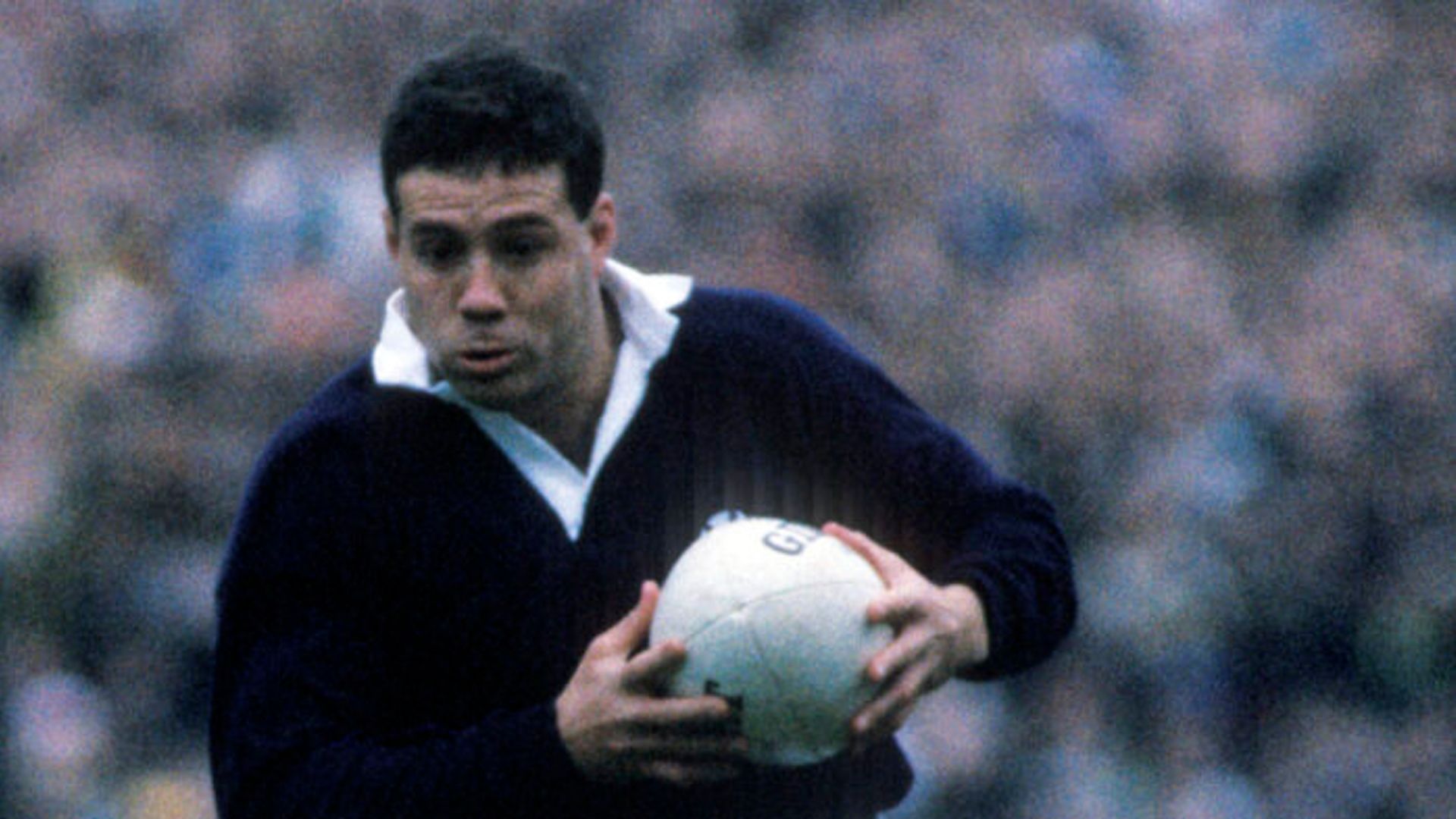
Former Scotland and British & Irish Lions centre Scott Hastings has died at the age of 61 following rapid complications from cancer treatment. His family confirmed he passed away peacefully on the morning of Sunday, May 17, 2026, at Edinburgh’s Western General Hospital. The date carried a poignant weight, falling on what would have been the birthday of his late wife, Jenny, who passed away in 2024. Hastings leaves a legacy as Scotland’s most-capped male centre of all time, earning 65 caps in an 11-year international career that spanned the monumental shift from amateurism to the professional era.
To look at Scott Hastings merely through the lens of modern sports statistics is to miss the entire point of the era he defined. He was not a product of an industrialized academy system or a laboratory-built athlete. He was a force of pure, unadulterated defiance on a rugby pitch.
During the late 1980s and early 1990s, Scottish rugby operated on a unique wavelength. It was a time when a squad composed of lawyers, farmers, and teachers could look a monolithic English or French side in the eye and simply refuse to break. Hastings was the defensive heartbeat of that philosophy. While his older brother, Gavin, provided the booming boot and the patrician authority from fullback, Scott was the enforcer in the midfield, a player whose game was built on a brutal, low-slung tackling technique that changed the momentum of test matches.
The Tackle That Defined a Generation
The zenith of this defiant era arrived on March 17, 1990. Scotland and England met at Murrayfield, both chasing a Five Nations Grand Slam. The political and cultural tension in Edinburgh that afternoon was palpable, but the sporting stakes were purely clinical. England possessed a backline of terrifying speed, spearheaded by the prolific winger Rory Underwood.
When Underwood broke through the Scottish line, a try seemed inevitable. It was the kind of moment that collapses a defense and alters the course of rugby history.
[England Breakaway] ----> Underwood clear on the wing
                                 |
                          [The Pursuit]
                                 |
                        Hastings' Cover Tackle ----> Ball dislodged / Try prevented
Hastings executed a cover tackle of such precision and velocity that it remains etched into the collective memory of the sport. He did not just stop Underwood; he erased the space the winger needed to breathe, driving him into touch and preserving a 13-7 victory. It was a defensive intervention that required an understanding of angles and an indifference to personal welfare that modern tracking data can quantify but never truly replicate.
That single moment secured Scotland’s last true Grand Slam. It also established a template for how Scotland had to play to survive at the highest level. Hastings understood that when you lack the sheer playing numbers of your neighbors, your margin for error is zero. You win through organizational telepathy and sheer physical refusal.
Transitioning Across the Fault Line of 1995
The true test of Hastings’ sporting intelligence came in 1995 when rugby union declared itself an open game, ending more than a century of amateurism. Many players of his generation struggled with the transition. The sudden influx of money, structured training regimes, and corporate expectations stripped away the collegiate atmosphere that had sustained the sport for decades.
Hastings did not flinch. Instead, he captained Edinburgh and showed younger players how to carry the values of the amateur era into a commercialized environment. He proved that professionalism did not mean losing your identity. He played 12 times for the British & Irish Lions across two grueling tours—Australia in 1989 and New Zealand in 1993—proving his defensive durability against the best standard of rugby the southern hemisphere could offer.
When he retired from the international game in 1997, he held the record as Scotland’s most-capped player.
The Modern Midfield Deficit
The passing of Scott Hastings forces a harsh assessment of where Scottish rugby stands today. Modern international rugby is obsessed with size in the midfield. Coaches routinely select giant, crash-ball centers designed to dent the defensive line through raw mass rather than subtle angles or anticipation.
International Cap and Try Efficiency (Historical Midfield Context)
| Player | Caps | Tries | Era | Primary Attribute |
|---|---|---|---|---|
| Scott Hastings | 65 | 10 | 1986–1997 | Cover tackling / Searing acceleration |
| Jim Renwick | 52 | 5 | 1972–1984 | Tactical kicking / Distribution |
| Gregor Townsend | 82 | 17 | 1993–2003 | Unpredictability / Line-breaking |
What Hastings possessed was an elite reading of the game that allowed him to play much bigger than his physical frame. He understood the concept of sliding defense before it became a staple of coaching manuals. He knew when to commit to a tackle and when to shepherd an attacker toward the touchline.
Current Scottish setups often struggle with consistency in the standard defensive channels. The game has become faster, certainly, but the fundamental requirement remains the same: someone in the midfield must be willing to do the dirty work so the creative players can play. Hastings did that work without demanding the spotlight, allowing his brother Gavin and fly-half Craig Chalmers the space to manage the game.
A Public Battle Handled with Private Dignity
After his retirement from the pitch, Hastings became a familiar, energetic voice in the commentary box. He brought the same lack of pretense to broadcasting that he did to the pitch. He did not rely on manufactured controversy or modern media buzzwords; he spoke with the quiet authority of a man who had stood in the eye of the storm at Murrayfield and knew exactly what a player was feeling when the pressure mounted.
His final years were defined by immense personal adversity. He was diagnosed with non-Hodgkin's lymphoma in 2022, a battle he fought openly to raise awareness for blood cancers. This came alongside the profound grief of losing his wife, Jenny, under deeply tragic circumstances in 2024.
Through it all, the rugby community watched a man apply the same resilience to his private life that had made him an icon on the field. He did not retreat from the world. He remained a visible, supportive figure for Scottish rugby, offering guidance to a new generation of players who knew him only through grainy video clips of the 1990 Grand Slam.
The generation of 1990 is beginning to thin out, and with their departure goes a specific brand of Scottish sporting identity—one rooted in local clubs, fierce civic pride, and an absolute refusal to be intimidated by larger nations. Scott Hastings was the embodiment of that spirit. His death marks more than the passing of a great player; it marks the steady closing of the curtain on a golden age when Scotland ruled its own destiny through sheer force of will.


