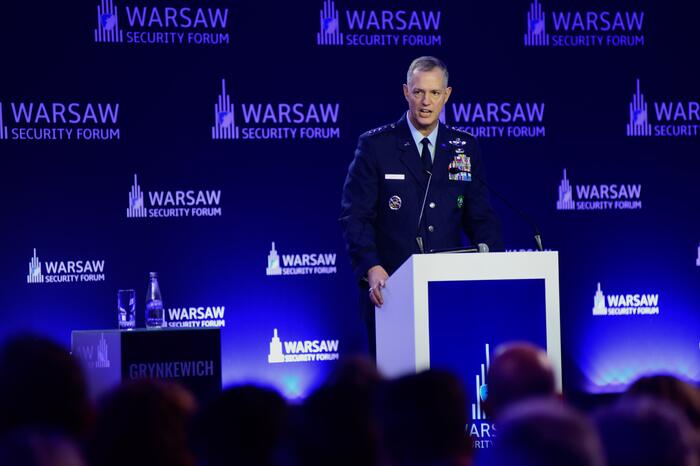
The posture of forward-deployed military commands is rarely captured by rhetorical flourishes about readiness. When a senior NATO commander articulates a stance of being ready to fight tonight while simultaneously disavowing any institutional desire for war, the statement reflects a fundamental tension in modern deterrence theory. This posture is not a casual expression of morale; it is a calculated signaling mechanism designed to manipulate an adversary's cost-benefit calculus under conditions of extreme strategic friction. Deconstructing this posture requires examining the underlying mechanics of credible deterrence, the economic and logistical constraints of high-intensity readiness, and the systemic vulnerabilities that emerge when political objectives diverge from operational capabilities.
To understand how modern military alliances maintain stability without escalation, one must dissect the primary drivers of credible deterrence. Deterrence is a function of two variables: capability and credibility. Capability represents the tangible instruments of destruction and defense, ranging from armored brigades to integrated air defense networks. Credibility, however, is abstract. It is the adversary's subjective probability assessment that threats of retaliation will actually be executed should a threshold be crossed. When a commander emphasizes immediate readiness, the objective is to collapse the temporal gap between political intent and military execution. This eliminates the adversary's window for opportunistic aggression, a tactical calculus often referred to as anti-access area denial disruption.
The operational architecture required to sustain a "ready tonight" posture is governed by strict resource allocation models. Military organizations operate under a perennial trade-off between readiness and modernization. Resources poured into maintaining high operational tempos and immediate ammunition stockpiles for legacy platforms inevitably draw capital away from research and development for next-generation capabilities. Consequently, an alliance maintaining immediate combat readiness must absorb significant opportunity costs. Maintenance cycles compress, personnel burnout increases, and supply chains experience heightened stress. This creates a fragile equilibrium where the appearance of absolute strength masks underlying sustainability vulnerabilities.
An analysis of this posture must also account for the strategic ambiguity inherent in multi-lateral alliances. NATO is not a monolithic actor; it is a coalition of sovereign states with divergent threat perceptions, domestic political pressures, and fiscal constraints. A commander's public declaration of readiness serves an internal audience just as much as an external one. It acts as a cohesive mechanism designed to reassure frontline member states that the collective defense guarantee remains operative, while signaling to domestic constituencies in distant capitals that deterrence is holding efficiently. Yet, this internal signaling introduces a structural hazard: moral hazard. If smaller member states perceive an ironclad, frictionless defense guarantee, they may adopt more provocative diplomatic postures, increasing the probability of inadvertent escalation.
The friction points in this dynamic are amplified by modern information warfare and rapid escalation dominance. In previous eras, mobilization was a visible, protracted process that gave opposing states time to de-escalate through diplomatic channels. Today, automated command and control systems, hypersonic delivery mechanisms, and cyber warfare capabilities compress decision cycles from days to minutes. A posture of immediate readiness is therefore a direct response to this temporal compression. If the speed of potential attack approaches zero, the speed of defensive response must match it. However, this high-readiness posture increases the risk of false positives, where routine exercises or defensive repositioning are misinterpreted by an adversary as preparations for a preemptive strike.
Evaluating the efficacy of this strategy requires looking beyond the rhetoric to examine structural resilience. True readiness is measured not by public declarations, but by industrial base capacity, logistics depth, and command redundancy. When supply chains for critical munitions face bottlenecks, or when interoperability among disparate national forces remains uneven, the "ready tonight" claim transitions from an operational reality to a psychological deterrent. The challenge for military strategists is ensuring that the psychological component does not outpace the material foundation supporting it. If an adversary develops intelligence capabilities sophisticated enough to map the true logistical limits behind the rhetoric, the deterrent effect evaporates, exposing a dangerous bluff.
The long-term trajectory of alliance readiness depends on resolving the tension between immediate defensive posture and long-term strategic adaptation. As geopolitical competition shifts toward persistent, below-threshold grey-zone conflicts, conventional high-readiness forces risk being optimized for the wrong threat environment. The strategic imperative moving forward is not merely maintaining the capacity to fight tonight, but developing the institutional agility to adapt to multi-domain shocks without destabilizing the fragile economic and political coalitions that underpin collective security.


