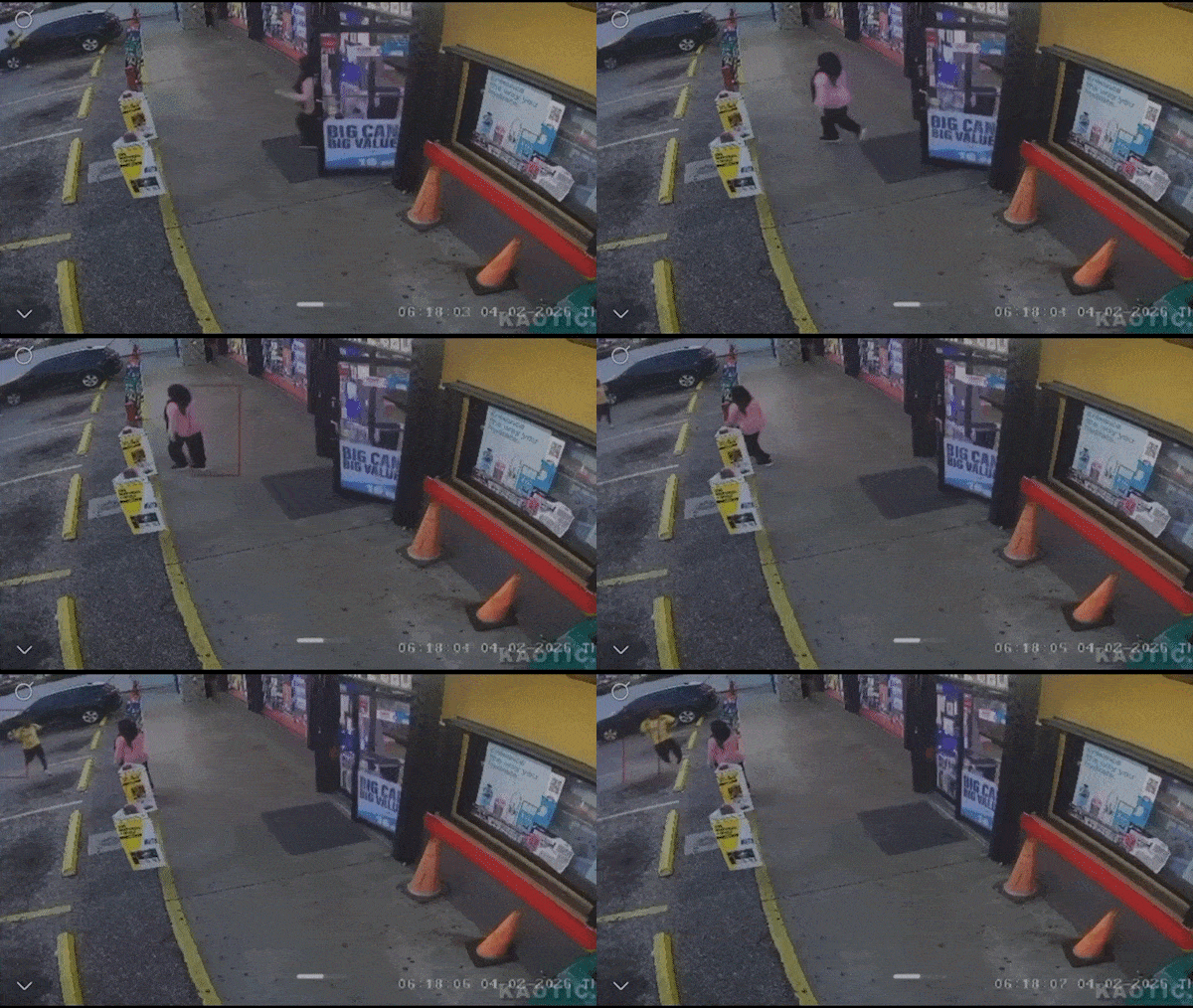
The screen glows with a soft, clinical light, illuminating the faces of millions of people who are currently finishing their morning coffee or riding the subway to work. On that screen, a life is ending. It isn’t a cinematic death with swelling violins and a scripted goodbye. It is messy. It is loud. It is final.
The footage is raw, grainy, and completely uncensored. When Donald Trump shared the video of a woman being killed, he wasn't just distributing a file; he was weaponizing the final seconds of a human existence to score a political point. We have moved past the era of the soundbite and entered the era of the visceral shock. The pixels on the screen don't represent a policy debate or a campaign platform. They represent a daughter, perhaps a mother, whose last moments have been transformed into a permanent, digital ghost that can be summoned by a single click.
Consider the weight of that click.
When we watch a person die through a smartphone, something inside us shifts. It’s a subtle fracture in the psyche. For the politician, the video is a tool—a blunt instrument used to hammer home a message about crime, border security, or perceived chaos. But for the viewer, it is an intrusion into the most private event a human being can experience. Death used to be the one thing we did alone or with those we loved. Now, it is public property.
The woman in the video becomes a character in a narrative she never signed up for. She is no longer an individual with a history, a favorite song, or a specific set of dreams. She is "The Victim." She is the "Proof."
Think about the family she left behind. Imagine sitting in a quiet living room, trying to process a loss that feels insurmountable, only to realize that your loved one’s death is currently trending. It is being replayed in loops. It is being dissected by pundits. It is being shared by a former president to millions of followers who are using those final, agonizing seconds to validate their own anger. This is the new collateral damage of the digital age.
The mechanics of the internet are designed to reward this kind of escalation. An algorithm doesn't have a moral compass. It doesn't know the difference between a viral dance video and a snuff film; it only knows engagement. It measures the spike in heart rates and the frantic tapping of keyboards. When a high-profile figure shares "vicious" footage, they are feeding a machine that thrives on the breakdown of empathy.
We used to have gatekeepers. There were editors and producers who had to weigh the public’s right to know against the basic dignity of the deceased. They asked: Is this necessary? Does the graphic nature of this footage add understanding, or does it merely titillate? Today, those gates have been torn off their hinges. The raw feed is the only currency that matters.
The danger lies in desensitization. When we are constantly exposed to the most extreme versions of reality, the "normal" world begins to look pale and insignificant. We start to require higher doses of outrage to feel anything at all. If a statistic about crime doesn't move us, perhaps a photo will. If a photo fails, maybe a video. If a video of a struggle isn't enough, we demand the video of the kill.
It is a race to the bottom of the human spirit.
Political strategy has always been about framing reality, but there is a line where framing becomes exploitation. Using the literal expiration of a human life to sharpen a campaign edge isn't just "tough" politics; it’s a fundamental rejection of the sanctity of the individual. It treats a person as a prop.
We are told this is about "the truth." We are told that we need to see the "uncensored" reality of the world to understand the stakes of the upcoming election. But whose truth are we seeing? The truth of the victim is silenced forever. The truth of the grieving family is ignored. All that remains is the truth of the viewer’s reaction—an immediate, lizard-brain response of fear and fury.
Fear is a powerful motivator. It bypasses the prefrontal cortex, the part of the brain that handles logic and long-term planning, and goes straight for the amygdala. When you see a "vicious" act of violence, your body reacts before your mind can catch up. You aren't thinking about crime statistics or the complexities of the justice system. You are just afraid. And a person who is afraid is much easier to lead.
This isn't just about one politician or one specific video. It's about a culture that has decided that nothing is sacred if it can be used as content. We have turned the most profound human experiences into "clips." We have traded our capacity for mourning for a capacity for outrage.
Suppose for a moment that the woman in that video was someone you knew. Not a hypothetical "character," but a person whose voice you recognized. Imagine the sound of her breath in those final moments being used as a background track for a political rally. The horror isn't just in the act of violence itself; it's in the secondary violence of its endless, indifferent broadcast.
The digital footprint of that death will never be erased. It will live on servers, in cloud storage, and in the cache of millions of browsers. Long after the election is over, long after the political talking points have shifted to something else, that woman will still be dying on our screens. She is trapped in a digital loop, a ghost in the machine that we created to keep ourselves entertained and "informed."
We are losing the ability to look away. We have convinced ourselves that "looking" is a form of courage—that by witnessing the most brutal aspects of our society, we are being "real." But there is a difference between witnessing and voyeurism. Witnessing requires a sense of responsibility to the subject. Voyeurism only requires a screen.
When the footage is described as "vicious" and "uncensored," it is marketed like a horror movie. It is designed to attract the curious and the morbid. It transforms a tragedy into a spectacle. In this theater of the macabre, the victim is the only one who doesn't get a curtain call.
The invisible stakes are the very fabric of our shared humanity. If we can no longer agree that a person's death is a private, solemn event, then we have lost the foundation of mutual respect. We are becoming a society of spectators, watching each other’s downfalls through a glass barrier that protects us from the blood but exposes us to the poison.
The real power doesn't belong to the person who shares the video. It belongs to the person who chooses not to watch. It belongs to the person who realizes that some things are too heavy to be used as digital currency.
Every time we refuse to engage with the commodification of death, we reclaim a small piece of our own dignity. We acknowledge that a human life is more than a data point or a viral moment. We recognize that the silence following a tragedy is often more profound and more honest than any political commentary could ever be.
The woman on the screen is gone. She cannot speak for herself. She cannot ask for her privacy back. She is at the mercy of our clicks, our shares, and our appetite for the extreme. We are the ones who decide if her death remains a tragedy or if it becomes just another piece of junk mail in the inbox of the American consciousness.
The glow of the smartphone eventually fades. The subway reaches its stop. The coffee cup is empty. But the image of that final moment lingers, a dark stain on the periphery of the mind, reminding us that once you see something, you can never truly unsee it. You can only choose what kind of world you want to build with the fragments of what remains.