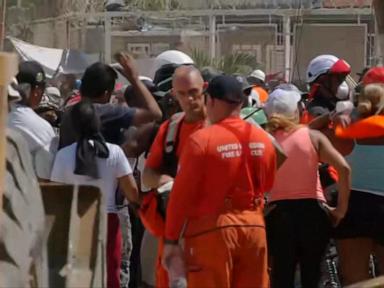
The standard breaking news formula is as predictable as it is broken. Ground shakes in Venezuela. Buildings collapse. Within minutes, international news feeds flood the internet with dramatic, tear-jerking videos of rescuers digging through concrete with their bare hands. The narrative is always identical: "Every second counts, and we must deploy every human being available to dig right now."
It is a comforting, heroic lie.
Having analyzed disaster logistics and structural failure data across multiple major Latin American seismic events, the brutal reality is that the immediate, chaotic rush to find survivors often kills more people than it saves. The "golden hour" narrative is a media-manufactured obsession that prioritizes emotional optics over structural engineering and cold, hard survival mathematics. When a crisis hits a fragile infrastructure environment like Venezuela, the conventional playbook of flooding the zone with untrained, emotionally driven volunteers is a recipe for secondary collapse and logistical paralysis.
Stop looking at the camera-ready rescue crews. Start looking at the structural physics and the supply chains they are actively disrupting.
The Mathematical Failure of Immediate Insertion
The standard premise of earthquake reporting is flawed because it assumes any action is good action. In reality, a collapsed building is not a pile of loose dirt; it is a highly unstable, precarious system of balanced vectors and friction.
When untrained personnel or rushed rescue teams scramble onto a freshly collapsed structure without conducting a rigorous structural integrity assessment, they introduce dynamic loads to a system that is barely holding itself together under static loads.
Imagine a scenario where a three-story residential concrete frame in Caracas suffers a soft-story failure. The ground floor has pancaked, but the upper two floors are suspended by damaged, exposed rebar and fractured columns.
$$F_{net} = 0$$
The system is temporarily at rest, but the margin of safety is practically non-existent. Shoving fifty eager rescuers onto that rubble pile changes the load distribution instantly.
- Dynamic loading: The vibration of footsteps and hand tools creates micro-shocks.
- Shifting centers of mass: Moving debris without calculating load-bearing paths triggers secondary structural failure.
- Air pocket collapse: Settling rubble crushes the very voids where victims are surviving.
Data from international urban search and rescue (USAR) deployments shows that a significant percentage of trapped victims who survive the initial shock perish during sloppy, early-stage extraction attempts. The media celebrates the one person pulled from the dust; they ignore the three who were crushed fifty feet away because someone stepped on the wrong slab.
The Logistics Paradox: More Help Equals More Death
The public wants to see cargo planes landing immediately, filled with foreign aid and specialized personnel. This sentiment ignores the foundational rule of disaster response: capability is useless without capacity.
When a major earthquake hits an area with already compromised infrastructure, the local airport, roads, and communication grids are severely degraded. Flooding these bottlenecked channels with international search and rescue teams creates a logistical nightmare that starves the affected region of what it actually needs: clean water, heavy earth-moving equipment, and automated shoring tools.
I have watched logistics hubs freeze up entirely because well-meaning organizations sent hundreds of personnel who required food, water, housing, and security themselves. Instead of extracting victims, local resources are diverted to keep the foreign rescuers alive.
If you want to maximize survival rates in a seismic crisis, the response must be heavily gated. You do not send people; you send heavy equipment operators, structural engineers, and heavy-duty hydraulic tools. The guy with a shovel and a high-vis vest is a liability, not an asset.
Dismantling the "People Also Ask" Flawed Premises
Should citizens immediately dig out their neighbors?
No. The instinct to help is human, but it is deeply dangerous. Untrained civilian excavation frequently causes localized cave-ins within the rubble pile. Furthermore, pulling someone out of a collapse incorrectly can trigger crush syndrome. When a limb has been compressed for hours, toxins build up. If you release the pressure instantly without medical stabilization, those toxins rush to the heart and kidneys, causing death within minutes of rescue. Extraction requires medical triage on-site, under the rubble, not a frantic tug-of-war.
Why doesn't the government accept all international aid instantly?
Because unfiltered aid is toxic. After major seismic events, airports are choked with un-inventoried boxes of expired medication, winter clothing sent to tropical climates, and search teams that don't speak the language. Sorting through this garbage diverts military and emergency personnel away from actual triage zones. Refusing aid isn't always political stubbornness; it is often basic operational survival.
The Uncomfortable Blueprint for True Resilience
The hard truth is that saving lives after an earthquake happens five years before the fault line slips, or it doesn't happen at all.
Investing millions into rapid-response search teams is a shiny, public-relations band-aid designed to cover up a systemic failure to enforce building codes. Venezuela’s seismic risk isn't dangerous because the earth moves; it is dangerous because informal settlements, like the barrios of Petare, are built with non-ductile concrete and unreinforced masonry on steep, unstable slopes.
A heavy search and rescue team cannot operate effectively in an informal hillside slum. The roads are too narrow for the equipment, the soil is too unstable for shoring, and the density ensures that one collapse triggers five more.
If the goal is genuinely to minimize the body count, the strategy must pivot entirely away from the post-disaster theater.
- Mandatory retrofitting over rescue training: Disburse micro-grants for structural reinforcement of informal dwellings rather than funding municipal rescue squads.
- Automated heavy-equipment registries: Create decentralized, blockchain-backed databases of privately owned excavators and cranes that can be legally commandeered by local engineers instantly, bypassing bureaucratic red tape.
- Accepting the loss: The most controversial, brutal reality that emergency planners understand but never say out loud: some structures must be written off immediately. Spending 48 hours trying to breach a deeply buried void in a completely pulverized high-rise while neglecting superficial collapses nearby is mathematically irresponsible. You maximize the total number of lives saved by focusing exclusively on high-yield, low-risk extraction points.
The next time you see a dramatic news broadcast showing a chaotic swarm of people clambering over a collapsed building in Latin America, turn it off. Do not applaud. Understand that you are watching a failure of engineering, a failure of logistics, and an operational disaster disguised as a human triumph.
Stop funding the rescue spectacle. Build walls that do not fall down.