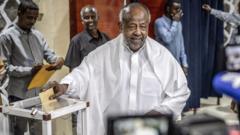
The 97.8% electoral victory of Ismail Omar Guelleh for a fifth consecutive term is not a measurement of public sentiment but a diagnostic indicator of a fully saturated political monopoly. In a functional competitive market, such a margin represents a statistical impossibility; in the context of Horn of Africa geopolitics, it represents the terminal stage of institutional capture. This outcome is the result of three specific structural mechanisms: the systematic elimination of political friction, the weaponization of the state's geostrategic rent-seeking model, and the deployment of digital and legal surveillance frameworks to atomize dissent.
The Frictionless State: Engineering the 97.8% Result
The primary objective of the Guelleh administration is the reduction of political transaction costs. By ensuring the main opposition coalition, the Union for National Salvation (USN), boycotted the election or faced insurmountable registration barriers, the state removed the "cost" of campaigning. This created a vacuum where the only remaining variable was the mobilization of the state apparatus to simulate legitimacy.
This simulation functions through a feedback loop of institutional dependencies:
- Executive Enclosure: The constitutional amendment in 2010 removed term limits, essentially converting the presidency into a lifetime appointment. This ensures that the bureaucracy views the incumbent not as a temporary administrator but as the permanent source of all capital allocation.
- Media Homogenization: With the state-run Radio Television Djibouti (RTD) serving as the exclusive source of broadcast information, the administration controls the narrative infrastructure. There is no competitive marketplace of ideas because the "bandwidth" is legally restricted to a single signal.
- Judicial Alignment: The Constitutional Council serves as the final arbiter of election results, yet its composition is determined by executive appointment. This creates a circular logic where the entity validating the win is a subsidiary of the winner.
Geostrategic Rent-Seeking as a Survival Logic
Djibouti’s internal stability is financed by its external utility. The nation has effectively commodified its geography, transforming its 23,200 square kilometers into a high-yield asset for global military powers. This creates a "Geostrategic Rentier State" where the primary revenue stream is detached from the productivity of the domestic workforce.
The presence of military installations from the United States, China, France, Japan, and Italy provides Guelleh with two layers of protection. First, it provides a steady stream of hard currency—estimated at over $125 million annually in base lease fees alone—which funds the security forces required to suppress internal unrest. Second, it creates a "Security Dilemma" for international observers. Western powers are hesitant to apply pressure regarding human rights or democratic norms because they require the logistics hub provided by the Port of Doraleh and Camp Lemonnier.
This rent-seeking model decouples the government from the governed. In a typical social contract, the state provides services in exchange for taxes. In Djibouti, the state provides access to foreign militaries in exchange for rent, rendering the economic welfare of the local population secondary to the maintenance of the infrastructure used by foreign tenants. This explains why, despite hosting some of the most sophisticated military technology on earth, Djibouti maintains a poverty rate where over 20% of the population lives in extreme poverty.
The Infrastructure of Suppression: Digital and Legal Control
The 2021 election cycle saw a refined application of "Smart Autocracy." This involves using specific legal instruments to preemptively stifle the coordination of dissent. The administration utilizes the 2017 Law on Cybercrime to categorize online criticism as a threat to national security or public order.
The mechanism of control follows a predictable sequence:
- Pre-emptive Detention: High-profile critics and journalists are detained weeks before the vote to disrupt their ability to organize.
- Information Blackouts: Targeted internet throttling in specific neighborhoods or during opposition gatherings prevents the viral spread of dissent.
- Asset Freezing: Utilizing anti-money laundering frameworks to target the funding sources of civil society organizations.
The result is an "asymmetry of information." The state has a granular view of the citizenry through surveillance and the neighborhood-level networks of the ruling People’s Rally for Progress (RPP), while the citizenry remains blind to the activities and intentions of the opposition.
The Externalities of Total Power: Strategic Risks
While the 97.8% victory suggests absolute stability, it introduces a significant "Single Point of Failure" risk. The centralization of power in a single 73-year-old individual creates a succession vacuum. In a system where institutions are hollowed out to serve the executive, the eventual transition of power—whether by biology or upheaval—will likely be non-linear and volatile.
Investors and geopolitical strategists must account for the "Fragility Paradox": the more rigid a regime becomes to maintain order, the less capable it is of absorbing shocks. The total suppression of legitimate political outlets forces dissent into underground or radicalized channels.
The strategic play for regional actors is no longer to wait for democratic reform, which is functionally extinct in the current Djibouti framework. Instead, the focus must shift toward mitigating the "Succession Shock." This requires establishing secondary and tertiary lines of communication with the military and business elites who operate the port infrastructure. The port remains the only asset of value; whoever controls the logistics, controls the state, regardless of the percentage of the vote claimed by the executive. The 97.8% figure is a lagging indicator of past control, not a leading indicator of future stability.