The coffee in the plastic cup had gone cold long before the first radio transmission cracked the silence of the Jalisco highlands. For the twenty-five men of the National Guard, the morning began not with a sense of impending history, but with the mundane discomfort of tactical vests and the smell of diesel. They were young. Many were from distant states, sent to a territory where the maps are clear but the loyalties are jagged.
By noon, they were gone.
The headlines will tell you that twenty-five guardsmen were killed in the wake of the death of Nemesio Oseguera Cervantes, the man the world knew as "El Mencho." They will speak of "retaliatory strikes" and "security vacuums." They will use the language of chess, where pieces are traded for position. But the math of a cartel war is never that clean. In the mountains of western Mexico, the death of a kingpin doesn't signal the end of a conflict. It signals the beginning of a frantic, bloody audition.
The Ghost of the Mountain
To understand why a single death triggers a massacre of federal agents, you have to understand the shadow "El Mencho" cast over the Jalisco New Generation Cartel (CJNG). He wasn't just a CEO; he was the gravity holding a thousand violent ambitions in place. When that gravity fails, the world doesn't just drift—it explodes.
Imagine a skyscraper where the foundation suddenly vanishes. The building doesn't sit neatly on the ground. It buckles. It shears. It collapses into the surrounding streets. That is the CJNG today.
For years, the Mexican government chased the ghost of Oseguera Cervantes through the dense forests of the Sierra Madre. He was a man of rural origins who built a paramilitary empire that rivaled the state's own power. When the news finally broke that the "Lord of the Rooster" was dead, the celebration in Mexico City was hushed, weighed down by the knowledge of what always comes next.
History is a cruel teacher in this region. We saw it when the Guadalajara Cartel splintered in the eighties. We saw it when the Zetas turned the northeast into a graveyard. Every time a "boss of bosses" falls, the lieutenants don't mourn. They hunt. They hunt each other for the throne, and they hunt the state to prove they aren't weak.
The Human Cost of a Vacuum
Consider a hypothetical young guardsman—let's call him Mateo. Mateo joined the Guard because the pay was steady and the uniform offered a sense of order in a country that often feels chaotic. He wasn't a strategist. He didn't care about the geopolitics of fentanyl or the shipping routes in the Port of Lázaro Cárdenas. He cared about the weight of his rifle and the letter he meant to write home to Oaxaca.
When the ambush hit, it wasn't a skirmish. It was an execution.
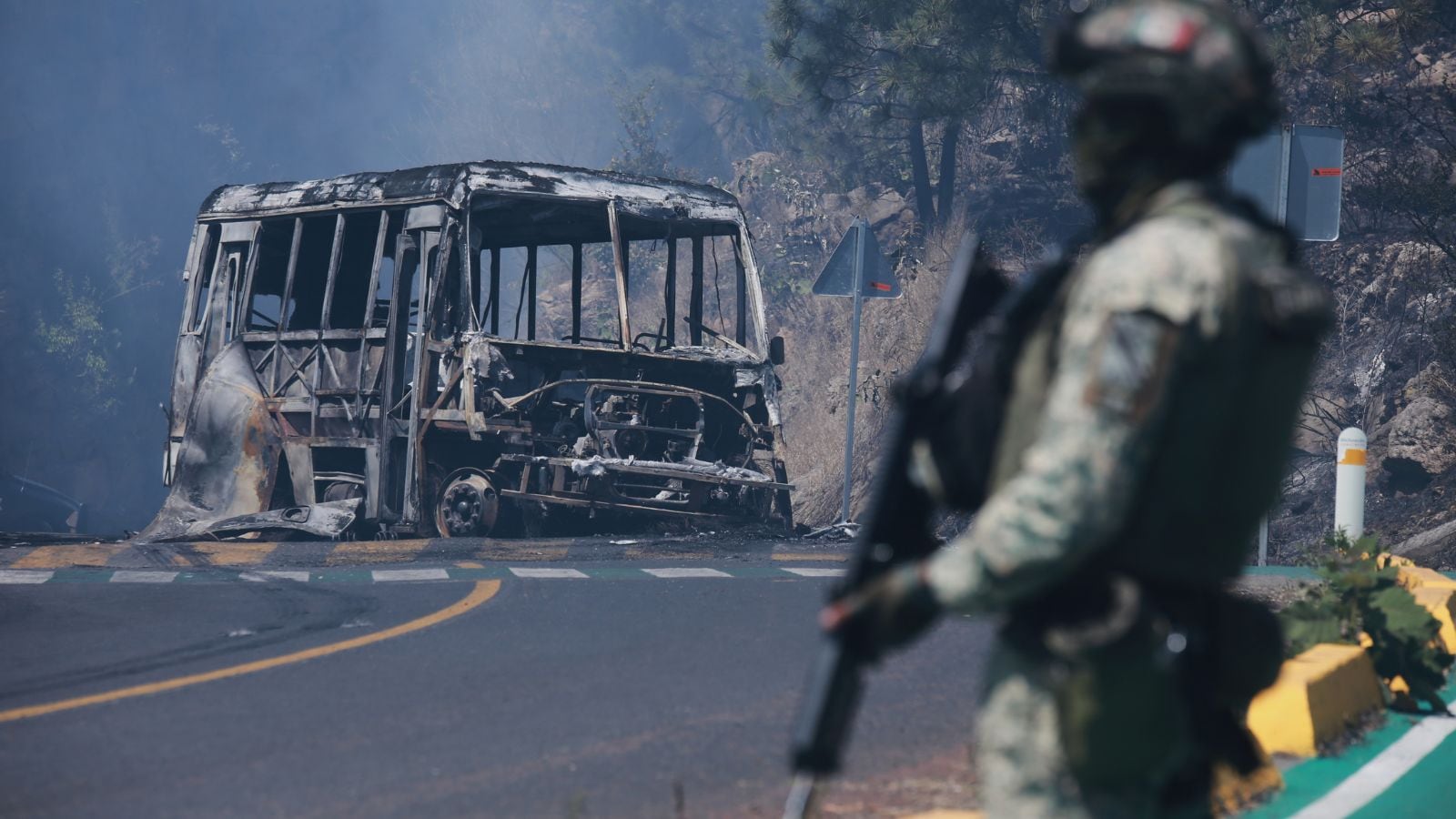
The reports describe "coordinated attacks" across multiple municipalities. This is a clinical way of saying that the roads were turned into killing zones. Burned-out tractor-trailers blocked the highways, black smoke choking the horizon, while gunmen with high-caliber rifles—tools of war often sourced from across the northern border—opened fire on the convoys.
Twenty-five lives ended. Twenty-five families received a knock on the door that changed the temperature of their world forever.
The tragedy lies in the futility of it. In the eyes of the cartel lieutenants, these guardsmen weren't enemies in a traditional war; they were messages. By killing them, the CJNG factions are screaming at the government: We are still here. We are still armed. Do not think his death makes us vulnerable.
The Myth of the Silver Bullet
There is a persistent, dangerous myth that the "Kingpin Strategy"—the targeting of top-tier leaders—is the silver bullet to ending the violence. The logic is simple: cut off the head, and the body dies.
But the body of a modern cartel isn't a single organism. It is a hydra. When you remove the head of an organization as vast as the CJNG, you don't get peace. You get a dozen smaller, hungrier organizations competing for the same resources.
The statistics back this up with a grim consistency. Over the last two decades, the arrest or death of a major cartel leader has almost always been followed by a sharp, sustained spike in homicides. It is the "fragmentation effect." Smaller groups are less predictable, more prone to using extreme violence to establish their brand, and more likely to diversify their crimes into kidnapping and extortion of the local population.
The invisible stakes here aren't just about who controls the drug trade. They are about the soul of the towns caught in the crossfire. When the National Guard is targeted so brazenly, the message to the average citizen in Jalisco or Michoacán is clear: If the men with the rifles and the armored trucks can't stay safe, what hope do you have?
The Language of the Highlands
If you walk through the plazas of small towns in the CJNG's heartland, you won't hear people talking about "El Mencho" in the past tense yet. They speak in whispers. They watch the road. They know that the departure of one strongman usually means the arrival of several smaller, more desperate ones.
The ground here is soaked in a specific kind of tension. It is the feeling of waiting for a storm that you know is coming, but you don't know from which direction it will blow.
The death of a boss creates a "succession crisis" that is far more violent than any corporate boardroom struggle. In the underworld, there is no HR department. There are no bylaws. There is only the ability to command fear. To be the next Mencho, a lieutenant must prove they are more ruthless than the person standing next to them.
The twenty-five guardsmen were caught in that audition.
Why the Violence Persists
It is tempting to look at this from a distance and see only a cycle of chaos. But the reality is more nuanced. The CJNG is a multi-billion-dollar enterprise. Its reach is global. Its influence in some regions of Mexico is so deep that it provides social services, building schools or giving out groceries to buy the silence of the people.
When the state removes a leader, it doesn't remove the economy that he built. It doesn't remove the demand for his product. It doesn't remove the corruption that allowed him to rise. It only creates a job opening.
Consider the aftermath: as the government celebrates the removal of a high-value target, the soldiers on the ground are left with the reality of an increasingly fractured and volatile battlefield. The "decapitation" of a cartel can be compared to blowing up a building in a crowded city. The rubble doesn't just sit there. It hits everyone around it.
The Heavy Silence of Jalisco
The smoke from the burned-out trucks in Jalisco has cleared now, but the air remains heavy. The twenty-five guardsmen will be given ceremonies. Their names will be read in a cold, echoing hall.
The question that remains isn't just who will replace El Mencho. It is how many more young men will be sacrificed to a strategy that seems only to sharpen the violence it intended to dull.
In the high, dry air of Jalisco, the dust never truly settles. It just waits for the next wind to kick it up again.
There is a widow in a small town tonight, holding a folded flag and a photo of a man who thought he was going to work. There are twenty-four more just like her. They don't care about the power vacuum. They don't care about the cartel's internal hierarchy. They care only that the world feels hollower than it did yesterday.
And in the mountains, the new bosses are already choosing their targets.