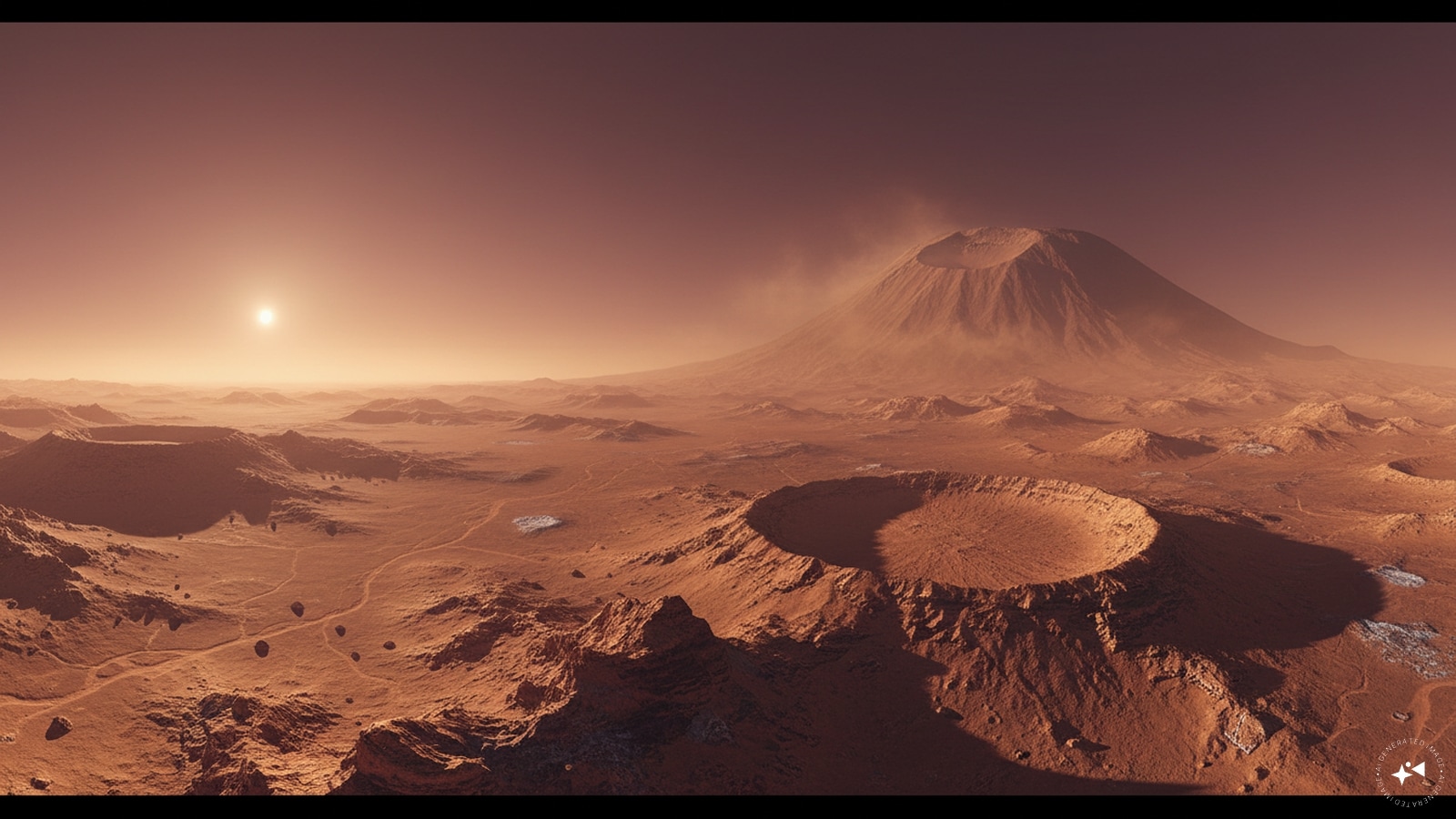
Darkness presses against the glass of the observation deck. Millions of miles away, a tiny, potato-shaped moon circles a rusty red world. Most people see only dead rock when they look toward Mars. They see craters, red dust, and an empty void. But inside a clean room thousands of miles from any ocean, a team of engineers is staring at a silver-grey capsule no larger than a kitchen trash can, and they see a mirror.
They see our future.
For decades, humanity has sent scouts to Mars. We have dropped rovers onto its dunes, bounced landers across its rocks, and watched from orbit as windstorms swallowed entire horizons. Yet every mission so far has been a one-way trip. We drop our mechanical children onto the surface, and there they stay, rusting quietly beneath a pink sky, unable to hand us a single grain of dirt to examine under the microscopes of Earth.
That limitation is about to shatter.
Consider the sheer audacity of the architecture. Instead of landing on Mars—where gravity fights your descent and toxic perchlorates coat every pebble—space agencies are reaching for Phobos. Phobos is the larger of the two Martian moons, a captured asteroid or a clump of primordial debris floating just six thousand kilometers above the planet. It is close enough to feel the tug of the Martian gravity well, yet distant enough to let a spacecraft slip in, touch down briefly, grab a handful of ancient history, and escape before the planet can drag it down.
Imagine standing on that lumpy, battered moon. The ground beneath your boots is not solid rock in the terrestrial sense; it is a jumble of shattered rubble held together by barely any gravity at all. If you dropped a wrench there, it would float away in slow motion. The horizon curves sharply, terrifyingly close. Dominating the jet-black sky is the swollen, ochre disk of Mars, a giant crimson eye watching your every move.
Now, imagine the machinery designed to pluck secrets from that desolate landscape.
The spacecraft is a marvel of calculated restraint. It carries no luxury, no excess weight, just titanium bones, solar wings, and a mechanical arm designed to punch into the regolith and scoop up material that has remained untouched since the dawn of the solar system. Why does this tiny handful of dust matter so much? Because Phobos may hold the answers to questions we have been asking since we first looked up at the night sky.
Some scientists believe Phobos is a captured asteroid from the outer reaches of the solar system, flung inward during the chaotic migrations of the gas giants billions of years ago. Others argue it is a splash of material kicked up into orbit when a massive asteroid slammed into Mars long ago, meaning we could study the ancient Martian crust without ever having to drill through the planet's actual surface.
Either way, it is a cosmic time capsule.
The journey to bring that capsule home is a masterclass in patience and terror. Space is indifferent to our ambitions. Radiation batters delicate circuits. Thermal swings between sunlight and shadow threaten to warp metal joints. A single miscalculation in trajectory means a multi-million-dollar probe sails past its target into the silent dark, missing its rendezvous by the width of a continent.
When the craft finally arrives at Phobos, it will not rush. It will hover. It will map every crater, every boulder, every shadow. The engineers back on Earth will hold their breath, watching telemetry data crawl across their monitors with a delay measured not in milliseconds, but in agonizing minutes. Radio waves travel slowly across the interplanetary gulf. By the time a warning light flashes on a console in mission control, the event that triggered it happened long before anyone could intervene.
This is the reality of deep space exploration. It is built on a foundation of calculated trust. We build our proxies, send them into the dark, and hope our math holds true.
When the landing mechanism finally kisses the surface of the moon, it will not slam down. It will gently settle, anchoring itself with drills so the low gravity doesn't bounce it back into orbit. A core sampler will rotate, biting into the dusty regolith, pulling up layers of history. Sealed tight in a pristine container, that sample will become the most valuable cargo ever carried through the inner solar system.
Then comes the hardest part. Leaving.
To return to Earth, the spacecraft must fire its thrusters precisely, escaping the weak gravity of Phobos and breaking free of Mars itself. It must thread a gravitational needle, using a carefully calculated trajectory that loops back toward our home planet.
Months turn into years. The capsule coasts through the vacuum, a silent silver cylinder carrying whispers from another world.
When it finally re-enters Earth's atmosphere, it will streak across the night sky like a falling star, plunging toward a remote desert floor. Helicopters will chase the smoke. Recovery teams will secure the heat shield. And inside a sterile laboratory, scientists in white coats will lift the lid.
They will look at grey dust. They will see tiny, jagged grains of rock.
And in that quiet room, the universe will feel just a little bit smaller. We are no longer confined to the dirt we were born on. We can reach out, touch the bone of the solar system, and bring a piece of it home.