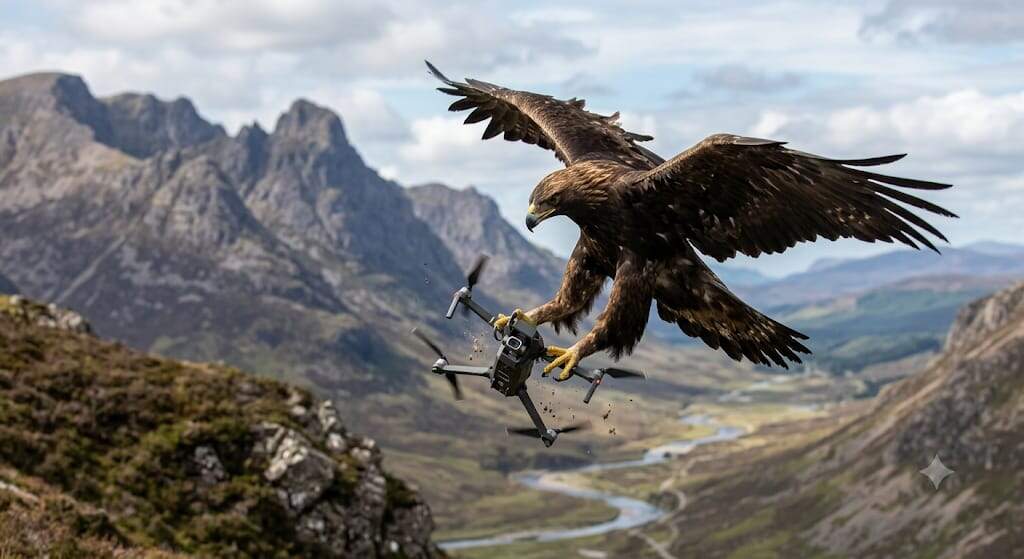
The media loved the narrative. In 2016, the Dutch National Police proudly announced they were training bald eagles to snatch illegal, rogue drones out of the sky. It was the ultimate "nature strikes back" story.
Most tech columnists treated it with a mix of novelty and awe, framing the project's eventual cancellation as a sad, quirky footnote in the history of law enforcement. They blamed the birds' disobedience, the high cost of training, and animal welfare concerns. They treated it as a noble, creative experiment that just happened to fall short.
That consensus is entirely wrong.
The Dutch eagle experiment was not a noble failure. It was an expensive, predictable gimmick that exposed a fundamental misunderstanding of both biology and robotics. It was security theater at its finest, designed to generate viral press releases while ignoring the harsh realities of physics and evolutionary biology.
We need to stop looking at the eagle project as a "beautiful try" and start seeing it for what it actually was: a warning sign of how desperate we are for low-tech silver bullets to solve complex digital problems.
The Fatal Flaw of the "Bio-Drone" Myth
The core premise of the program was simple: eagles have been hunting airborne prey for millions of years. Why not redirect that evolutionary programming toward plastic and carbon fiber?
It sounds logical until you look at the mechanics of a raptor’s hunting drive.
An eagle does not hunt because it enjoys the sport of aviation. It hunts because it is hungry. When a wild eagle strikes a duck or a rabbit, it is performing a high-stakes cost-benefit analysis. The energy expended and the risk of injury must be lower than the caloric payoff of the meal.
A DJI Phantom drone has zero caloric value.
To bypass this, trainers used food rewards to condition the birds. But conditioning is not a hardwired biological drive. During active operations, an eagle quickly realizes that a whirring, carbon-fiber quadcopter is not a duck. It is a loud, terrifying, aggressive object that does not smell like food, does not taste like food, and fights back with spinning blades.
When the Dutch police actually deployed these birds in uncontrolled, noisy urban environments, the eagles did what any highly intelligent apex predator would do when confused: they went on strike. They ignored the drones entirely or flew away.
You cannot patch a bird's operating system when it decides the risk-reward ratio of a mission is no longer in its favor.
Carbon Fiber vs. Talons: A Battle Physics Always Wins
Let us talk about the absolute disregard for physics that this project required.
Proponents of the program pointed to the incredible gripping power of an eagle's talons, which can exert over 400 pounds per square inch of pressure. They claimed the birds’ scaled legs protected them from the spinning propellers of small consumer drones.
This argument might hold up if we were still living in 2012, when drones were slow-moving, flimsy plastic toys.
By the time the Dutch program was being dismantled, the consumer drone market had shifted. Modern quadcopters utilize stiff, ultra-lightweight carbon fiber propellers spinning at upwards of 10,000 RPM.
[Spinning Carbon Fiber Blades (10,000+ RPM)]
                    VS
[Raptor Talons / Keratin Scales]
                    =
[Severe, Lacerating Tendon Damage]
To put this in perspective: a carbon fiber prop spinning at high speed acts as a flying scalpel. It does not just bruise; it slices. While an eagle might successfully snatch a cheap toy drone out of a backyard, tasking a living animal with intercepting a commercial-grade, heavy-payload drone is not innovative tactics. It is animal cruelty disguised as innovation.
No amount of leather gauntlets or custom Kevlar booties—which trainers actually experimented with—can fully protect a bird’s delicate tendons from the kinetic energy of a fast-moving, multi-rotor drone. If an eagle loses a tendon in its foot, it cannot grip prey. It cannot survive.
The Dutch police did not cancel the program because the eagles were "too difficult to train." They canceled it because they realized they were one high-speed drone collision away from a public relations disaster involving a mutilated national icon.
The False Promise of the Low-Tech Savior
Every time a new, disruptive technology emerges, there is a reactionary movement that desperately wants to prove that ancient, low-tech methods are superior. We want to believe that a well-trained dog, a falcon, or an eagle can outsmart the silicon and steel of modern engineering.
It is a comforting, romantic idea. It is also a dangerous distraction.
By focusing on biological interceptors, the Dutch police delayed the deployment of serious, scalable counter-drone technologies. While they were busy breeding and training raptors—a process that takes years per bird—drone technology was advancing at an exponential rate.
Consider the scalability math:
- Training an Eagle: Requires a highly skilled handler, years of intensive individual conditioning, specific housing, transportation, and veterinary care. You get one interceptor that can operate in a highly limited radius, only during daylight, and only in favorable weather conditions.
- Deploying RF Jamming or Directed Energy: Requires capital investment up front, but can be operated by standard security personnel, works 24/7 in rain, wind, or snow, and can neutralize multiple targets simultaneously.
If a stadium or an airport faces a coordinated threat from a swarm of three basic, off-the-shelf drones, what is the plan? Release three eagles and hope they do not get distracted by the crowd, the bright lights, or each other?
The math never worked. It was a boutique solution to a mass-production problem.
Dismantling the Counter-Drone Premise
When security experts discuss drone defense, they often ask the wrong question: "How do we physically stop the drone?"
This flawed question is what leads to absurdities like eagle training, net-guns, or trained monkeys. The real question we should be asking is: "How do we disrupt the system that allows the drone to operate?"
A drone is not an isolated object; it is an endpoint in a digital network. It relies on radio frequency (RF) signals, GPS coordinates, and onboard software to navigate.
If you want to stop a rogue drone, you do not attack the physical chassis with a pair of claws. You attack the data link.
| Defense Method | Scalability | Cost per Intercept | Risk of Collateral Damage |
|---|---|---|---|
| Raptor Interception | Abysmal | Extremely High | High (Injured bird, uncontrolled crash) |
| Kinetic Nets / Projectiles | Low | Medium | High (Falling debris in urban areas) |
| RF / GPS Spoofing | High | Low | Low (Soft-landing or return-to-home protocols) |
By hijacking the control signal or spoofing the GPS coordinates, security forces can force a drone to safely land itself or return to its launch point—revealing the operator's location in the process. This is elegant, scalable, and does not require feeding raw meat to an angry, expensive bird of prey.
Admittedly, electronic warfare has its own downsides. Jamming can disrupt local Wi-Fi networks, emergency communications, and legitimate aviation signals if used incorrectly. It requires strict regulatory clearance and precise targeting. But unlike an eagle, an RF jammer does not decide to take a nap on a stadium light pole because it saw a seagull it liked better.
The Real Cost of Security Theater
The Dutch police eventually sold off their eagles to private buyers, quietly shuttering the program after spending a significant, undisclosed amount of taxpayer money.
The legacy of the project is not one of pioneering spirit. It is a case study in how public institutions fall prey to flashy, photogenic concepts that fail the simplest engineering stress tests. It was the security equivalent of bringing a sword to a gunfight, simply because the sword looked great on the evening news.
Stop romanticizing the eagle experiment.
The next time some startup or government agency promises to solve a complex, digital security threat with a medieval gimmick, do not write a glowing profile about their creative thinking.
Ask them how their solution handles a carbon-fiber blade spinning at ten thousand revolutions per minute. Ask them how it scales when ten targets appear at once.
If their answer involves bird food, walk away.