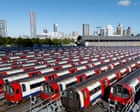
Industrial action on the London Underground during the fourth quarter operates as a targeted supply-side shock against the capital’s retail, hospitality, and commercial service sectors. While surface-level reporting frames Tube driver strikes as a localized inconvenience for commuters and holiday shoppers, operational reality dictates a far more complex cascade of economic friction. When a primary arterial transit network shuts down during peak seasonal demand, the resulting disruption triggers non-linear capacity failures across alternative transport modes, depresses consumer footfall elasticity, and forces businesses to absorb unrecoverable productivity losses. Mitigating this exposure requires businesses and urban travelers to abandon reactive commuting habits in favor of structured contingency routing, asynchronous demand shifting, and inventory buffer adjustments.
The Structural Vulnerability of Hub-and-Spoke Transit
To understand why a Tube strike paralyzes London more severely than comparable industrial action in other global cities, one must examine the network topology of Transport for London (TfL). The London Underground functions as a classic hub-and-spoke system with extreme node concentration in Zone 1. Central interchange stations—such as King’s Cross St. Pancras, Waterloo, Oxford Circus, and Bank—act as high-volume throughput bottlenecks. Under normal operating conditions, the Underground moves millions of passengers daily at frequencies that surface transport cannot mathematically replicate.
When drivers walk out, the system does not merely lose capacity; it loses network connectivity. In network theory, removing high-centrality nodes fractures the entire graph into isolated sub-networks. A single Tube train carries upwards of 1,000 passengers during peak hours. Replacing that throughput requires roughly 12 to 15 double-decker buses occupying finite road space. Because London’s medieval street grid lacks the lane capacity to absorb this sudden modal shift, surface transport experiences immediate gridlock.
The Substitution Fallacy and Modal Collapse
Commuters and retail planners frequently fall victim to the substitution fallacy—the assumption that alternative transit modes (buses, the Elizabeth line, London Overground, National Rail, micro-mobility, and ride-hailing) can absorb displaced Underground demand. In practice, these systems operate near maximum capacity during the pre-Christmas rush.
- Surface Road Saturation: Buses share road infrastructure with private vehicles, commercial delivery vans, and taxis. As displaced Tube riders hail rideshares or drive into central London, average traffic speeds plummet. Bus bunching occurs within hours, destroying timetable reliability and reducing effective fleet capacity.
- Parallel Rail Spillover: Services like the Elizabeth line and Thameslink experience severe overcrowding at suburban interchange stations. Once platform densities reach safety thresholds, station staff implement crowd control measures—closing gates and holding passengers outside—which creates secondary bottlenecks on surrounding streets.
- Micro-Mobility and Active Travel Limits: Cycling and e-scooter networks absorb a fraction of short-to-medium distance commuters, yet winter weather conditions in November and December, combined with dark evening commutes and wet road surfaces, cap adoption rates among casual travelers.
The Pre-Christmas Retail and Hospitality Cost Function
The timing of Q4 strikes maximizes economic pressure because retail and hospitality businesses operate on highly skewed seasonal revenue curves. For many central London retailers, theaters, and restaurants, the six weeks preceding Christmas generate a disproportionate share of annual operating profit. Unlike manufacturing, where lost production hours can sometimes be recouped through overtime shifts, service and hospitality revenues are perishable. An empty restaurant table on a Friday night in December or an unvisited retail floor represents permanent revenue destruction.
We can model the financial impact of a strike day on a central London commercial enterprise through three distinct cost variables:
- Direct Footfall Attrition: Discretionary shoppers exhibit high sensitivity to travel friction. When journey times double or require complex multi-modal transfers, consumers defer or cancel trips to physical retail hubs like Oxford Street, Regent Street, and Covent Garden. While a portion of retail spend migrates online, impulse purchases and experiential spending—dining, live entertainment, and seasonal attractions—suffer near-total attrition.
- Labor Productivity Erosion: Businesses that remain open still incur fixed overhead costs, including commercial rent, utilities, and salaried staff wages. However, operational efficiency degrades rapidly. Hourly staff arrive late due to transit delays, managers spend shift hours reorganizing schedules rather than overseeing customer service, and exhausted employees operate at reduced output.
- Supply Chain and Last-Mile Delays: Commercial deliveries to central London stores rely on predictable traffic windows. Strike-induced gridlock delays restocking vehicles, causing localized stockouts of high-demand seasonal goods right when inventory turnover should peak.
The Asymmetry of Remote Work Resilience
Not all sectors absorb transit shocks equally. Knowledge-work industries—finance, legal, technology, and consulting—possess high operational elasticity due to remote work infrastructure. During a strike, these firms trigger work-from-home protocols, preserving core white-collar output.
This resilience creates an unintended secondary casualty: the Zone 1 ecosystem economy. Coffee shops, lunchtime grocers, dry cleaners, and after-work bars depend entirely on the daily migration of office workers. When corporate employers tell staff to stay home to avoid strike chaos, the physical retail ecosystem loses its baseline captive audience, compounding the loss of discretionary holiday shoppers.
Game Theory and Bargaining Dynamics in Public Transit
Industrial disputes on the Underground follow a predictable game-theoretic framework. Unions representing train drivers—primarily ASLEF and the RMT—hold asymmetric bargaining power during the fourth quarter. Their leverage derives from the high visibility of disruption and the political sensitivity of holiday economic performance.
From the union perspective, calling strikes in November and December maximizes the cost of disagreement for TfL and the Mayor’s office without requiring prolonged, indefinite walkouts that would deplete union strike funds. A series of staggered 24-hour or 48-hour strikes across different lines or grades creates continuous uncertainty. Even on non-strike days, the threat of disruption suppresses advance ticket bookings for entertainment and dampens consumer confidence in planning central London excursions.
Conversely, TfL faces rigid fiscal constraints. Operating budgets remain tight following structural shifts in post-pandemic commuting patterns, which permanently reduced baseline farebox revenue compared to historical norms. Management must balance union demands regarding pay, pension terms, and working conditions against long-term capital expenditure requirements for fleet modernization and signaling upgrades.
Operational Limitations of Standard Commuter Workarounds
Standard advice issued during transit strikes—such as "leave earlier," "work from home," or "use local buses"—fails to address systemic constraints and introduces hidden risks for both individuals and businesses.
First, advising millions of commuters to travel earlier simply shifts the peak demand curve forward without expanding total system capacity. Instead of congestion peaking at 08:30, platforms become saturated at 07:00, extending the duration of operational strain on remaining rail staff.
Second, over-reliance on dynamic pricing ride-hailing apps creates severe cost spikes. Surge pricing algorithms respond to sudden supply-demand imbalances by multiplying fares, pricing out lower-income hospitality and retail workers who cannot perform their jobs remotely. When front-line service workers cannot afford to commute, businesses face acute staffing shortages even if customer demand holds steady.
Third, fragmented communication regarding partial service operations often misleads travelers. A line listed as operating a "special service" frequently runs only between outer suburban termini and Zone 2 boundaries, leaving commuters stranded miles from their final destinations with few onward options.
Tactical Execution for Businesses and Urban Travelers
Surviving Q4 transit disruptions without sacrificing operational output or personal time requires abandoning passive reliance on real-time journey planners. Stakeholders must execute pre-planned operational adjustments at least 72 hours before scheduled industrial action.
For Retail and Hospitality Operators
- Shift Marketing Spend to Hyper-Local Demographics: Immediately reallocate digital advertising budgets away from suburban commuter catchments toward residential postcodes within walking or cycling distance of your physical storefront. Capture neighborhood residents who are stranded locally due to their own canceled office commutes.
- Implement Dynamic Staffing Subsidies: For essential front-line staff who cannot work remotely, offer flat-rate travel stipends or organize private group shuttle vans from major suburban rail hubs. The cost of subsidizing employee transport is consistently lower than the margin lost from understaffed peak trading hours.
- Compress Delivery Windows: Reschedule supplier deliveries to overnight windows between 23:00 and 05:00 on strike days to bypass surface road gridlock entirely.
For Commuters and Holiday Shoppers
- Establish Fixed-Node Walking Routes: Map walking corridors between major National Rail termini (such as Paddington, Victoria, Liverpool Street, and Waterloo) and Zone 1 destinations. Walking 30 to 40 minutes across central London reliably beats waiting in static bus queues during network paralysis.
- Batch High-Friction Errands: Consolidate in-person shopping and medical or administrative appointments onto verified non-strike days, utilizing click-and-collect services at suburban transit hubs rather than central flagship stores.
- Audit Interchange Dependencies: Never rely on a multi-leg rail journey that requires passing through a Zone 1 Underground interchange. Select routes served entirely by single-operator National Rail or Overground lines, even if the geographic distance is longer, to eliminate exposure to station gate closures.
Businesses and travelers must treat pre-Christmas Tube strikes not as anomalous weather events, but as recurring structural variables in London’s Q4 operating environment. Entities that build permanent modal redundancy into their seasonal logistics—decoupling their revenue and mobility from Zone 1 Underground throughput—will capture market share while competitors remain paralyzed by predictable gridlock.