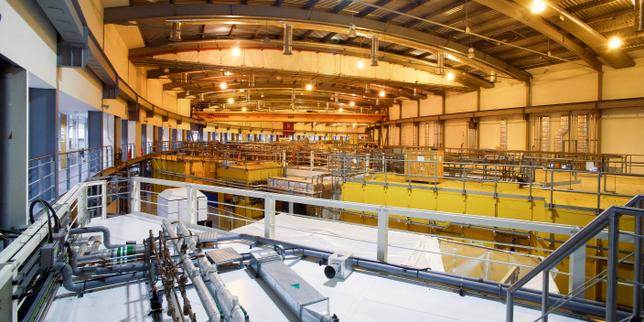
Walk into a modern data center at three o'clock in the morning, and the first thing that hits you isn't the light. It is the sound. A brutal, industrial scream of ten thousand cooling fans fighting a losing battle against physics. It smells like ozone and hot copper. If you stand near the server racks, the air vibrates so violently that you can feel the frequency in your teeth.
This is where the ghost lives.
Every line of poetry, every lines-of-code optimization, and every medical diagnosis generated by artificial intelligence is born in these screaming metal corridors. But lately, the ghosts are running out of room. They are starving for power.
Silicon Valley likes to pretend its greatest commodity is genius. It isn’t. It is electricity. And right now, a quiet, desperate scramble for that electricity is reshaping the global balance of power, culminating in a whispered ten-billion-dollar handshake that tells us everything we need to know about who is winning the future—and who is running out of breath.
The Vendor and the Visionary
Consider two entities operating on entirely different planes of existence.
On one side, you have Meta. Mark Zuckerberg’s empire spent the last decade building an ocean of hardware. They bought up graphics processing units—the specialized silicon chips known as GPUs—by the truckload. They built massive, monolithic temples of data across the globe, from the freezing plains of Iowa to the fjords of Denmark. They possess an absolute mountain of computing muscle.
On the other side sits Anthropic. Founded by rebels who fled OpenAI over safety concerns, Anthropic is the intellectual darling of the research community. Their Claude models are celebrated for their nuance, their ethics, and their eerie knack for sounding genuinely human.
But brilliance requires a furnace.
To train the next generation of artificial intelligence, Anthropic does not just need smart engineers. They need a staggering, terrifying amount of raw, unadulterated computing power. They need the kind of infrastructure that takes years and billions of dollars to build from scratch. They do not have that kind of time. The market is moving too fast.
So, the researchers had to go knocking on the door of the social media giant.
The deal currently taking shape in the shadows is breath-taking in its scale. Reports indicate Meta is in deep discussions to lease its own computing capacity to Anthropic. The price tag floating through the valley is a staggering ten billion dollars.
To put that number in perspective, ten billion dollars could buy you a fleet of aircraft carriers. It could fund the entire space program of a medium-sized nation for a decade. Here, it is being spent to rent someone else’s computers for a few years.
The Irony of the Open Hand
To understand how bizarre this alliance is, you have to look at the ideological war splitting the tech world in two.
Meta has positioned itself as the great democratizer. Zuckerberg has thrown his weight behind the open-source movement, giving away the blueprints of his Llama models to the public for free. His philosophy is simple: if everyone uses our architecture, we control the ecosystem.
Anthropic represents the closed-door approach. They believe that advanced AI is too dangerous to be scattered carelessly across the internet. They keep their models behind strict API walls, tuning them with obsessive care.
Yet, here they are. The open-source evangelist and the cautious gatekeeper, locked in a multi-billion-dollar embrace.
Why? Because pragmatism beats philosophy every single time. Meta has a surplus of silicon; Anthropic has a deficit. Meta gets a massive infusion of cash and a front-row seat to the operations of their sharpest ideological rival. Anthropic gets the lifeblood they need to survive the coming winter.
What Happens When the Silicon Melts
Let us step away from the corporate press releases and look at what this actually means on the ground.
Imagine a hypothetical engineer named Sarah. She works at a company like Anthropic. She has spent the last fourteen months developing a new algorithmic architecture that could theoretically predict corporate supply chain failures before they happen, or synthesize a protein to combat a novel pathogen. Her code is perfect. Her math is elegant.
But when she presses enter on her terminal, nothing happens.
Her project is stuck in a queue. It is waiting for "compute." In the modern tech landscape, compute is the ultimate bottleneck. It is the water ration in a desert. Sarah’s ideas are trapped in her head because there are not enough chips available to process the trillions of calculations required to test them.
When a deal like the Meta-Anthropic lease goes through, the queue vanishes.
Suddenly, Sarah’s team has access to tens of thousands of synchronized H100 or Blackwell chips. The lights switch from amber to green. The models begin to drink the data. This is not just a financial transaction; it is a mechanical acceleration of human capability. The velocity of discovery increases.
But it comes at a cost that regular people are only just beginning to feel.
The Phantom Grid
Every time a tech giant signs a ten-billion-dollar infrastructure deal, a tremor ripples through the physical world.
These data centers do not exist in a vacuum. They plug into the same power grids that light our hospitals, run our schools, and cool our homes during record-breaking summer heatwaves. A single modern data center can consume as much electricity as a city of a hundred thousand people.
We are entering an era where the digital demands of a few elite corporations are directly competing with the physical needs of human communities.
When you ask an AI to write a memo or generate an image, it feels weightless. The text appears instantly on your glass screen. It feels like magic. But that magic is an illusion. That prompt triggered a localized surge of heat in a facility thousands of miles away, requiring gallons of water to cool and kilowatts of energy to sustain.
The Meta-Anthropic deal is an admission of a harsh reality: we are running out of runway. The digital gold rush has outpaced the physical infrastructure of the planet.
The New Geography of Power
We used to measure the strength of nations by their oil reserves, their steel production, or the size of their standing armies.
Those metrics are obsolete.
The new geography of power is measured in flops, megawatts, and latency. The organizations that control the server farms control the terms of human progress. If you are a startup with a brilliant idea but no relationship with a hyperscaler like Meta, Microsoft, or Google, you simply do not exist. You cannot compete. You cannot build.
This reality breeds a strange kind of dependency. Anthropic is fiercely independent, yet their survival now hinges on the infrastructure of a competitor. It is a digital feudalism, where the lords own the silicon valleys and the peasants must rent the soil just to grow their thoughts.
Beyond the Bottom Line
The money involved in this deal is historical, but focusing on the ten billion dollars misses the point entirely.
The real story is the desperation. It is the realization that the race toward artificial general intelligence is no longer just a software problem. It is a logistics war. The company that wins will not necessarily be the one with the smartest code, but the one that managed to secure the biggest straw to suck down the world's energy supply.
Think back to that screaming data center in the middle of the night.
The fans will keep spinning. The air will stay hot. The bills will keep mounting. As Meta and Anthropic finalize their terms, the rest of us are left to watch the digital thermometer rise, wondering what happens when the ghost in the machine finally gets everything it ever asked for.