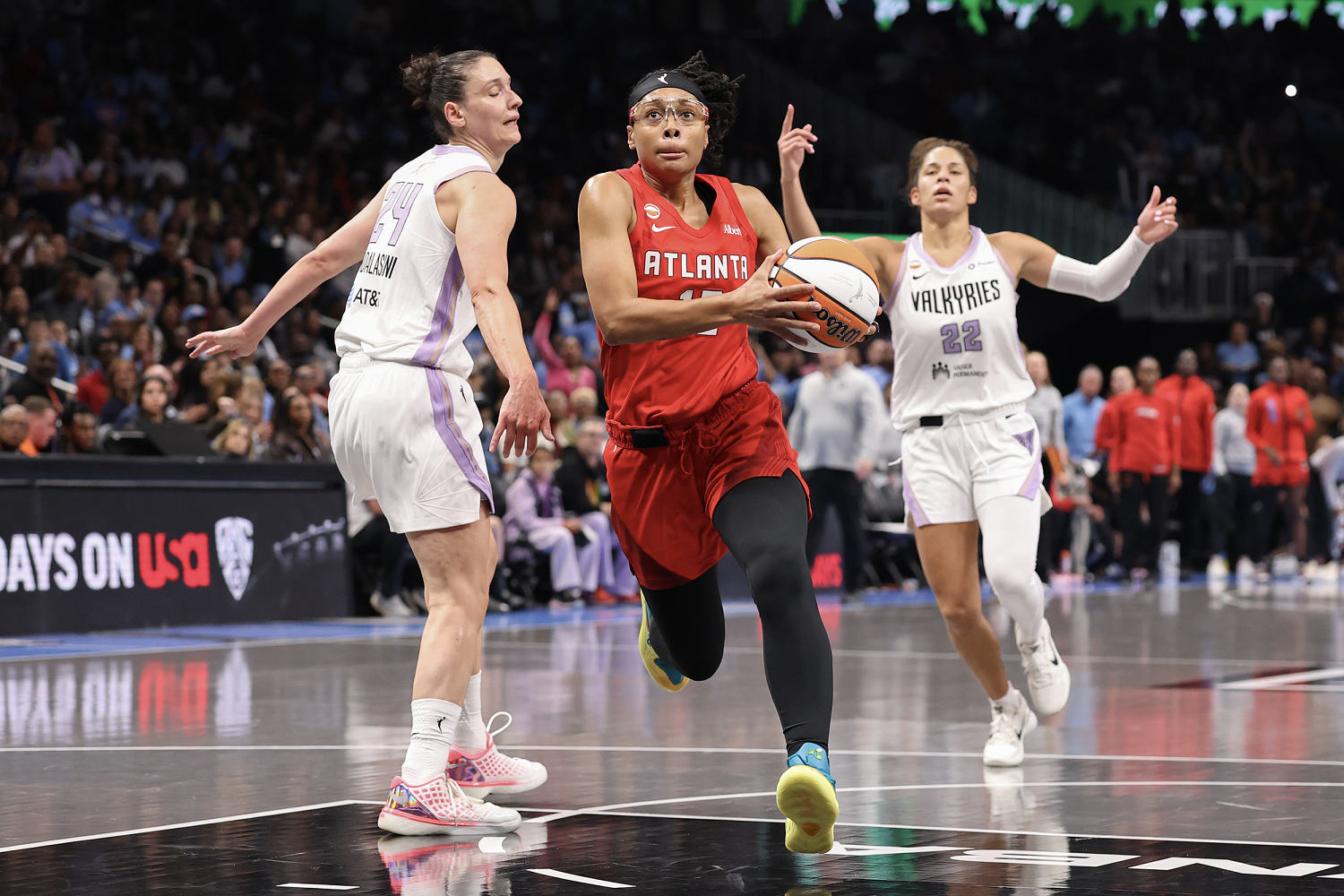
Eighty to sixty-nine.
Read those two numbers on a cold box score the morning after, and they look tidy. Manageable. Almost polite. An eleven-point win by the Atlanta Dream over the Golden State Valkyries to force a Game 7 in the WNBA Finals reads like a clean ledger balanced before midnight, a neat little bridge to a winner-take-all finale.
Box scores lie. Not about the math, never about the math, but about what it costs a human body to produce those digits when your entire season is balanced on the edge of a razor blade.
If you were sitting in the third row behind the baseline when the fourth quarter bled into its final four minutes, you did not see an eleven-point margin. You saw lungs burning from six games of attrition. You saw tape peeling off swollen ankles. You saw the quiet, terrifying realization spreading through the Golden State bench that a championship trophy—one they could practically smell in the hallway before tip-off—was being pried out of their fingers by a team that refused to pack its bags.
Elimination games have a specific smell. Anyone who has spent enough winters in arenas knows it immediately: stale popcorn, sharp menthol rub, and the metallic tang of collective panic. When a team faces the end of its year, basketball stops being a graceful geometry of spacing and cutting. It becomes a knife fight in a phone booth.
And in Game 6, the Atlanta Dream brought the bigger blade.
The Architecture of Refusal
To understand how an 80-69 scoreline actually feels from court level, imagine a composite figure—let us call her Maya, a veteran wing on Atlanta’s roster who has spent eight years in this league watching other women lift the trophy while she cleaned out her locker in September. Maya is not a real player on the box score, just a lens through which to see what thirty-five minutes of Finals basketball does to a nervous system.
By the third quarter of an elimination game, Maya’s legs feel as though someone has poured wet concrete into her high-tops. Every screen she navigates requires negotiating a collision with a 190-pound defender whose sole mission is to bruise her ribs. Her shooting thumb is jammed. Her brain is processing six defensive coverages in two seconds while nineteen thousand people scream at a decibel level that vibrates in her teeth.
In that environment, talent stops mattering. Everyone on the floor in the WNBA Finals is extraordinarily gifted. What separates a team that survives from a team that goes home is something far uglier: an irrational stubbornness about loose balls.
Golden State arrived in Game 6 holding every psychological advantage. They had the series lead. They had the momentum of an expansion-turned-juggernaut franchise trying to complete one of the most audacious championship runs in professional basketball history. All the Valkyries needed was forty minutes of poise, one clean stretch of shot-making to break Atlanta’s spirit and pop the champagne in the visiting locker room.
Instead, they ran straight into a defensive wall built out of desperation.
Think of playoff defense like compound interest in reverse. In the first quarter, holding an opponent to one extra dribble or forcing a guard two feet farther from the three-point line looks invisible. Nothing breaks. The scoreboard stays close. By the middle of the third quarter, however, those extra dribbles have stolen the oxygen out of the opponent’s legs. Suddenly, the open corner three-pointer that dropped effortlessly in Game 2 hits the front rim. The routine entry pass arrives a half-second late, right into the waiting hands of a help defender.
Atlanta did not beat Golden State with a sudden burst of offensive genius. They suffocated them. Holding a high-powered Valkyries offense to 69 points in a modern WNBA Finals game is the statistical equivalent of holding your breath underwater for three minutes. You do not do it comfortably. You do it because the alternative is drowning.
Why Eleven Points Felt Like Thirty
There is a peculiar cruelty to an eleven-point loss in a close-out game. If you lose by twenty-five, the grief is clean; you were beaten by a better team on that night, and you can begin processing the defeat before the final buzzer even sounds. If you lose by two on a buzzer-beater, you have the comfort of bad luck—a rim-out, a whistle that went the other way, a bounce that betrayed you.
Eleven points is purgatory.
For the Valkyries, 80-69 means you were close enough to touch the trophy, close enough that three possessions—a missed box-out in the second quarter, a careless turnover against full-court pressure in the third, a forced step-back jumper early in the shot clock—represent the entire distance between celebrating on the floor and boarding a charter flight back for a coin-flip Game 7.
Consider what happens next in the mind of a coach walking down the tunnel after letting a series-clinching opportunity slip away. All season long, coaches preach process over results. They talk about habits, film sessions, and trusting the system. Yet the moment a team fails to close out a series, doubt creeps into the cracks of that system like winter draft under a front door. Should we have shortened the rotation? Did we abandon the post too early? Why did our spacing collapse every time Atlanta switched onto our primary ball-handler?
Meanwhile, forty yards away in the home locker room, the psychology flips completely.
Pressure is not distributed evenly in a seven-game series. In Game 6, the Dream carried all of it; one bad quarter meant their season ended before midnight. Now, heading into Game 7, that weight transfers onto Golden State’s shoulders like a lead vest. Atlanta has already stared into the abyss and walked away. They know they can drag the Valkyries into the mud and hold them under eighty points.
The Strange Democracy of Game 7
We romanticize Game 7s from the couch because we get to enjoy the theater without paying the toll. Fans love the phrase "winner-take-all." Television networks build entire marketing campaigns around the drama of two teams tied at three games apiece.
From inside the lines, Game 7 is terrifying.
I have always struggled to explain the emotional texture of a decisive seventh game to people who have never competed with real stakes on the line, mostly because it contradicts everything we usually celebrate about sport. Normally, we watch basketball to see human excellence—the effortless arc of a deep three-pointer, the blind no-look pass threading through traffic, the ballet of a transition fast break.
Game 7 rarely looks like ballet. It looks like survival.
History across every major basketball league tells the exact same story: in Game 7s, shooting percentages plummet. Rotations shrink to six or seven trusted players. Stars play forty-plus minutes on bruised knees and dead legs, hunting for free throws because legs are too heavy to guarantee jump shots. Every single possession carries the emotional weight of a fourth-quarter sequence.
If you are trying to understand what will decide the final forty minutes between Atlanta and Golden State, forget the regular-season averages. Forget the analytical projections that predicted who had the deeper bench or the cleaner offensive rating back in July. By Game 7, both coaching staffs know every set play the other team runs before the point guard even crosses half-court. There are no tactical secrets left.
What remains is character under fatigue.
Who sprints back on defense after turning the ball over? Who steps into a wide-open three-pointer after missing their last four, refusing to let hesitation poison their mechanics? Which team absorbs a 10-0 run in the second quarter without splintering into five individuals trying to rescue the season alone?
The Silence Before the Tip
When Atlanta walked off the floor with an 80-69 victory, the arena erupted with the kind of deafening, cathartic roar that shakes dust from the rafters. People hugged strangers in the concourse. Towels whipped through the air. For ten glorious minutes, survival felt indistinguishable from triumph.
Then the building emptied, the arena crew began mopping the sweat off the hardwood, and the reality of what the Dream had actually earned settled in.
They did not win a championship. They won the right to do it all over again—forty-eight hours later, against a wounded, furious Golden State squad that just watched its coronation postponed, with forty minutes left on the clock before one team lifts gold and the other disappears into the off-season.
Somewhere in the quiet bowels of the arena, long after the cameras packed up and the last reporter filed their story, a trainer was wrapping an ice bag around an exhausted knee, and a player was staring at a blank locker stall, waiting for the adrenaline to drain out of her bloodstream so she could try to get four hours of sleep before film study.