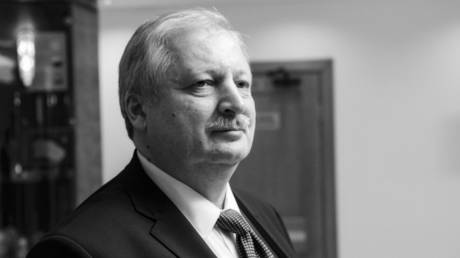
The secure line on the seventh floor of the State Department does not ring with a chime. It clicks. A heavy, mechanical clack that sounds like a deadbolt sliding into place.
On a gray Tuesday in Washington, D.C., when the news broke that the Russian Ambassador to the United States had died, that line went entirely silent.
To the casual observer scrolling through a morning news feed, the headline was a four-word footnote in an already crowded news cycle. An elderly diplomat, a career apparatchik of a rival superpower, had passed away. Perhaps there was a brief mention of a heart condition, a sterile condolence statement issued by the White House press secretary, and a boilerplate confirmation from the Russian Foreign Ministry in Moscow. Then, the feed refreshed. The world moved on to stock tickers, weather patterns, and celebrity gossip.
They missed the point entirely.
When an ambassador dies at their post—especially the envoy of a nuclear-armed adversary during a period of acute geopolitical friction—the tragedy is not merely personal. It is structural. A vital, invisible circuit breaker in the global security apparatus just blew out, leaving two nations with the capacity to end human civilization staring at each other through a darkened window.
The Man Behind the Heavy Oak Doors
To understand what actually disappears when an ambassador dies in Washington, you have to step past the wrought-iron gates of 1125 Sixteenth Street NW. Built in 1910 as a gilded-age mansion for the widow of George Pullman, the building is a masterpiece of Beaux-Arts architecture, all sweeping marble staircases and chandeliers that drip like frozen waterfalls. For decades, it has served as the residence and diplomatic nerve center of the Russian Ambassador.
I remember standing in that grand foyer years ago during a rare diplomatic reception. The air smelled of beeswax, expensive cologne, and old paper. You could feel the weight of history pressing down from the coffered ceilings. Every handshake in that room was calibrated to the millimeter. Every smile was a calculated maneuver.
In the public imagination, an ambassador is a caricature: a man in a bespoke suit sipping champagne at Georgetown dinner parties, delivering canned talking points to television cameras, and defending the indefensible actions of his government. That is the theater. The reality is far more grueling, far more human, and infinitely more dangerous.
Consider a hypothetical scenario to grasp the sheer psychological weight of the job. Imagine a career diplomat—let’s call him Viktor—who has spent forty years climbing the rigid, unforgiving ladder of the foreign service. He knows the nuances of English idiom better than most native speakers, yet he thinks in the syntax of Moscow. His days begin at five in the morning, reading encrypted cables that carry the paranoia, the demands, and the blind spots of leaders five thousand miles away. By noon, he is sitting across a polished mahogany table from an American Assistant Secretary of State, trying to translate the rigid, uncompromising directives of the Kremlin into language that won't trigger a military escalation in Eastern Europe or the Arctic.
Viktor is a shock absorber.
That is the simplest way to understand modern diplomacy. Think of the relationship between Washington and Moscow as a heavy freight train barreling down a warped track at eighty miles an hour. The political leaders in both capitals are the engineers, their hands hovering near the throttle and the brake. The ambassador is the coupling mechanism between the cars. He absorbs the violent jerks, the sudden stops, and the lateral sway so the entire train doesn't jump the rails.
When Viktor’s heart stops beating in the middle of the night, the coupling snaps.
What Happens in the First Sixty Minutes
Protocol is a cold comfort in the face of sudden death. The moment a foreign head of mission dies on American soil, a rigid, centuries-old choreography begins, governed by the 1961 Vienna Convention on Diplomatic Relations.
First comes the verification. A diplomatic security detail—agents of the U.S. State Department’s Diplomatic Security Service who guard the perimeter of the embassy compound—is notified by the embassy’s internal security officer. Paramedics from the D.C. Fire and Emergency Medical Services Department may be waved through the gates, though diplomatic immunity means American authorities cannot enter the sovereign territory of the mission without explicit invitation.
Silence.
Inside the compound, the emotional reality collides with bureaucratic necessity. Staffers who have spent years working under the ambassador’s grueling, perfectionist gaze are suddenly grappling with grief while simultaneously scrambling to lock down classified terminals. The Deputy Chief of Mission—the number two diplomat—immediately becomes the Chargé d'Affaires ad interim. Overnight, a bureaucrat accustomed to managing budgets, visa backlogs, and mid-level meetings is thrust into the hottest seat in international politics.
Meanwhile, across town at Blair House or inside the Truman Building, the Office of the Chief of Protocol begins drafting letters of condolence. Flags at the embassy are lowered to half-staff. A black-bordered portrait is placed on a velvet-draped table in the main reception hall, flanked by white lilies and a leather-bound condolence book.
It looks orderly. It looks civilized. Yet beneath that veneer of diplomatic etiquette, a dangerous vacuum is opening up.
The Invisible Stakes of the Vacuum
Why does the death of one envoy matter so much when presidents can pick up a phone, or foreign ministers can meet at a summit in Geneva?
Because summits are scripted, and presidential phone calls are rare, high-stakes events that require months of preparation. The day-to-day prevention of catastrophe happens in the quiet, unrecorded conversations between an ambassador and his counterparts in the host government.
Let’s look at the historical record. During the thirteen days of the Cuban Missile Crisis in October 1962, the formal channels between the White House and the Kremlin were dangerously slow—cables took hours to encrypt, transmit, decrypt, and translate. The world survived largely because of the backchannel relationship between Attorney General Robert F. Kennedy and Soviet Ambassador Anatoly Dobrynin.
Dobrynin had been in Washington long enough to read the micro-expressions on Kennedy’s face. He knew when the Americans were bluffing and when they were preparing to launch an invasion. Kennedy, in turn, trusted that Dobrynin would relay his exact words to Nikita Khrushchev without the ideological distortion that plagued the rest of the Soviet bureaucracy. That personal trust, built over countless quiet meetings, allowed them to negotiate the secret trade of Jupiter missiles in Turkey for Soviet missiles in Cuba.
Now, strip that away.
When an ambassador dies unexpectedly, you do not just lose a name on a roster. You lose decades of accumulated institutional memory. You lose the unwritten understandings, the personal rapport with key senators, the quiet telephone numbers of National Security Council directors who will actually take a call at two in the morning when a radar operator in the Baltic Sea misinterprets a flock of geese as a squadron of fighter jets.
A Chargé d'Affaires does not carry the same weight. In the rigid hierarchy of diplomacy, an acting envoy is a caretaker. American officials know the caretaker lacks the personal mandate of the Russian President. They know he is terrified of making a mistake that could ruin his career back home, which makes him rigid, overly cautious, and bound strictly to his talking points. Conversely, the Kremlin views an acting envoy with a degree of skepticism, knowing he lacks the stature to command immediate access to the Oval Office.
Communication slows down. Misunderstandings fester. A routine naval exercise in the Black Sea, which a seasoned ambassador could have smoothed over with a five-minute phone call to the Pentagon, suddenly looks like a prelude to war.
The Loneliness of the Long-Distance Envoy
There is a human cost to this profession that rarely makes it into the obituaries. We tend to view diplomats through the lens of privilege—motorcades, tax-free imports, diplomatic plates that allow them to park anywhere in Manhattan or Washington without paying a fine.
We forget the isolation.
To serve as the Russian Ambassador to the United States in the modern era is to live inside a gilded cage. Following rounds of diplomatic expulsions, embassy closures in San Francisco and Seattle, and sweeping sanctions, the footprint of the Russian diplomatic corps in America has shrunk to a fraction of its Cold War size. The ambassador’s movements are tightly restricted; travel beyond a twenty-five-mile radius of the Washington Monument often requires advance notification to the State Department.
Imagine living in a city where almost everyone you meet outside your compound views your country as a rogue state. You turn on the television in your residence, and every cable news channel is dissecting the failures, cruelties, or ambitions of your government. You walk down the street, and protesters stand across from your gates holding signs that condemn your life’s work.
Yet you cannot flinch. You cannot show doubt. If you soften your tone in a meeting with the Americans, hardliners in Moscow will accuse you of going native—of falling victim to "clientitis," the cardinal sin of the foreign service. If you are too abrasive, Washington shuts its doors, rendering you useless to your own capital.
The stress is relentless, silent, and corrosive. High blood pressure, cardiac events, and stress-induced illnesses are the unacknowledged occupational hazards of the diplomatic corps. When an envoy dies at his post, his colleagues don't just mourn a boss; they look into a mirror and see the toll that the job exacts on the human body.
I spoke once with a retired European ambassador who had served in Moscow during a particularly bleak winter of East-West relations. He told me that the hardest part of the job wasn't the espionage, the surveillance, or the hostile press conferences. It was the sheer cognitive dissonance of waking up every morning and trying to build a bridge out of glass while two armies stood on either side throwing stones.
"You carry the whole weight of the relationship in your chest," he said, tapping his sternum with two fingers. "Eventually, something gives."
The Succession Shadow Game
Even before the casket is loaded onto a chartered flight back to Moscow—draped in the white, blue, and red tricolor, escorted by an honor guard—the succession battle begins.
Replacing an ambassador to Washington is never a simple administrative task. In the Kremlin, the appointment is a high-stakes political decision that signals the direction of Russian foreign policy for the next half-decade. Will the leadership choose a hardline ideologue, a veteran of the security apparatus meant to signal defiance and intransigence? Or will they tap a pragmatic technocrat, an arms-control specialist who knows the intricacies of nuclear treaties and signals a desire to keep the guardrails intact?
And what happens on the American side?
Under international law, a receiving state must grant agrément—formal diplomatic consent—before a new ambassador can take up their post. During periods of severe diplomatic freeze, agrément becomes a weapon. Washington can sit on the paperwork for months, demanding concessions on embassy staffing, visas for American diplomats in Moscow, or the release of detained citizens before allowing a new Russian envoy to present their credentials to the President.
During those months of limbo, the empty chair on Sixteenth Street grows colder.
The routine business of diplomacy grinds to a halt. Nuclear arms reduction talks, already hanging by a thread, lose their primary point of contact. Discussions over space cooperation on the International Space Station, climate change in the Arctic, and regional conflicts in the Middle East are relegated to mid-level bureaucrats who lack the authority to say yes, and are terrified to say no.
We live in an era that worships disruption and speed. We assume that because we can send an instant message across the globe in a fraction of a second, the ancient art of human diplomacy has become obsolete. We think leaders can just tweet at each other, or hash things out over a video link.
That is a dangerous illusion.
Technology transmits data, not wisdom. It conveys words, not intent. When two superpowers are locked in a generational standoff, the space between what is said and what is meant is wide enough to swallow the world. Filling that space requires human beings—flawed, mortal, exhausted men and women who know how to read the silence between sentences.
The Final Departure
On the morning of the repatriation, the gates at 1125 Sixteenth Street swing open.
There are no cameras from the major networks waiting across the street; the news cycle has already moved on to the next outrage, the next scandal, the next fleeting distraction. A black hearse pulls slowly onto the asphalt, flanked by two diplomatic sedans with dark tinted windows. A handful of embassy staffers stand on the marble steps in dark coats, their breath misting in the crisp morning air, watching the taillights disappear down the avenue toward Andrews Air Force Base.
Inside the building, the heavy oak doors click shut. The reception hall is quiet again. The lilies are cleared away, the condolence book is packed into a diplomatic pouch, and the portrait is taken down from the wall.
Down the hall, in a quiet office overlooking the courtyard, a phone sits on a polished wooden desk. Somewhere in Moscow, a secure line clicks, and an aide begins drafting a new set of talking points for a caretaker who does not yet know the rules of the room. And five thousand miles away, across a darkened ocean, two nuclear arsenals remain aimed at the horizon, waiting for someone to pick up the receiver and explain what the silence means.


