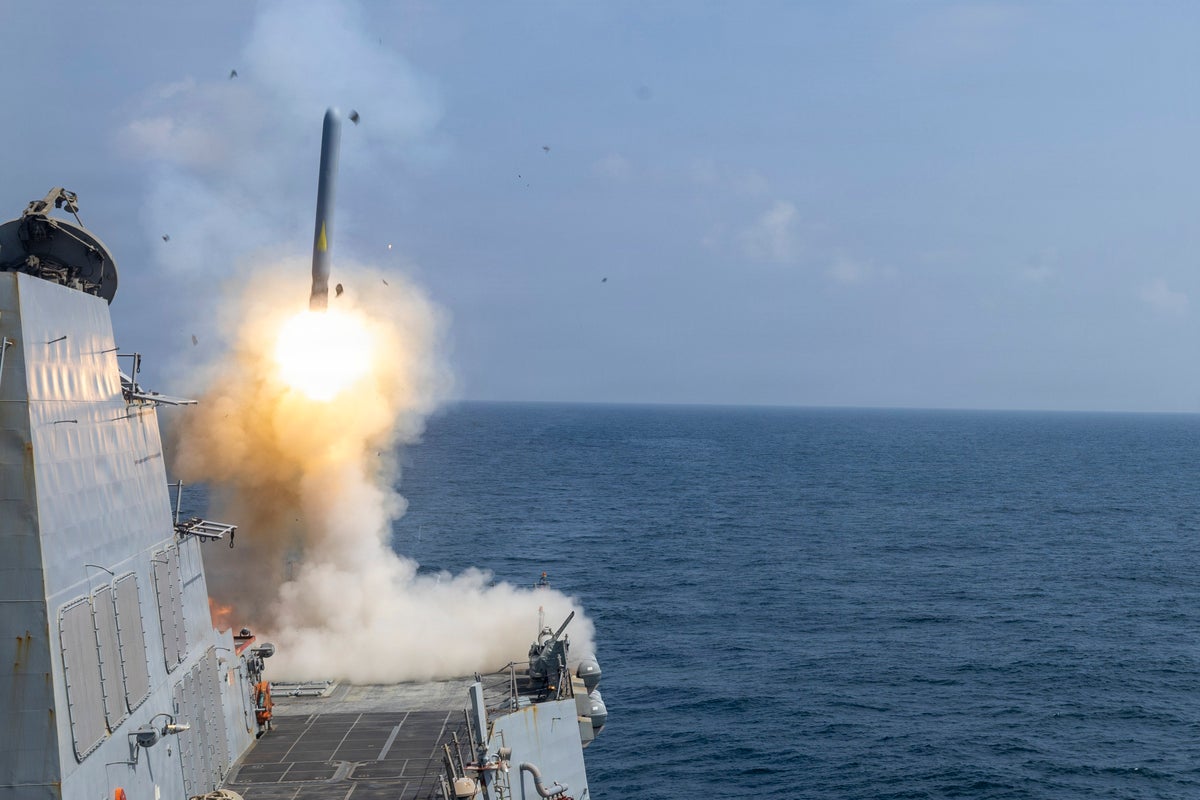
The steel skin of a missile is cold, indifferent, and deceptively permanent. To the average person, an arsenal is a static thing—a collection of expensive items sitting in a warehouse, waiting for a day that hopefully never comes. But to those who track the movement of heavy machinery and the shifting tides of global power, an arsenal is more like a battery. It drains.
Lately, it has been draining fast.
JD Vance found himself at the center of a swirling digital storm recently, one of those quintessentially modern political moments where a denial and a confirmation occupy the same breath. It started with a report suggesting the Senator was deeply concerned about the "drastic depletion" of American missile stockpiles. He initially pushed back on the framing, or perhaps the timing, only to pivot and underscore the exact same reality moments later. It was a rhythmic dance of political optics, but beneath the verbal sparring lies a terrifyingly physical problem.
Think of a specialized tool in your garage. You use it once a year. You assume it will always be there. Now imagine your neighbor asks to borrow it because his house is falling down. Then the neighbor across the street asks. Then the person three blocks over. You want to help. You do help. But eventually, you look at the empty peg on the wall and realize that if your own roof starts to sag tomorrow, you are holding nothing but a handful of air.
The Math of Metal and Fire
The United States has spent decades perfecting the art of precision. We don't just fire rockets; we fire sentient computers capable of threading a needle from three counties away. But these computers are not built on an assembly line that can be turned up to eleven overnight. They are handcrafted marvels of aerospace engineering, requiring rare minerals, specialized microchips, and a workforce that doesn't exist in infinite numbers.
When JD Vance sounds the alarm—even when he stumbles over the acoustic echoes of his own messaging—he is pointing to a ledger that no longer balances.
The conflict in Ukraine has acted as a giant vacuum. Systems like the Patriot, the HIMARS, and the Javelin have become household names. They are effective. They are life-saving. They are also being consumed at a rate that far outstrips our ability to replace them. This isn't a matter of writing a bigger check. You cannot print a missile. You have to forge it.
Consider the hypothetical life of a single interceptor missile. It begins in a clean room, a silent cathedral of high-tech components. It is tested, crated, and shipped. It sits in a climate-controlled bunker for five years. Then, in a span of six seconds, it is gone. It fulfills its purpose in a flash of heat and light. In that instant, five years of labor and millions of dollars in resources vanish.
The problem Vance is grappling with—and the reason for his frantic back-and-forth with the press—is that we are currently living in the "vanishing" phase of the cycle without a clear path back to the "forging" phase.
A Conflict of Two Horizons
The anxiety radiating from the Senator's office isn't just about the present. It’s about the shadow of a second horizon.
While the Atlantic remains a theater of active consumption, the Pacific is a theater of potential confrontation. If the "drastic depletion" Vance worries about continues, the U.S. finds itself in a strategic paradox. To defend the world of today is to potentially disarm the defense of tomorrow.
Critics of this view argue that we are the "Arsenal of Democracy," a title earned in the smoke and grit of the 1940s. They suggest that American industry can always pivot, always adapt, always out-produce the competition. But the 1940s involved welding steel plates on ships and assembly-line tanks. Today, we are talking about semi-conductors that require a decade to master and supply chains that stretch across oceans we might soon find ourselves unable to cross.
Vance’s public "slimming" of the report, followed by his immediate doubling down on the danger, reveals the tension of a man who knows the cupboard is getting bare but is wary of how that admission sounds to the rest of the world.
Weakness is a blood-scent in international politics.
If you admit you are running low on the very things that keep your rivals at bay, you invite the very aggression you are trying to prevent. It is the poker player who looks at his dwindling stack of chips and tries to decide whether to admit he's hurting or keep betting like a high roller.
The Human Weight of Hardware
Behind every statistic about "missile counts" and "production capacity" is a human being making a choice.
There is the factory worker in Alabama who sees the overtime shifts piling up and wonders why the machines are breaking down. There is the young officer in a silo who looks at the inventory digital display and notices the numbers are lower than they were last month. And there is the politician, like Vance, caught between the need to be a loyal partisan and the duty to be a cold-eyed realist.
The "confirmation" that followed his "slamming" of the report wasn't just a flip-flop. It was a collision with reality.
We are used to an America that is an infinite fountain of resources. We grew up in a culture of abundance where "more" was always a phone call away. But the world has changed. The materials are harder to find. The technology is harder to build. The threats are more synchronized.
When the Senator speaks of depletion, he isn't just talking about tubes of explosives. He is talking about the erosion of a safety net. He is talking about the moment when the "big stick" of American diplomacy becomes a little more brittle, a little more prone to snapping.
The Invisible Stakes
It is easy to get lost in the partisan bickering of whether Vance "lied" or "confirmed" or "backtracked." That is the noise. The signal is the silence in the warehouses.
If the U.S. continues to burn through its sophisticated munitions at the current rate, the math eventually dictates a hard stop. We reach a point where we can no longer provide the shield we have promised to half the globe.
That is the emotional core of this story: the fear of being found wanting.
It’s the dread that hits a parent when the bank account hits zero before the month is over. It’s the realization that our reach may finally have exceeded our grasp. Vance's erratic communication is the sound of a system trying to process a truth it isn't ready to face.
We are watching the end of an era of effortless military supremacy.
The steel skin of the missile is still cold. The silos are still there. But the hum of the machinery is changing. It’s getting thinner. It’s getting more desperate. We are learning, in real-time, that even the most powerful nation in history cannot live on credit forever—not when the currency is made of titanium and fire.
The pegs on the wall are empty, and the roof is starting to groan.