Deep inside a reinforced concrete bunker somewhere in the American Midwest, a technician stares at a digital manifest. It is a quiet, sterile room. The air smells of ozone and industrial cooling. On paper, the numbers represent "assets" and "expendables." In reality, those numbers represent the physical barrier between global stability and a descent into the unknown.
That manifest is looking thinner than it has in eighty years.
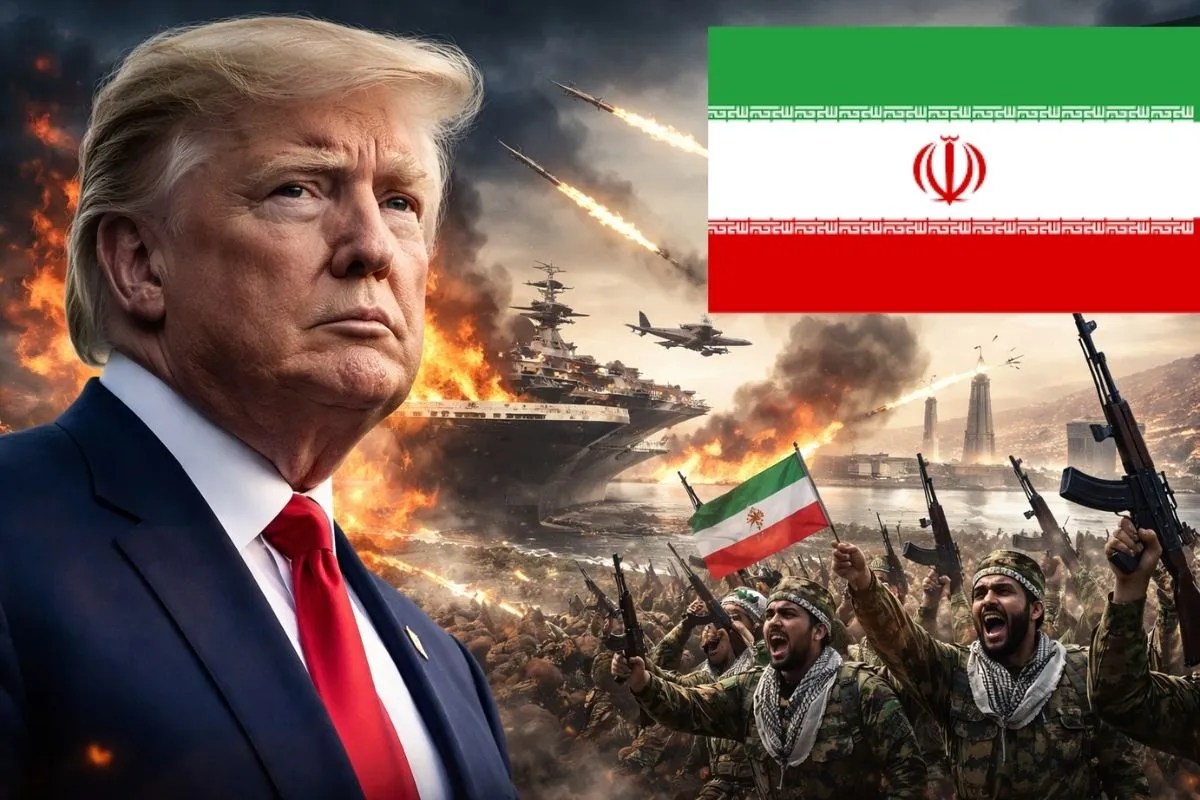
The conflict in the Middle East has stopped being a localized fire. It has become a furnace, and it is consuming the very tools the United States relies on to keep the rest of the world in check. We aren't just talking about money. We are talking about the physical inventory of power. When 50% of your specialized weaponry vanishes into the dust of a regional war, the silence from the other side of the globe—from Moscow and Beijing—becomes deafening.
The Physics of an Empty Shelf
Imagine a blacksmith working a single piece of iron. He can make a sword, or he can make a plow, but he cannot make both at the same time with the same metal. Washington is currently that blacksmith. For decades, the American military-industrial machine was viewed as an infinite fountain. You pressed a button, and a missile appeared. You signed a check, and a drone took flight.
That illusion has shattered.
Modern warfare isn't fought with bullets and grit alone; it is fought with sophisticated, high-precision electronics that take months, sometimes years, to assemble. A single interceptor missile used to knock a cheap drone out of the sky over the Red Sea contains more advanced computing power than most small towns used twenty years ago. We are trading Ferraris to stop bicycles.
The math is brutal. If Donald Trump returns to the Oval Office, he won't just be inheriting a geopolitical map. He will be inheriting an empty pantry. When half of your primary deterrents are spent, you no longer have the luxury of "strategic ambiguity." You are forced to choose which fire to put out and which one to let burn.
The Dragon and the Bear are Watching
While the world focuses on the explosions in the Middle East, two observers are taking meticulous notes.
In Moscow, military planners see an America that is distracted and depleted. They see a superpower that is digging through its pockets for spare change. Every missile fired in a desert skirmish is one less missile available to defend the borders of Eastern Europe. It is a game of attrition where the U.S. is the only player losing pieces.
In Beijing, the perspective is even more cold-blooded. China doesn't just watch the depletion of American stockpiles; they monitor the factory lines. They know that American manufacturing has become a lean, "just-in-time" operation. We no longer have the massive, soot-stained factories of the 1940s that could churn out a bomber every hour. We have clean rooms and delicate supply chains that rely on minerals often controlled by—ironically—China.
Consider the psychological shift. A bully stays in the corner of the playground not because he likes the shade, but because he knows the teacher has a whistle. If the teacher blows the whistle and no sound comes out, the playground changes instantly. Russia and China aren't just fearing what Trump might do; they are calculating what he can't do.
The Human Cost of a Cold Calculation
This isn't about metal and gunpowder. It is about the person sitting in a cockpit or standing on the deck of a destroyer.
When a commander knows that their inventory is at 50%, their soul changes. They hesitate. They wonder if this specific threat is worth the "expendable" asset. That hesitation is where wars are lost. It’s the father who can’t promise his son he’ll be home by Christmas because the ship he’s on has to stay out another six months to cover for a fleet that has no more teeth.
We often think of "national security" as a giant, abstract shield. It’s not. It’s a collection of very specific things made by very specific people. It’s the welder in Ohio who can’t get the high-grade steel he needs. It’s the software engineer in California trying to patch a system that was never meant to be used at this frequency.
The stakes are invisible until they aren't. They are invisible until a radar screen blips in the South China Sea and the person at the console realizes the nearest support is three thousand miles away and currently out of ammunition.
The Trumpian Dilemma
Donald Trump campaigned on a platform of "America First," a philosophy built on the idea of strength through withdrawal and renegotiation. But you cannot negotiate from a position of perceived weakness.
If the reports are true and the arsenal is depleted, the next administration faces a choice that has no good ending.
- Option one: Rapidly re-industrialize, pouring trillions into a war economy during a time of fragile inflation.
- Option two: Pull back from global commitments, essentially handing the keys of the international order to the rivals waiting in the wings.
- Option three: Innovation through desperation—relying on unproven autonomous tech to fill the gaps left by missing missiles.
None of these are "seamless" transitions. They are jagged, painful shifts that will be felt at every kitchen table in the country. If the U.S. has to spend the next decade just refilling its silos, it won't have the resources to fix its bridges, its schools, or its healthcare system. This is the "guns vs. butter" debate of the 20th century, back with a vengeance and a much higher price tag.
The Silence in the Silo
There is a specific kind of dread that comes with realizing a safety net has holes in it. For the last eighty years, the global economy has hummed along on the assumption that the American security umbrella was impenetrable. That umbrella is now looking more like a sieve.
The fear isn't just about a war with Iran. It’s about the vacancy. It’s about the "What if?"
What if a crisis breaks out in the Taiwan Strait tomorrow? What if the North Sea becomes a theater of conflict? The U.S. is currently a marathon runner who has just sprinted the first five miles and realized they forgot to bring water.
Russia knows this. China knows this. And soon, the American public will have to confront the reality that the "Arsenal of Democracy" is currently running on "E."
The technician in the bunker closes his manifest. He turns off the light. The room is left in darkness, save for the blinking red lights of a system that is waiting for parts that might not arrive for years. The silence isn't peaceful. It is the sound of a vacuum waiting to be filled. And in history, vacuums are always filled by the most ambitious, the most patient, and the most prepared.
The world is holding its breath, not because of what is happening, but because of what is missing.