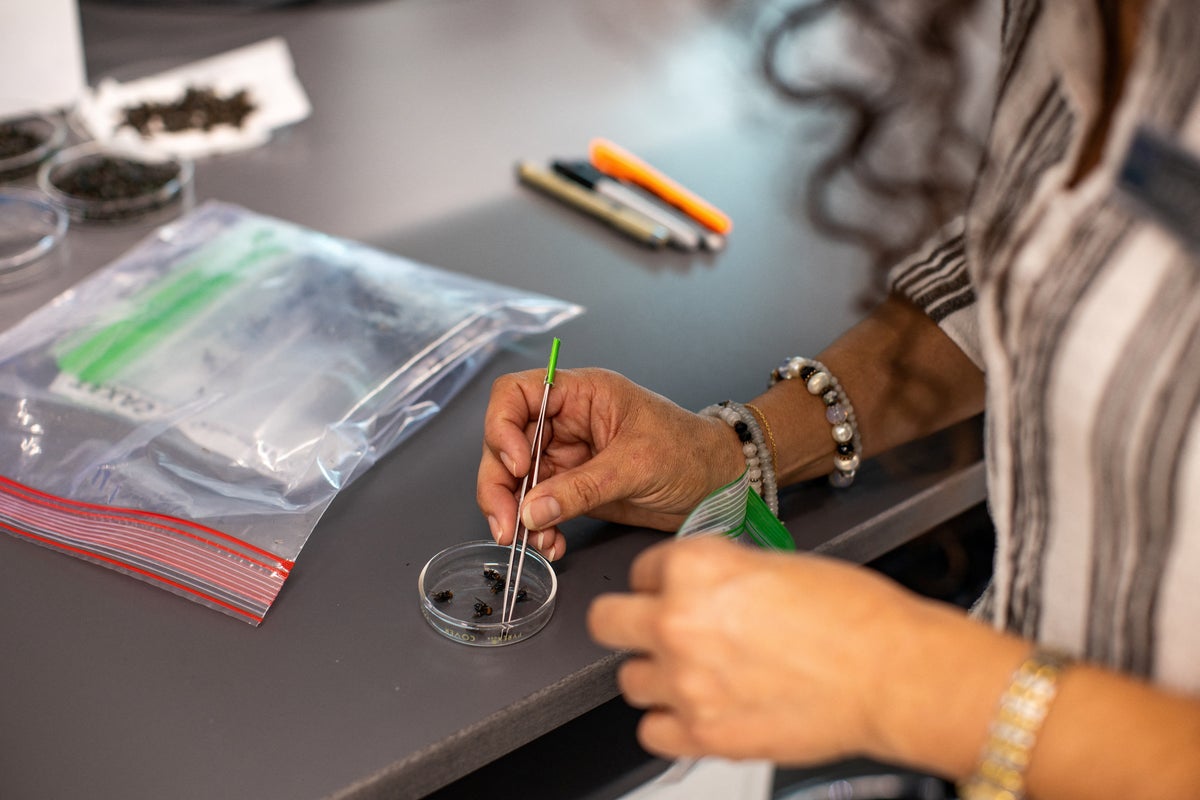
The resurgence of Cochliomyia hominivorax—the New World screwworm—along the Central American Isthmus threatens livestock populations, trade flows, and public health across North America. Containment relies on a simple economic reality: the cost of eradication scales linearly, while the cost of unchecked infestation scales exponentially through agricultural supply chains. Suppressing this obligate parasite requires moving beyond historical sterile insect techniques toward genetically engineered suppression vectors.
The Mechanistic Threat of Cochliomyia Hominivorax
Unlike facultative necrophagous flies, Cochliomyia hominivorax deposits eggs in the open wounds of warm-blooded animals. Upon hatching, the larvae consume living tissue, using barbed mouthhooks to burrow deeply into muscle beds. Left untreated, the host experiences systemic inflammation, secondary bacterial infections, and death within seven to ten days.
The biology of the species accelerates its spread through three primary mechanisms:
- Extreme Fecundity: A single mated female deposits up to 400 eggs per clutch and produces multiple clutches during its 14-day lifespan.
- High Adult Mobility: Adult flies can traverse up to 200 kilometers in search of suitable hosts, rendering local physical quarantines ineffective without regional biological suppression.
- Broad Host Specificity: The parasite attacks any warm-blooded species, eliminating the possibility of vector management through host-deprivation strategies alone.
The economic cost of an unchecked invasion stems from direct livestock mortality, labor-intensive wound treatments, and secondary trade restrictions imposed by importing countries seeking to preserve parasite-free status.
The Structural Limits of Classic Sterile Insect Technique
For six decades, containment of the screwworm relied on the Sterile Insect Technique (SIT). Mass-reared male pupae were exposed to ionizing radiation from Cesium-137 or Cobalt-60 sources, inducing dominant lethal mutations in their sperm. Once released into wild populations, these sterile males competed with wild males for female mates. Because female screwworms mate only once, a female that mates with a sterile male produces non-viable eggs, driving population collapse across successive generations.
SIT maintained a biological barrier at the Darién Gap in Panama for decades. However, the model faces inherent structural constraints:
Radiation Fitness Penalty
Ionizing radiation inflicts somatic damage alongside germline mutations. Radiated males exhibit reduced flight capacity, shorter lifespans, and decreased mating competitiveness compared to wild-type males. To offset this fitness penalty, facilities must release sterile males at ratios exceeding 100:1 relative to the wild male population.
Capital-Intensive Mass Rearing
Continuous production of millions of flies per week demands vast facilities, specialized dietary media (blood, milk, and protein substitutes), and precise climate control. Operating these facilities creates high fixed costs that do not scale down during low-density suppression phases.
Logistics Bottlenecks and Single-Point Vulnerabilities
Centralizing mass-rearing in a single facility—such as the Pacora plant in Panama—exposes the entire containment strategy to facility failures, supply chain disruptions, or local outbreak spikes that outpace maximum production capacity.
When wild populations cross regional control lines, the fixed output of classical SIT facilities proves insufficient to maintain the high sterile-to-wild ratio needed for suppression.
Genetic Vectors and Conditional Lethality Mechanics
To bypass the operational limits of radiation-based SIT, field trials now deploy genetically modified strain architectures using RIDL (Release of Insects carrying a Dominant Lethal) and gene drive systems. These approaches decouple male sterility from somatic radiation damage.
[ Wild Female ] + [ Genetically Modified Male (Transgenic) ]
       │
       ▼
[ Offspring Inherit Dominant Lethal Gene ]
       │
       ├── Female Offspring: Lethal Gene Expresses (Die before maturity)
       └── Male Offspring: Carry & Spread Transgene (Survive to mate)
Female-Specific RIDL (fsRIDL)
The core architecture uses a repressible, female-specific lethal gene controlled by a tetracycline-off (Tet-Off) genetic switch. In the rearing facility, tetracycline added to the larval diet binds to a synthetic transactivator protein (tTA), blocking its ability to induce lethal protein expression. The flies develop normally.
When transgenic males are released into the wild and mate with wild females:
- All offspring inherit the lethal transgene construct.
- Wild environments lack tetracycline, activating the Tet-Off system.
- The tTA protein accumulates unchecked, causing transcriptional overload and cell death exclusively in female larvae during early development.
- Male offspring survive, carrying the construct and continuing to mate with remaining wild females, driving a multi-generational suppression cycle.
This selective elimination eliminates female rearing costs prior to release and prevents released males from competing with females within the release batch.
Mating Competitiveness Recovery
Because these males undergo no radiation treatment, their physical performance metrics—flight range, courtship display frequency, and lifespan—match wild-type males. Recovering male fitness reduces the required release ratio from 100:1 down to approximately 10:1 or 5:1, lowering transport and aerial distribution costs.
Supply Chain Realities and System Bottlenecks
Deploying transgenic suppression strategies shifts operational risks from physical rearing constraints to biological, regulatory, and environmental dependencies.
Temperature and Transport Sensitivities
Transgenic pupae and adult males require temperature-controlled cold chains during transport from specialized laboratories to field drop sites. Sub-optimal conditions reduce male flight performance, eroding the efficiency gains achieved by avoiding radiation.
Resistance Selection
Continuous release of a single transgenic strain creates selection pressure for wild females to evolve mate discrimination. If wild females begin preferring wild males over lab-reared transgenic males, mating frequencies drop, rendering the release ineffective. Mitigating this risk requires regular backcrossing of lab strains with local wild-type stocks to preserve natural pheromone profiles and courtship behaviors.
Political and Regulatory Friction
Vector control programs operate across international borders. Disagreements over biosafety protocols, release approvals, and public communication delay deployment schedules. A breakdown in containment within one jurisdiction compromises neighboring areas regardless of local eradication efficiency.
Vector Deployment Strategy
Containing screwworm advancement into uninfested territory requires replacing uniform release protocols with targeted deployment models.
+-------------------------------------------------------------------+
|               INFESTED ZONE (High Density Population)             |
|                                                                   |
|   Strategy: Chemical Control + Classical SIT                      |
|   Action: Suppress gross population density before transgene drop.|
+-------------------------------------------------------------------+
                                  │
                                  ▼
+-------------------------------------------------------------------+
|               CONTAINMENT BUFFER (Border Zone)                    |
|                                                                   |
|   Strategy: High-Density fsRIDL Releases                          |
|   Action: Establish biological wall to prevent vector transit.     |
+-------------------------------------------------------------------+
                                  │
                                  ▼
+-------------------------------------------------------------------+
|              SURVEILLANCE ZONE (Clean Territory)                  |
|                                                                   |
|   Strategy: Trapping Networks + Precision Spot-Releases           |
|   Action: Identify and extinguish isolated outbreak clusters.     |
+-------------------------------------------------------------------+
- Deploy Layered Interception Zones: Do not rely on a single physical line. Establish a three-tier containment corridor consisting of a high-density release buffer zone, a secondary suppression ring utilizing classical SIT, and an active surveillance perimeter leveraging baited traps and wound monitoring.
- Pre-Treat High-Density Clusters with Direct Suppression: Transgenic releases are most cost-effective at low-to-medium population densities. Before releasing fsRIDL males into high-density outbreak areas, apply localized chemical treatments (such as topical organophosphates or ivermectin on livestock) to lower the baseline wild population.
- Establish Multi-Strain Rearing Pipelines: Avoid reliance on a single transgenic line. Maintain at least two distinct transgenic lineages with varied genetic backgrounds to deploy if wild mate discrimination emerges.
- Integrate Real-Time Spatial Modeling: Replace scheduled, uniform grid drops with satellite-derived vegetation and moisture mapping. Screwworm breeding scales with ambient humidity and host density; aerial distribution must match micro-climate conditions dynamically.